Every vendor writes for the multi-site medical group. Nobody writes for the community health center, which is odd, because the health center is the one with the heaviest language load and the least room in the budget.
This is written for that reader. What the obligation is, where it comes from, and what to do first when you cannot do everything.
The scale of the population, in HRSA’s own numbers
In 2025, more than 32.7 million people used HRSA-funded health centers, across 144.1 million visits, according to HRSA’s Bureau of Primary Health Care. About 90 percent of those patients had incomes at or below 200 percent of the federal poverty level. Health centers serve one in five rural residents and one in eight children.
Health centers do not just happen to see patients with limited English proficiency. They are the primary care system for the communities where those patients live, which is why the language question is structural here rather than occasional.
The number that matters for your own planning is not national. It is the line in your Uniform Data System submission that counts patients best served in a language other than English. Pull it by site before you make any decision described below. The UDS data tools hold your submission and the national comparison.
Where the obligation actually comes from

For a health center the analysis is short. You receive a federal award under section 330 of the Public Health Service Act. That is federal financial assistance, which makes the health center a covered entity under Section 1557 of the Affordable Care Act.
From there the requirements sit at 45 CFR part 92. Reasonable steps to provide meaningful access. Language assistance free to the patient, accurate and timely, protecting privacy and independent decision-making. A qualified interpreter offered when interpretation is required, under 92.201(c)(1).
Two document requirements catch health centers most often.
The written language access procedure at 45 CFR 92.8(d). It has a content list: the Section 1557 Coordinator’s contact details, how staff identify a patient’s language needs, how staff obtain qualified interpreters and translated materials, the names of any qualified bilingual staff, and an inventory of translated materials. Multi-site health centers frequently have one policy written for the main site and nothing describing how a satellite clinic on a Thursday afternoon actually gets an interpreter.
The notice of availability at 45 CFR 92.11. English plus at least the 15 most common LEP languages in each state where the entity operates, in the locations the rule lists, including your website. Note the phrase “each state.” A health center operating across a state line has two lists to check, not one.
Interpretation and translation typically appear as enabling services within a health center’s scope of project. Check your own Form 5A before assuming what is in scope, and raise anything unclear with your project officer rather than deciding internally.
The cost problem is specific to this setting
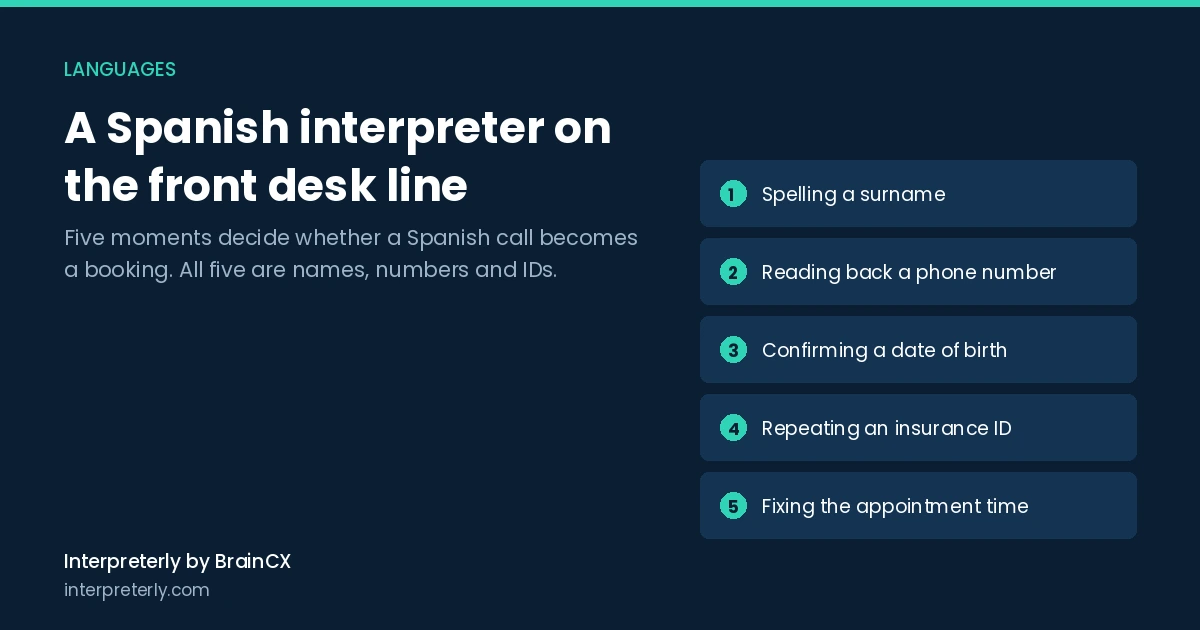
A health center front desk makes an enormous number of short calls. Appointment reminders, confirmations, reschedules, eligibility checks, directions to a satellite site, prescription refill queries.
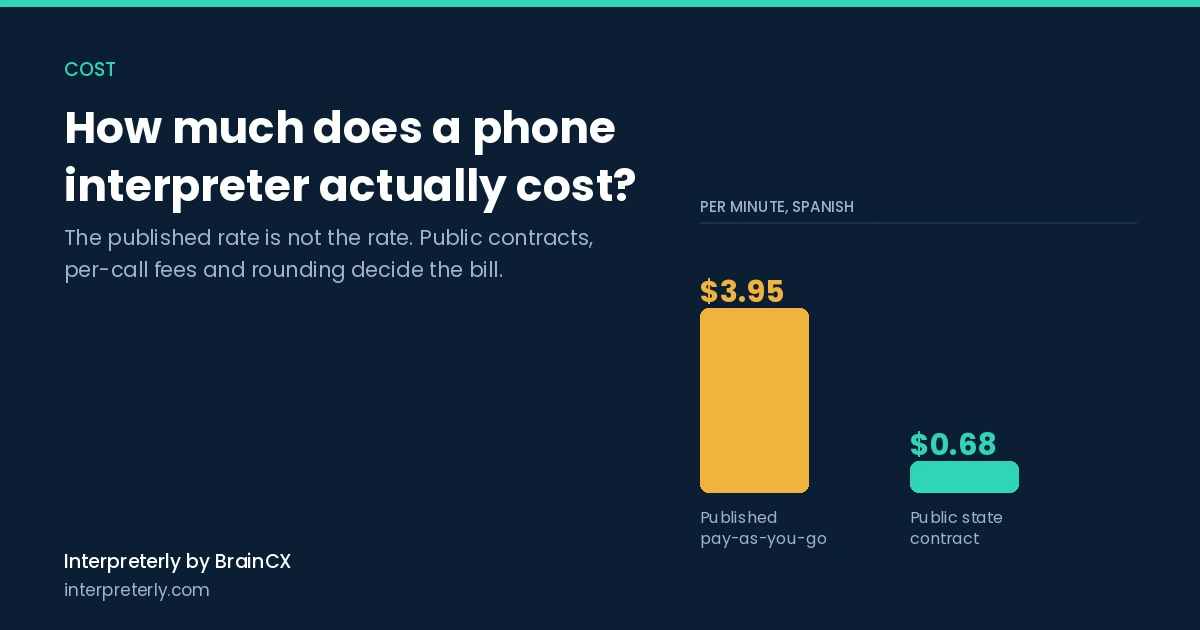
On a per-minute interpretation contract, short calls are the expensive ones. Published on-demand rates run roughly $1 to $3 per minute across the market, and LanguageLine publishes $3.95 per minute for audio on its self-service tier. Where a contract carries a per-call minimum, a forty-second reminder bills at the minimum every time.
That is the structural mismatch. The billing model assumes a clinical encounter of several minutes. A health center scheduling desk is not making those calls, it is making hundreds of ninety-second ones. The full arithmetic sits in what phone interpretation actually costs a front desk, and you can work out what per-minute interpretation is costing you against your own call log.
The second cost is invisible and larger. When the per-minute meter is running, staff ration the service. They try to get by, they promise a call back, and the patient is lost. Nobody writes that down as a language access failure. It appears as a no-show rate or an empty slot.
What to fix first when the budget will not stretch

The first three items on that list cost staff time rather than money, and they remove most of the regulatory risk. Do them in order.
Start from your own UDS line. Patients best served in a language other than English, by site. If one satellite carries 60 percent of your language need, that is where the money goes.
Fix the first call before the exam room. Clinical interpretation at most health centers is already funded and already routed. The scheduling call usually is not, and it is where patients disappear before they ever become a visit.
Get the notice and the written procedure done. Both are required, both are documents rather than budget lines, and both are the first things an investigator or a site visit asks to see.
Then buy coverage for the hours you are actually open. Including evening clinics and Saturday sessions, which is where a single bilingual staff member’s shift stops covering you.
The staffing reality nobody accounts for
Health centers hire bilingual staff, and it is genuinely one of their strengths. The difficulty is that being bilingual and being qualified bilingual staff under the rule are different things.
Under 45 CFR 92.4, qualified bilingual staff must be designated to provide in-language assistance as part of their assigned job and must have demonstrated proficiency to the health center, including specialized vocabulary. Two consequences: it belongs in the job description, and the proficiency assessment has to exist on file.
There is also the coverage problem. One bilingual medical assistant covers one shift at one site. Pull them to interpret and their own work stops. The fuller version is in why bilingual staff isn’t a compliance strategy.
And there is the language that your vendor cannot reach. Health centers in agricultural regions serve speakers of Mam, K’iche’, Mixtec and other languages of limited diffusion, where the answer is a human relay chain through an intermediate language rather than anything automated. That is explained in relay interpretation, and it is a question to put to your interpretation vendor in writing.
Where a language tool fits here, honestly
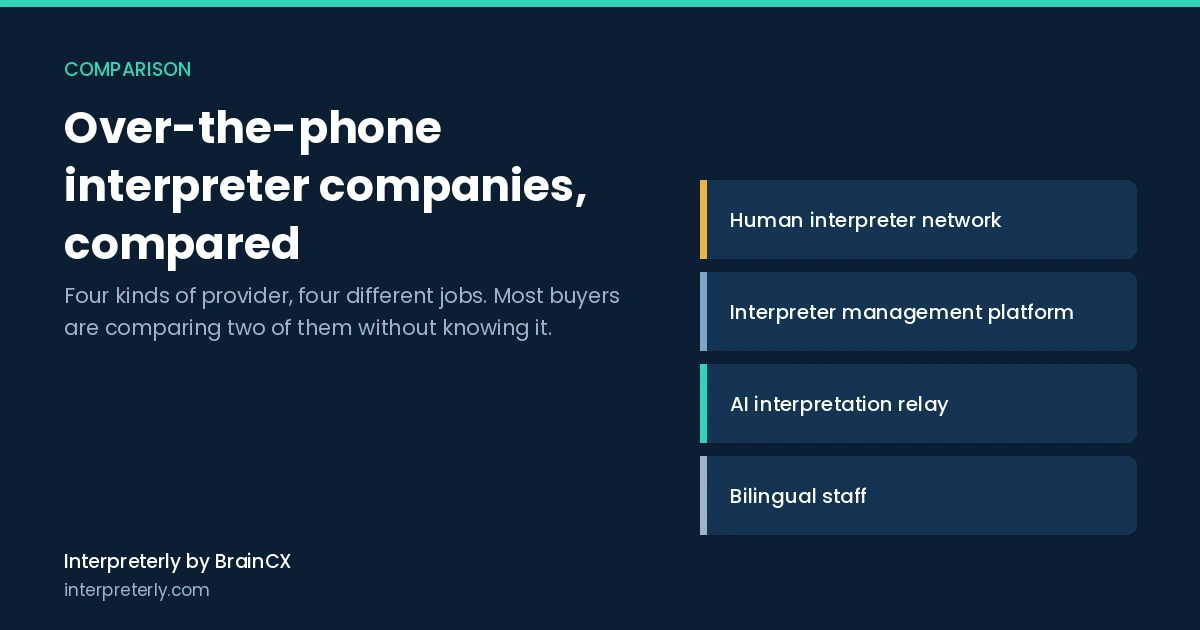
Traditional interpreter companies add a third person to the phone call. AI companies replace the employee entirely. Interpreterly does neither. The employee stays on the call and we carry the language, in Spanish and Brazilian Portuguese today, with Haitian Creole coming soon.
For a health center that means one specific thing: the routine call volume that a per-minute meter punishes hardest can be handled by the staff you already have, at a flat monthly cost, without pulling a bilingual colleague off their own work.
The limits matter more here than anywhere, because health center patients have the fewest alternatives. Interpreterly is a language assistance tool, not a certified interpreter service. It does not replace a qualified human interpreter where the law requires one, and it does not serve languages of limited diffusion. Clinical encounters, consent and assessment stay with qualified human interpreters.
If a BAA, data handling or retention is the question, our compliance approach covers it, and see flat monthly pricing if you need a figure for a budget line without a sales call.
Six things to check this quarter
- Pull your UDS language line by site and put it in front of your leadership team.
- Read your written language access procedure and ask whether a new receptionist at your smallest site could follow it.
- Check your notice of availability against the 15-language list for every state you operate in.
- Confirm which staff are formally designated as qualified bilingual staff, and whether an assessment is on file for each.
- Ask your interpretation vendor, in writing, which of your patient languages they can and cannot serve, and what a relay chain costs and takes to assemble.
- Divide last month’s interpretation invoice by the number of calls. That single figure will tell you more than the rate on the contract.
The wider regulatory picture is in our guide to Section 1557 language access requirements.
Frequently asked questions
Are FQHCs covered by Section 1557?
Health centers receiving federal awards under section 330 receive federal financial assistance, which makes them covered entities under Section 1557. Confirm your specific status with your own counsel.
Can an FQHC bill a patient for interpretation?
No. Language assistance services must be provided free of charge under 45 CFR 92.201(b), and a covered entity must not require a patient to provide or pay for their own interpreter.
How many languages does the notice of availability have to be in?
English plus at least the 15 languages most commonly spoken by individuals with limited English proficiency in each state where the entity operates, under 45 CFR 92.11.
How do we work out our own language need?
Use the Uniform Data System line reporting patients best served in a language other than English, broken down by site. It is your own reported data, so it is the figure to plan and budget against.
What do we do about indigenous languages our vendor cannot serve?
Ask the vendor in writing which languages they cover and how relay interpreting through an intermediate language is arranged, including expected time to assemble a chain. Then write that route into your language access procedure.