If your office frequently deals with limited English proficiency (LEP) patients or customers, Managing language access for limited English proficiency (LEP) patients and customers turns into an administrative headache fast. You track human interpreter availability. You chase no-shows. You reconcile per-minute invoices that add up faster than anyone budgeted for.
Interpreter Management Systems (IMS) and scheduling software exist to solve that problem. Here’s the thing. Before you invest in a calendar tool to manage human interpreters, ask a more basic question: do you need to schedule a human for every call?
This guide covers the top interpreter scheduling software on the market, with honest pros and cons for each. It also covers how clinics and businesses are using AI to skip scheduling entirely for their most routine calls.
What is interpreter scheduling software?
Interpreter scheduling software is a digital platform that automates the logistics of human language services. These systems are used heavily by Language Service Providers (agencies) and large hospital networks to match non-English speakers with qualified human interpreters.
Core features typically include calendar and availability management, interpreter credential tracking, automated billing and invoicing, and call routing or dispatch. A full interpretation management system (IMS) adds rate management, reporting, and sometimes the interpreting delivery itself.
Top 10 interpreter management systems on the market
Your choice comes down to whether you want to manage human schedules or eliminate them for routine calls. Here are the leading solutions, based on their own published features.
1. Boostlingo (IMS)
Boostlingo is one of the most recognized names in interpreting technology. Its Interpretation Management System covers scheduling, billing and invoicing, rate management, and reporting, and the wider platform adds on-demand phone, video, and AI interpreting.
- Pros: Broad, mature platform; scheduling plus interpreting delivery in one ecosystem; strong brand and support; handles phone, video, and on-site.
- Cons: More platform, and cost, than a small clinic needs; enterprise-oriented; onboarding takes time.
2. Eclipse Scheduling
Eclipse Scheduling is a full-service platform built by linguists to manage all language services in one place, designed to scale with language service providers and healthcare systems.
- Pros: HIPAA compliant, SOC 2 Type II attested, and 99.9% uptime, with automated provider matching based on credentials and availability.
- Cons: Because it manages everything from translation and localization to live captioning and dubbing, it can have a steep learning curve for a small clinic that only needs basic phone interpreting.
3. Interpreterly(best for eliminating the schedule entirely)
If you are a practice manager at a mid-sized clinic, you do not want to become a dispatch agency. You want to talk to your patients right now. Instead of managing calendars and paying high per-minute rates, modern offices use the interpretation platform powered by Interpreterlyto bypass scheduling altogether.
Interpreterlyis an on-demand AI voice interpreter you conference into any phone call in real time. Because it handles the routine 80% of front-desk calls with AI, there is no scheduling software to manage, no app for the other person to download, and no waiting on hold. It also swaps unpredictable per-minute billing for predictable pricing from $147 a month, and you can see how it works on any call before committing.
- Pros: No scheduling or booking for routine calls; flat monthly pricing instead of per-minute; HIPAA compliant with a BAA; conferences into any phone; live in about 12 minutes.
- Cons: Not a scheduling or management system, if you need to roster and dispatch human interpreters, you still need one of the other tools here; three languages today (Spanish, Brazilian Portuguese, Haitian Creole); does not replace a qualified human interpreter for complex clinical, legal, or consent calls.
4. Interpreter IO
Interpreter IO provides a centralized hub for managing interpreter profiles, storing records like certifications and specializations.
- Pros: Supports all modes of interpreting, including onsite, telephone, and Video Remote Interpreting (VRI), and is versatile enough to support American Sign Language (ASL) and British Sign Language (BSL).
- Cons: Managing the complete end-to-end workflow, from client portals to automated invoicing, requires dedicated project-manager time to keep the database updated.
5. Aqua Schedules
Aqua Schedules focuses on saving agencies time with a system that calculates charges and expenses directly.
- Pros: Mobile-friendly, HIPAA compliant, and syncs invoices with QuickBooks Online. Usage-based pricing ($100 to deploy, $0.50 per appointment, $100 minimum per month) keeps entry costs low.
- Cons: The interface requires users to learn layout editing and some HTML styling to match their brand, which may need minor technical skills.
6. Anolla
Anolla is a cloud-based interpreter booking platform offering a modular order-management system for agencies and freelancers.
- Pros: Includes a context-aware AI assistant for repetitive booking inquiries, a dynamic pricing module, a free tier, and a service marketplace for visibility.
- Cons: Activating the numerous add-on modules and configuring multi-tier client programs can require significant administrative setup.
7. GoFluently (Fluency Inc.)
Fluency licenses its Interpreter Scheduling System as SaaS, letting language service managers track and deploy interpreters from anywhere.
- Pros: Matching tools factor in mileage proximity, real-time availability, and continuity of care; requesters and interpreters get 24/7/365 self-service; payroll, invoicing, and QuickBooks export are built in.
- Cons: As a legacy SaaS platform, it relies on manual human deployment rather than instant automated connections, and the interface feels dated.
8. IMS Online
IMS Online is marketed as a best-in-class interpreter scheduling and management system focused specifically on the healthcare sector.
- Pros: Dedicated healthcare case studies and tools built for medical scheduling needs, with an IMS.Connect module.
- Cons: The heavy healthcare focus can make it less flexible for other industries like legal or automotive, and full features require a demo to evaluate.
9. LanguageLine (managed OPI, not software)
LanguageLine is the largest human interpreter network rather than scheduling software, but many buyers evaluate it in the same search because it removes the need to manage interpreters yourself, at a per-minute price.
- Pros: On-demand access to human interpreters in 240+ languages, 24/7, no scheduling required; established compliance track record.
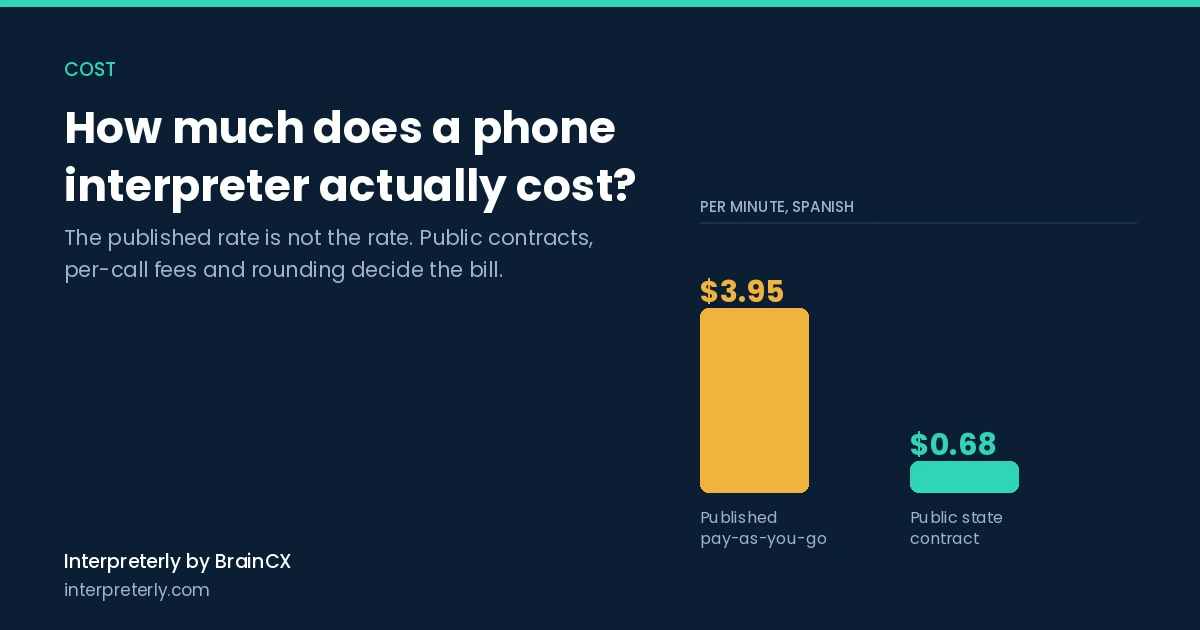
- Cons: Per-minute pricing ($3.95/min audio publicly listed) scales fast with volume; you are buying interpreting minutes, not a system you control. See how Interpreterly compares to LanguageLine for the operational difference.
The alternative: skipping the schedule with AI
Most routine calls do not need a scheduled interpreter at all. A 90-second appointment confirmation does not require the same booking process as a 45-minute clinical consult.
Operational leaders are adopting the 80/20 rule instead: human interpreters and traditional scheduling for the 20% of calls that are complex, on-demand AI for the routine 80%. For high-volume, short-duration calls like scheduling, reminders, and basic intake, that removes most of the booking work and most of the per-minute cost.
Healthcare compliance: balancing AI and humans
If you are looking for an AI phone interpreter for medical clinics, it is vital to understand that AI does not replace your legal compliance obligations.
Important compliance note: Under the 2024 Section 1557 final rule, machine translation alone does not satisfy the “qualified interpreter” requirement in covered healthcare settings. Interpreterlyhandles routine administrative calls, such as scheduling and basic intake, with about 99% accuracy on numbers and IDs via read-back confirmation. It does not replace a qualified human interpreter where one is legally required, such as during a complex medical diagnosis.
The most effective strategy is hybrid: use an AI voice relay for the heavy volume of front-desk calls, and reserve your human interpreter network for the complex clinical encounters that require them. That keeps you in HIPAA and language-access compliance while lowering overhead.
Ready to stop scheduling and start answering? You can talk to the Interpreterlyteam to see how quickly you can automate routine language access.
Frequently asked questions
What is an Interpreter Management System (IMS)?
An IMS is a specialized software platform used to schedule, dispatch, and bill for human interpreter services. Language agencies and large healthcare networks use it primarily to manage freelance interpreter availability, credentials, and invoicing.
Do I need scheduling software to use an AI phone interpreter?
No AI interpreters are automated and available on demand, there is no need to book them in advance or use calendar software. You conference the AI into your call exactly when you need it.
Is it cheaper to use AI or schedule a human interpreter?
For routine administrative calls, yes. Human interpreters typically charge by the minute (often $1 to $3, with LanguageLine listing $3.95/min) and may enforce minimum call times. AI phone interpreters run on a flat monthly subscription, which is far more cost-effective for high-volume, short-duration calls like appointment scheduling.
Can AI replace my human interpreter scheduling software entirely?
It depends on your industry. In healthcare, Section 1557 requires qualified human interpreters for complex medical care, so you will still need a human network (and possibly scheduling software) for clinical visits, while relying on AI to eliminate scheduling for routine front-desk calls.
Do small clinics or offices need interpreter scheduling software?
Usually not. These systems are built for organizations managing a roster of interpreters. A single clinic or small business that just needs occasional calls handled in another language does not manage interpreters as a workforce, so a full IMS is more than they need. A real-time AI phone interpreter or on-demand service is usually the better fit.