The whole problem is one room and one moment. A customer negotiates a car deal in Spanish, builds a rapport with a bilingual salesperson, agrees a price and a trade-in, and then walks into the finance office and signs a stack of English documents nobody translated.
That single sentence, negotiated in Spanish and signed in English, is the entire subject of this article. It is where the profit sits, where the legal risk sits, and where most dealers have no process at all.
The handoff that keeps failing
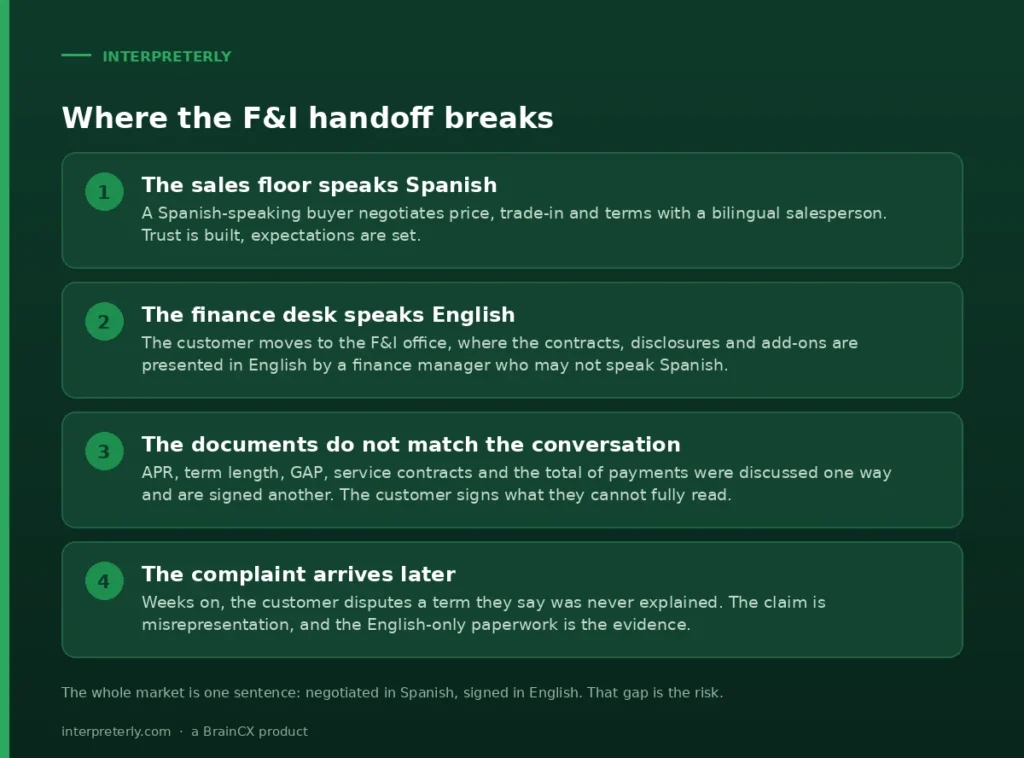
At most dealerships, the sale happens in two rooms. The salesperson agrees to the deal on the floor. Then the customer moves to the Finance and Insurance office, the box, where a finance manager arranges the loan and presents service contracts, GAP, and the paperwork that makes the sale legal.
The break is structural. The sales floor is often staffed to speak Spanish because that the language many customers speak. The finance desk frequently is not, because F&I managers are hired for their lender relationships and their compliance knowledge, and bilingual ones are scarce.
So the customer who negotiated comfortably in Spanish arrives at the most consequential part of the transaction, the part with the APR, the term, the add-ons, and the total of payments, and the person explaining it does not speak their language. The documents get signed anyway. The dealership books the deal and moves on.
The problem does not show up that day. It shows up weeks later.
Why it becomes a legal problem, not just a service one
A customer who did not understand the terms and later feels misled has a straightforward story to tell, and the English-only paperwork is the evidence that supports it.
The claim is rarely about translation as such. It is about misrepresentation of material terms: the buyer says the deal they signed did not match the deal they negotiated, and points to the fact that the negotiation was in Spanish while the contract was in English. Deceptive-practice statutes exist in every state to handle exactly that fact pattern.
This is the point F&I directors miss when they treat language as a customer-experience nicety. It is a documented, provable gap between what was said and what was signed, in the highest-risk transaction the store does.
What the law actually expects
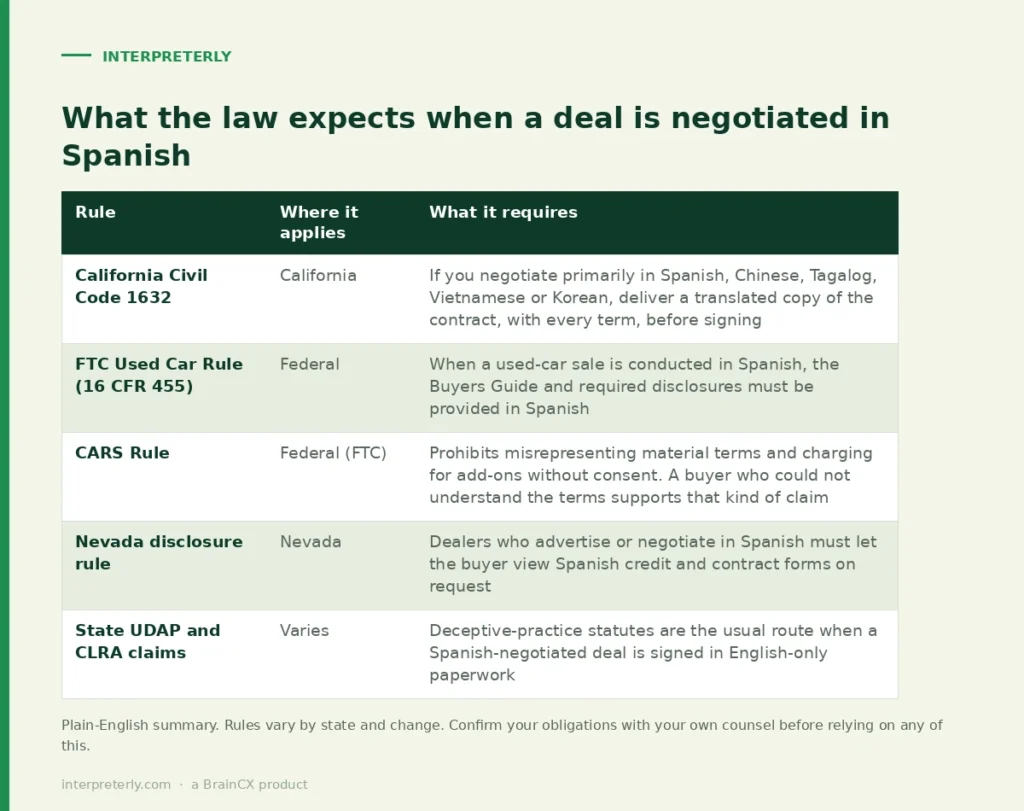
Several rules converge on the same behaviour. None of them is satisfied by good intentions.
California Civil Code 1632 is the strongest. If a business negotiates a covered contract primarily in Spanish, Chinese, Tagalog, Vietnamese, or Korean, it must deliver a translated copy of the contract, including every term and condition, before the customer signs. The detail is in California Civil Code 1632 explained for dealers, and the statute text itself is on the California legislature site.
The FTC Used Car Rule at 16 CFR part 455 requires that when a used-car sale is conducted in Spanish, the Buyers Guide and required disclosures are provided in Spanish.
The CARS Rule is the Federal Trade Commission’s rule aimed at deceptive practices in vehicle sales and financing, including misrepresenting material terms and charging for add-ons without consent. A customer who could not understand the terms supports that kind of claim.
Nevada requires dealers who advertise or negotiate in Spanish to let the buyer view Spanish credit and contract forms on request.
State UDAP and consumer-protection statutes, including California’s Consumers Legal Remedies Act, are the usual vehicle for a claim when a Spanish-negotiated deal is signed in English-only paperwork.
Rules vary by state and change, and none of the above is legal advice. The consistent through-line is that if you sell in a language, the law increasingly expects you to document and disclose in that language too.
The distinction that trips dealers up
There are two different obligations here, and it is worth keeping them apart, because conflating them causes dealers to buy the wrong fix.
One is the live conversation. The customer needs to understand what the finance manager is telling them about the APR, the term and each add-on, in the room, as it happens.
The other is the document. Some states, California most clearly, require a translated copy of the contract itself, delivered before signing.
A live interpreter solves the first. It does not, by itself, satisfy a rule that requires a translated document. A translated document does nothing for a customer who had every term explained in English at the desk. A dealer serious about closing this gap needs to handle both, deliberately, with counsel advising on the document requirements in each state it operates in.
What to fix first
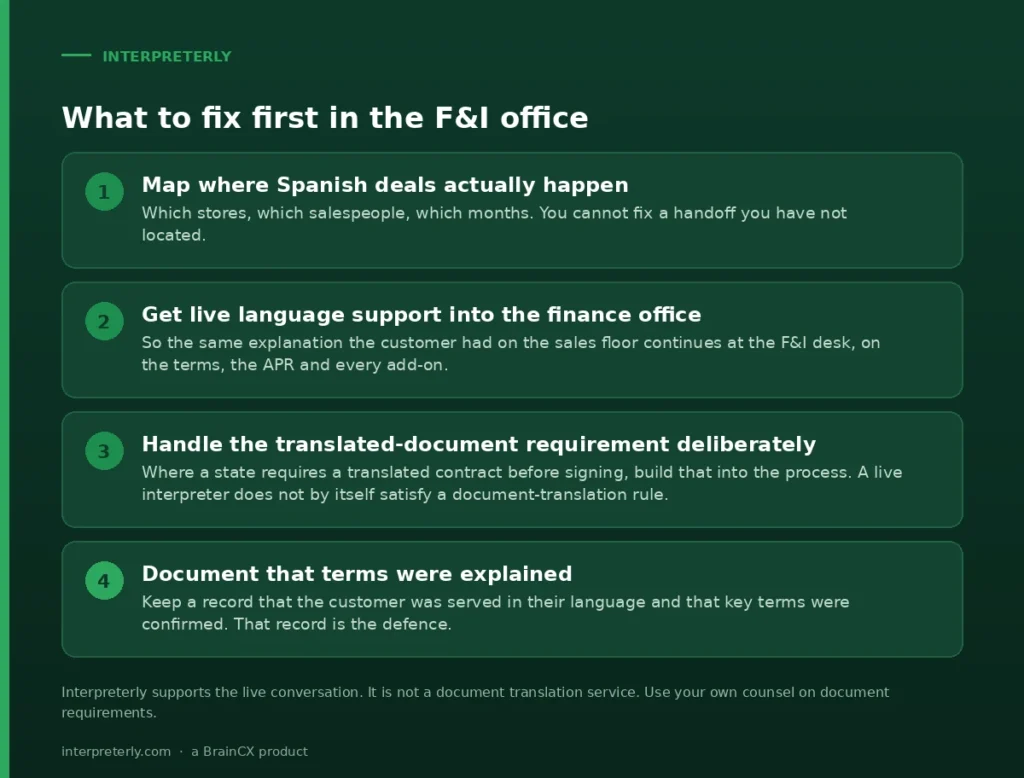
Map where Spanish deals happen. Which stores, which salespeople, which months. Most dealer groups have never counted, and the concentration is usually higher than management expects.
Get live language support into the finance office. So the explanation that started on the sales floor continues at the F&I desk, covering the numbers and every add-on, rather than stopping at the door. This is the operational half, and it is where an English-speaking finance manager can still serve a Spanish-speaking buyer directly. The mechanics are in how AI phone interpretation works and the vertical detail sits on language support in the F&I office.
Handle the document requirement deliberately. Where a state requires a translated contract before signing, build that into the deal jacket process. Do not assume a live interpreter covers it.
Document that terms were explained. Keep a record that the customer was served in their language and that the key terms, APR, term, total of payments and each add-on, were confirmed. That record is the defence if a dispute arrives later.
Why “just hire bilingual F&I managers” does not scale
It is the obvious answer and it rarely works. A bilingual finance manager for every shift at every store is a hiring problem most groups cannot solve, because the role is hard to fill in one language and much harder in two.
Even where you find one, they cover one desk on one shift. Evening and weekend deals, the second F&I office, the store across town, and the fortnight they are on leave are all uncovered. One bilingual hire is a person, not a process, which is the same coverage problem covered in the healthcare context in the true cost of relying on bilingual staff.
Traditional interpreter companies add a third person to the phone call. AI companies replace the employee entirely. Interpreterly does neither. The employee stays on the call and we carry the language, in Spanish and Brazilian Portuguese today, with Haitian Creole coming soon, which keeps your existing finance manager in the conversation rather than requiring you to hire a new one for every shift.
Interpreterly supports the live conversation. It is a language assistance tool, not a certified interpreter service, and it is not a document translation service. Where a state requires a translated contract, that is a separate obligation to handle with counsel.
What this is worth to the store
Two numbers a general manager will care about.
The deals that currently collapse in the finance office because the customer gets uncomfortable and walks. A Spanish-speaking buyer who cannot follow the F&I presentation is a buyer more likely to leave, and a floor-agreed deal that dies in the box is lost gross.
And the disputes, chargebacks, and complaints that arrive later from customers who say a term was never explained. Those cost money, time and, in the worst cases, a regulator’s attention.
Serving the customer in their language at the finance desk protects both. If you want to talk it through for your own store mix, talk through your volume with us.
Frequently asked questions
Does a car contract have to be in Spanish if the sale was in Spanish? In several states, effectively yes. California Civil Code 1632 requires a translated copy of a covered contract negotiated primarily in Spanish, before signing, and the FTC Used Car Rule requires the Buyers Guide and disclosures in Spanish when the sale is conducted in Spanish. Requirements vary by state, so confirm with your own counsel.
Can a dealership be sued for selling in Spanish and signing in English? Yes. The usual claim is misrepresentation of material terms under state deceptive-practice statutes, supported by the gap between a Spanish negotiation and English-only paperwork. State attorneys general have brought such actions.
Does a live interpreter satisfy California Civil Code 1632? Not on its own. Where the statute requires a translated copy of the contract before signing, a live interpreter addresses the conversation but not the document requirement. Handle both, with counsel.
Do we have to hire bilingual F&I managers? No. Live language support lets an existing finance manager serve a Spanish-speaking customer directly, which covers shifts and stores that hiring cannot. Where a translated document is legally required, that is a separate step.
Which languages does California Civil Code 1632 cover? Spanish, Chinese, Tagalog, Vietnamese and Korean.