If your sales floor speaks Spanish and you sell in California, this is the one state law to understand properly. Most of what is written about California Civil Code 1632 is a law-firm client alert written for other lawyers. This is the operational version, written for the person running the deal.
What California Civil Code 1632 requires
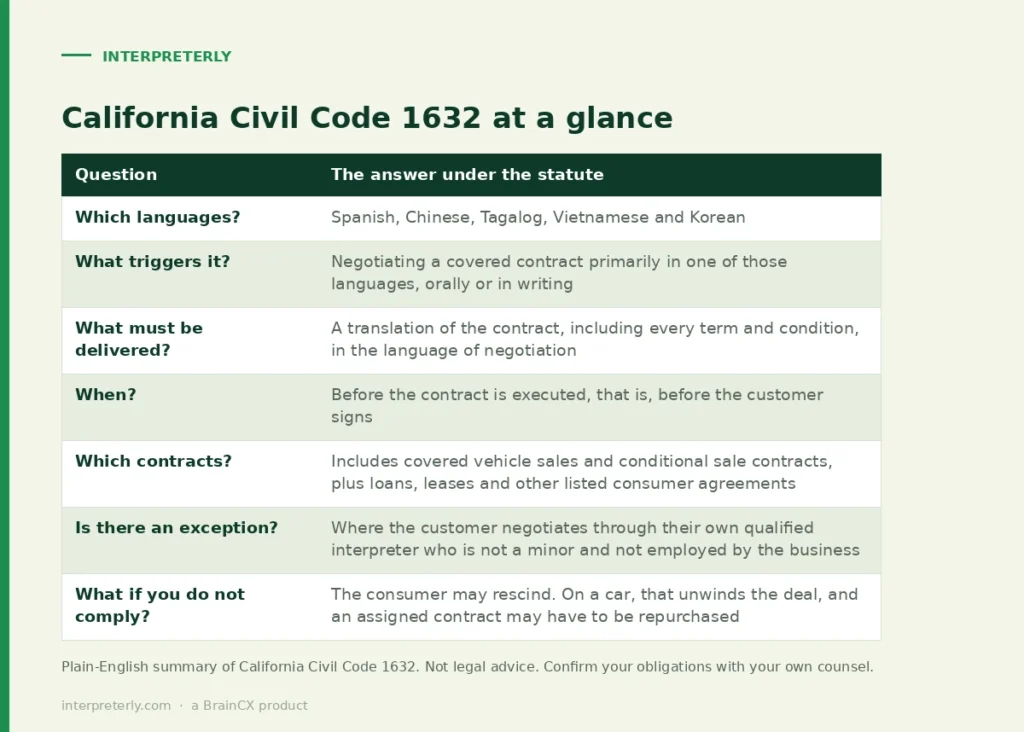
A business that negotiates a covered contract primarily in Spanish, Chinese, Tagalog, Vietnamese or Korean must give the customer a translated copy of that contract, including every term and condition, before the customer signs.
That is the whole rule in one sentence. The statute itself is on the California legislature site, and the legislature notes that these five languages are spoken at home by approximately 3.5 million of the 3.8 million Californians with limited or no English proficiency.
Which deals it covers
For a dealership, the important categories are the vehicle sale and the financing. The statute reaches contracts under the Automobile Sales Finance Act and related provisions of the Civil Code, which is where a conditional sale contract for a vehicle sits, along with a list of other consumer agreements such as loans, leases and certain rental agreements.
The practical read for a store is straightforward. If a retail installment sale or lease was negotiated primarily in one of the five languages, assume the translated-copy obligation applies and confirm the specifics with counsel. Do not try to reason your way around it based on which document is which. The trigger is the language of the negotiation, not the label on the form.
The five languages, not just Spanish
This is the detail dealers most often get wrong. The obligation is not Spanish-only. It covers Spanish, Chinese, Tagalog, Vietnamese and Korean, each treated the same way.
A dealership in an area with a large Vietnamese or Korean-speaking community has exactly the same obligation for those customers as it does for Spanish-speaking ones. If your salespeople negotiate in any of the five, the translated-copy requirement attaches.
What “before signing” actually means
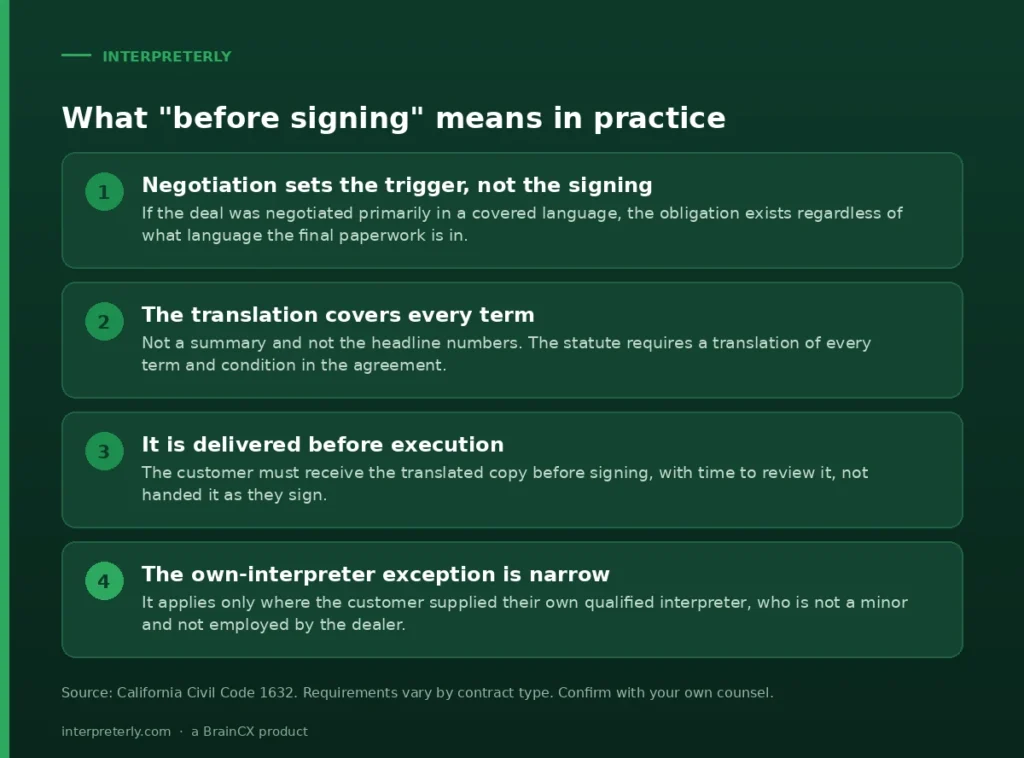
Four points decide whether a store actually complies, and each one is a place where dealers slip.
The negotiation sets the trigger. If the deal was negotiated primarily in a covered language, the obligation exists regardless of what language the final paperwork happens to be in. You cannot negotiate in Spanish and escape the rule by producing an English contract.
The translation covers every term. The statute requires a translation of every term and condition, not a summary and not just the headline numbers. A translated one-page overview is not the translated contract the rule describes.
It is delivered before execution. The customer receives the translated copy before signing, with a genuine opportunity to review it. Handing it across the desk at the moment of signature is not what “before the execution thereof” means.
The own-interpreter exception is narrow. The statute provides an exception where the customer negotiated through their own interpreter. That interpreter must be capable of speaking fluently and reading with full understanding in both English and the covered language, must not be a minor, and must not be employed by or associated with the business. In other words, the salesperson’s bilingual colleague does not count, and a customer’s child does not count.
Can a customer cancel if they did not get a Spanish copy?
According to the California Attorney General, a consumer who does not receive a required translation before signing may be able to rescind the contract. The requirement may not apply if the consumer used their own qualified interpreter.
That framing matters, and it is the Attorney General’s, not ours. Interpreterly does not give legal opinions, and whether a particular contract can be unwound is a question for a lawyer looking at the specific facts.
What is not in dispute is the direction of the remedy. Rescission on a vehicle generally means the deal unwinds: the buyer returns the car and the seller returns what was paid. Where the contract was assigned to a lender, an unwind can reach back up the chain, and the original creditor may have to repurchase the contract. That is why a 1632 problem is not only a customer-relations problem. It is a problem for your lender relationships too.
Where this sits next to the federal rules
California Civil Code 1632 does not operate alone. On a used-car sale conducted in Spanish, the FTC Used Car Rule at 16 CFR part 455 requires the Buyers Guide and required disclosures in Spanish. The FTC’s CARS Rule addresses misrepresenting material terms and charging for add-ons without consent, which is the claim a language gap tends to feed. The way these fit together in the finance office is the subject of the language gap inside the F&I office.
A dealer operating in more than one state has more than one rulebook. Nevada, for example, requires dealers who advertise or negotiate in Spanish to let the buyer view Spanish credit and contract forms on request. Check state by state, because the obligations are not uniform.
What a compliant process looks like
Compliance here is a process problem, not a translation problem, and it splits cleanly into two parts.
The live conversation. The customer needs to understand the F&I presentation, the APR, the term, the total of payments, and each add-on, as it happens. This is where an English-speaking finance manager needs live language support to serve a Spanish-speaking buyer directly, and it is the operational gap most stores actually feel day to day.
The document. Where 1632 applies, the translated copy of the contract has to exist and be delivered before signing. That is a document-production step, handled with counsel and with whatever translated-forms process your DMS and your lenders support.
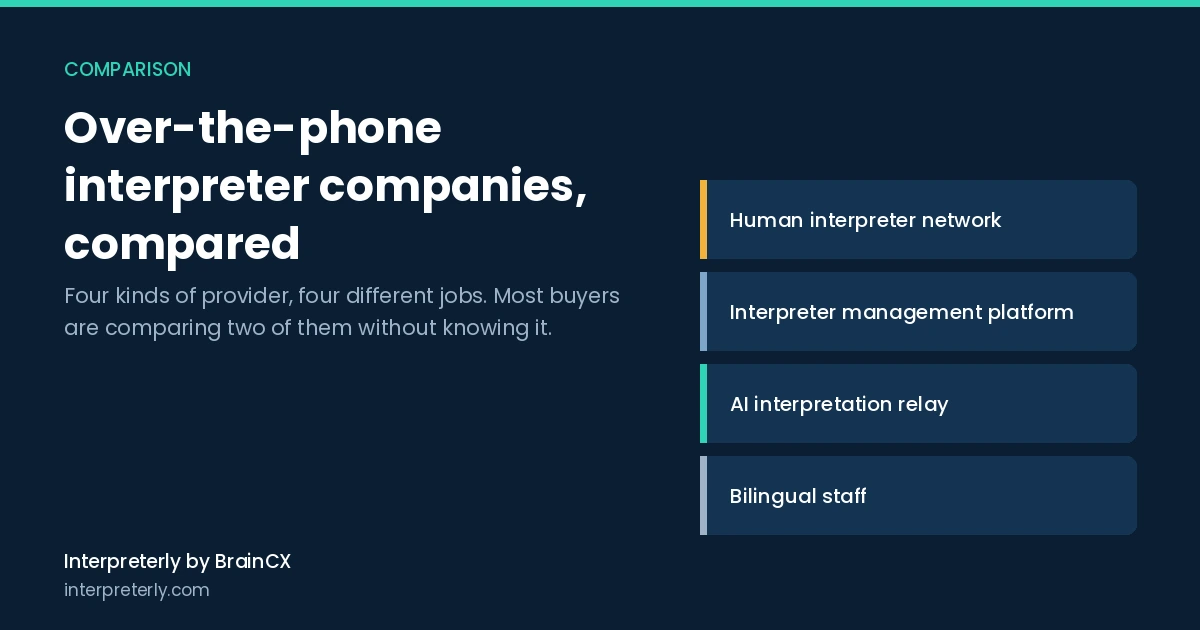
Keep the two separate in your own mind. Traditional interpreter companies add a third person to the phone call. AI companies replace the employee entirely. Interpreterly does neither. The employee stays on the call and we carry the language, which handles the live conversation. It is a language assistance tool, not a certified interpreter service, and it is not a document translation service, so the translated-contract requirement is a distinct obligation that you handle.
A short checklist
- Identify which of the five covered languages your stores negotiate in, and how often.
- Treat the language of negotiation as the trigger, and stop assuming an English contract avoids the rule.
- Build the translated-copy step into the deal jacket where 1632 applies, on counsel’s advice.
- Make sure the F&I presentation itself happens in the customer’s language, not just the paperwork.
- Confirm your own-interpreter policy: a qualified interpreter the customer brought, not a minor, not your employee.
- Document that the customer was served in their language and that key terms were confirmed.
If you want to see how the live-conversation half works on a real deal, here is how the interpreter joins your call, and you can talk through your volume with us.
Frequently asked questions
What is California Civil Code 1632? A California law requiring a business that negotiates a covered contract primarily in Spanish, Chinese, Tagalog, Vietnamese or Korean to give the customer a translated copy of the contract, including every term, before signing.
Which languages does 1632 cover? Spanish, Chinese, Tagalog, Vietnamese and Korean.
Can a customer cancel a car contract if they did not get a Spanish copy? The California Attorney General states that a consumer who did not receive a required translation before signing may be able to rescind. The requirement may not apply if the consumer used their own qualified interpreter. Whether it applies to a specific deal is a question for your counsel.
Does the own-interpreter exception cover our bilingual salesperson? No. The exception is for an interpreter the customer supplied who reads and speaks both languages with full understanding, is not a minor, and is not employed by or associated with the dealership.
Does a live interpreter meet the 1632 requirement? Not on its own. 1632 requires a translated copy of the contract before signing. A live interpreter addresses the conversation, not the document. Handle both, with counsel.