If you searched for the CARS Rule to find out what it requires, start with the one fact that changes everything: it does not require anything, because it is not in effect.
The rule was vacated by a federal court before it ever took effect and then formally withdrawn. That matters for a dealer, but not in the way a relieved F&I director might assume, because the behaviour the rule targeted is still illegal under laws that never went anywhere. Here is the accurate picture, and what it means when a customer signs terms they did not understand.
What happened to the CARS Rule
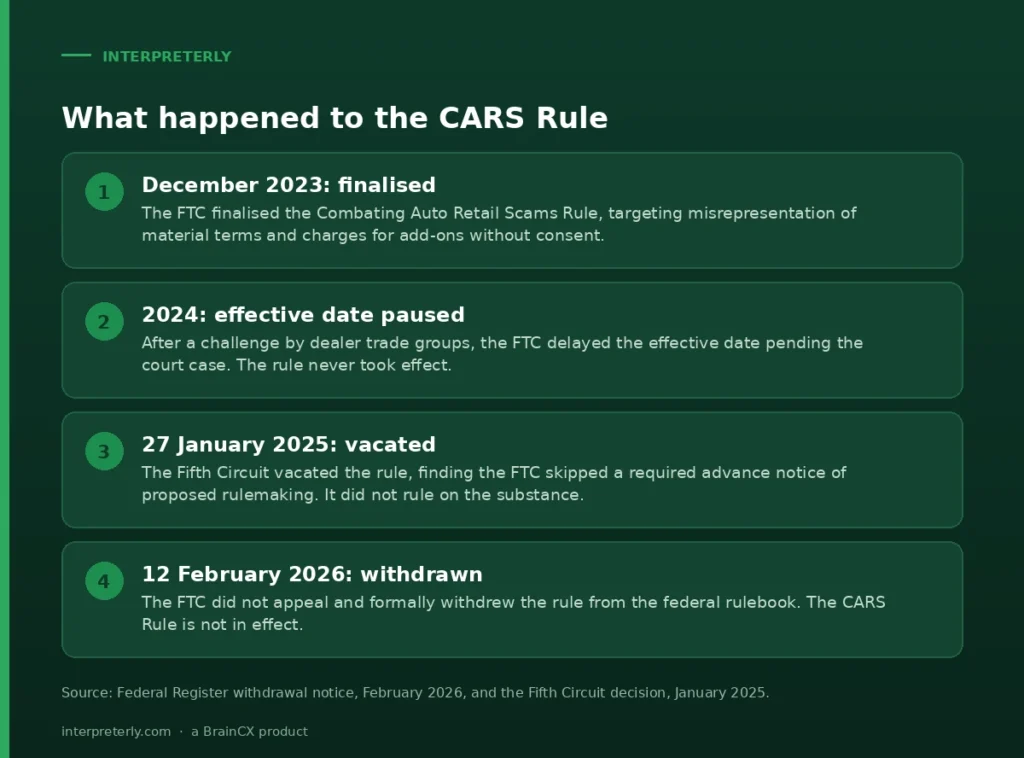
The Federal Trade Commission finalised the Combating Auto Retail Scams Rule in December 2023. It targeted misrepresentation of material terms, required clearer pricing, banned add-ons that provide no benefit, and required express informed consent before charging for anything.
Dealer trade groups challenged it, and the FTC paused the effective date pending the case, so the rule never took effect. On 27 January 2025 the Fifth Circuit vacated the rule, finding the FTC had skipped a required advance notice of proposed rulemaking. The court decided the case on that procedural ground and did not rule on whether the substance was valid.
The FTC did not appeal, and effective 12 February 2026 it formally withdrew the rule from the federal rulebook. The CARS Rule is not in force.
Two cautions. The FTC could attempt a new rulemaking on the same subject, so this is a status worth re-checking rather than a settled fact for all time. And nothing about the vacatur made the underlying conduct legal.
Why “the rule is gone” is not the headline dealers think it is
The CARS Rule did not create the idea that misrepresenting a car deal is illegal. It tried to codify specific disclosures around a prohibition that already existed. When the rule fell, the prohibition stayed exactly where it was.
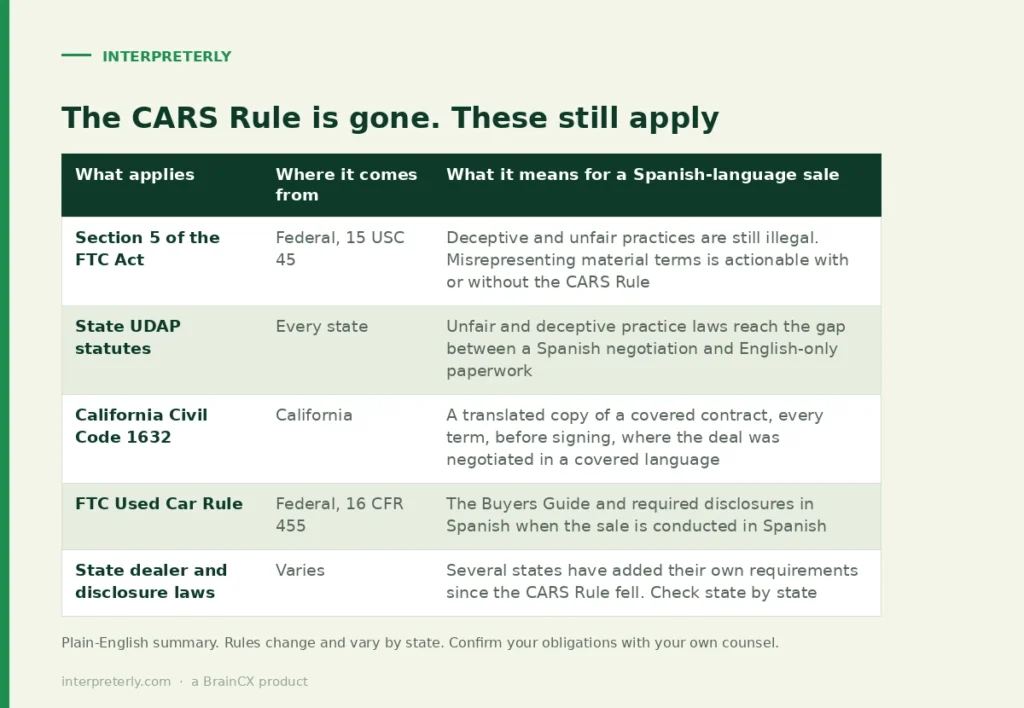
Section 5 of the FTC Act prohibits unfair or deceptive acts or practices, full stop. Misrepresenting a material term of a vehicle sale is actionable under Section 5 with or without a dedicated rule, and the FTC has brought and settled dealer cases on that basis. A customer who agreed one thing in Spanish and signed another in English is the kind of fact pattern Section 5 reaches.
State UDAP statutes, the unfair and deceptive acts and practices laws every state has, cover the same ground and are enforced by state attorneys general and, in many states, by private lawsuits. When the CARS Rule fell, several states moved to add their own requirements, so for many dealers the net regulatory burden did not drop.
California Civil Code 1632 is untouched by any of this. If you negotiate a covered contract primarily in Spanish, Chinese, Tagalog, Vietnamese or Korean, you still owe the customer a translated copy of every term before signing. The detail is in California Civil Code 1632 explained for dealers.
The FTC Used Car Rule at 16 CFR part 455 is also untouched. When a used-car sale is conducted in Spanish, the Buyers Guide and required disclosures must be in Spanish.
So the honest summary is this. One rule that never took effect is gone. Every law that made a deceptive Spanish-language deal risky before the CARS Rule existed is still here.
Can a dealership get sued for selling in Spanish and signing in English?
Yes, and the vacatur of the CARS Rule changes nothing about that answer.
The claim does not depend on the CARS Rule. It runs on deception: the buyer says the deal they agreed, in Spanish, is not the deal they signed, in English, and points to material terms they say were never explained. That is a Section 5 theory at the federal level and a UDAP theory at the state level. State attorneys general have brought actions against dealers who marketed and negotiated in Spanish but delivered English-only contracts and disclosures.
The English-only paperwork is not a defence in that story. It is the evidence.
The language gap is the fact pattern these laws are built for
Strip away the rule names and the exposure is simple to describe. A material term was not understood by the person who signed it, because it was never conveyed in the language the deal was done in.
That single sentence is what Section 5, the state UDAP statutes and California Civil Code 1632 are all, in their different ways, aimed at. The specific regulation changes. The fact pattern does not, and it is the one a Spanish-speaking buyer, a plaintiff’s lawyer or a state regulator can describe without needing an expert.
This is why treating the CARS Rule’s death as “one less thing to worry about” gets it backwards. The compliance frameworks that remain are broader and older than the CARS Rule, and they do not come with the tidy checklist the CARS Rule would have provided. A dealer is arguably less certain about what to do now, not more.
What actually reduces the risk
The exposure comes from a gap between what was said and what was signed. Close the gap and the fact pattern falls apart. Two parts, and they are different obligations.
Serve the customer in their language during the F&I presentation. The APR, the term, the total of payments and every add-on, explained in the language the deal was negotiated in, as it happens. This is the live-conversation half, and it is where an English-speaking finance manager needs language support to serve a Spanish-speaking buyer directly. The way this breaks in practice is covered in the language gap inside the F&I office, and the mechanics are in how the interpreter joins your call.
Handle any document-translation requirement separately. Where California Civil Code 1632 or a similar state law requires a translated contract before signing, that is a document step, not a conversation step, and it is handled with counsel. A live interpreter does not satisfy a document-translation rule, and a translated document does not fix a presentation the customer could not follow.
Then document it. Keep a record that the customer was served in their language and that the key terms were confirmed. If a dispute arrives, that record is the difference between a defensible deal and a swearing match.
Traditional interpreter companies add a third person to the phone call. AI companies replace the employee entirely. Interpreterly does neither. The employee stays on the call and we carry the language, in Spanish and Brazilian Portuguese today, with Haitian Creole coming soon. It is a language assistance tool, not a certified interpreter service, and it is not a document translation service, so the translated-contract requirement stays a separate obligation you handle with counsel.
What to tell your compliance team this week
- Update any training that referenced the CARS Rule as a live obligation. It is not one.
- Do not relax the underlying practices. Section 5 and state UDAP statutes cover the same conduct and are being enforced.
- Confirm your California Civil Code 1632 process is intact, because it never depended on the CARS Rule.
- Check whether any state you operate in added dealer requirements after the CARS Rule fell.
- Make sure the F&I presentation happens in the customer’s language, and that you keep a record it did.
If you want to talk it through for your own store footprint, talk through your volume with us.
Frequently asked questions
Is the FTC CARS Rule in effect?
No. The Fifth Circuit vacated it on 27 January 2025, before it took effect, and the FTC formally withdrew it from the federal rulebook effective 12 February 2026. Because agency rulemaking can change, confirm the current status before relying on it.
Does that mean dealers no longer have to worry about deceptive sales practices?
No. Section 5 of the FTC Act and state unfair and deceptive practice statutes still prohibit misrepresenting material terms. The conduct the CARS Rule targeted remains illegal under laws that are still in force.
Can a dealership be sued for selling in Spanish and signing in English?
Yes. The claim runs on deception and misrepresentation of material terms under Section 5 and state UDAP laws, supported by the gap between a Spanish negotiation and English-only paperwork. It does not depend on the CARS Rule.
Does California Civil Code 1632 still apply?
Yes. It is a California statute and was not affected by the CARS Rule litigation. A covered contract negotiated primarily in Spanish, Chinese, Tagalog, Vietnamese or Korean still requires a translated copy before signing.
What should we do now that the CARS Rule is gone?
Keep the practices that reduce deception risk: serve customers in their language during the F&I presentation, meet any state document-translation requirement with counsel, and document that key terms were explained and confirmed.