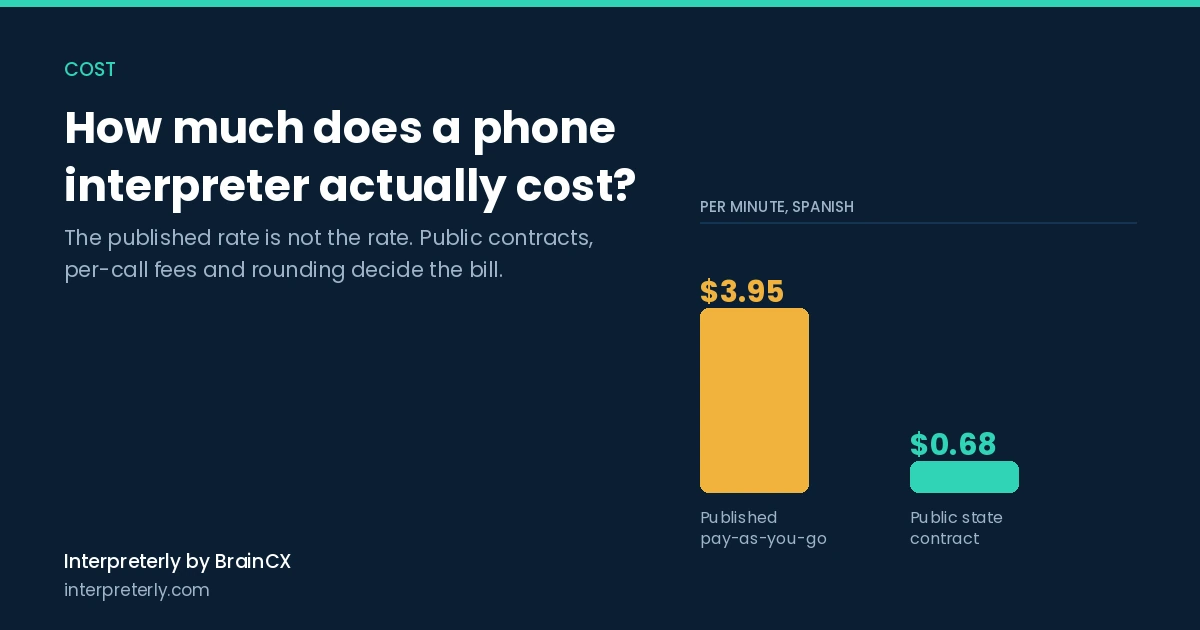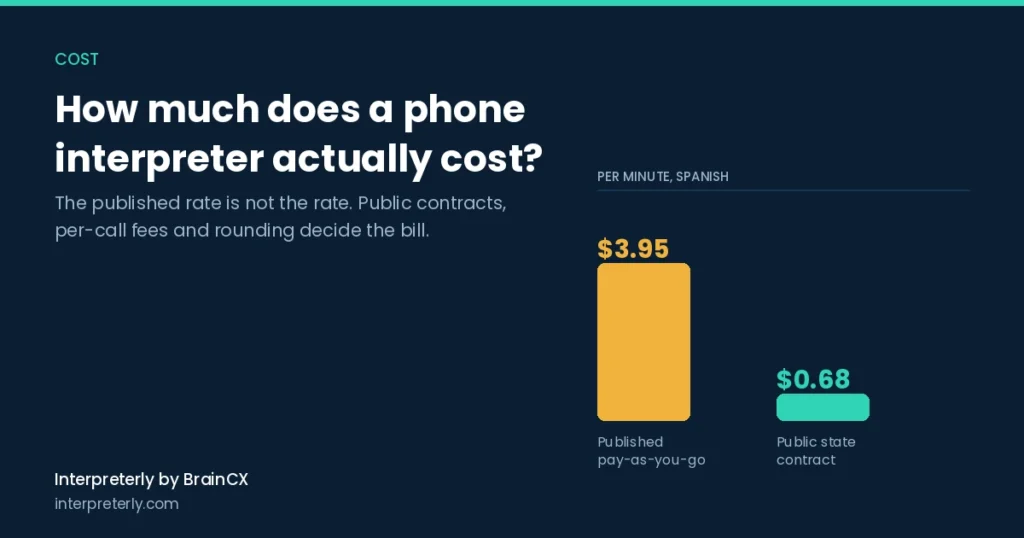
A phone interpreter costs between roughly $0.68 and $3.95 per minute in 2026, depending entirely on whether you are buying at a published self-service rate or under a negotiated contract. LanguageLine publishes $3.95 a minute for audio on its pay-as-you-go service. The California Governor’s Office of Emergency Services pays $0.68 a minute for telephonic interpretation under a public contract. Same service, nearly six times the price.
That gap is the real answer to the question, and almost nobody writes it down.
The rate is a range, not a number
Most pages about interpreter cost give you a range and stop there. The range is true and it is useless on its own, because the number you land on is set by how you buy, not by who you buy from.
Two public documents show the spread.
LanguageLine’s pay-as-you-go page lists $3.95 per minute for audio interpreting and $4.95 per minute for video, in 240+ languages, with no contract and no monthly minimum. That is the retail price, available to anyone with a credit card.
The California Governor’s Office of Emergency Services contracted telephonic voice interpretation at $0.68 per minute and American Sign Language video interpretation at $1.25 per minute under its Foreign Language Interpretation Services agreement. That is a volume contract for 911 call centres, published as a public record.
Everything your practice or dealership will be quoted sits somewhere between those two documents. If a vendor gives you a rate without telling you which kind of buyer you are being priced as, you have not been given a price. You have been given a starting position.
How much does a phone interpreter cost per minute?
Published per-minute rates for over-the-phone interpretation run from roughly $0.68 on a public volume contract to $3.95 on a published self-service rate. Spanish is usually the cheapest language on any rate card. Rare languages, certified medical or legal interpreting, and after-hours work are priced higher by most providers.
A useful habit when you are comparing two quotes: ask for the rate by language tier, in writing. Published price lists are organised by tier, and the tier your highest-volume language falls into decides most of your bill.
What else is on the invoice
The per-minute rate is the headline. It is rarely the whole invoice. These categories appear on published interpretation price lists, and most of them never come up in a sales conversation.
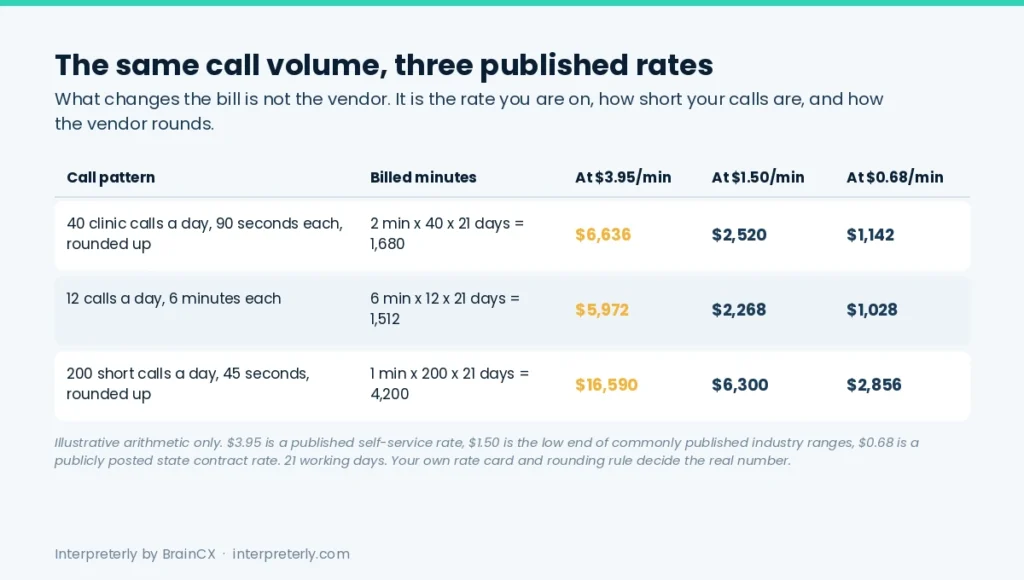
Rounding. Public interpretation contracts commonly specify that each call is billed rounded to the nearest full minute. The Cal OES agreement states exactly that. If your front desk makes two hundred forty-second calls a day, every one of them bills as a full minute. Rounding is not a fee and it is not hidden, but it quietly changes the arithmetic on short-call operations more than any discount you will negotiate.
Third-party dial-out. A flat per-call fee applied when the interpreter line dials out to a third party rather than simply joining your call. Published price lists show this as a fixed charge per call, not per minute.
Scheduled appointments. Booking an interpreter for a specific time carries a one-time setup fee per appointment on published price lists, plus a separate cancellation fee if the appointment is missed. For a clinic that schedules interpreted consultations in advance, that pair of fees can matter more than the minute rate.
Reporting and training. Custom report configuration, monthly report maintenance, training material development and on-site training days all appear as separately priced line items on published lists. Some are waived in a given contract. None of them are free by default.
Regulatory surcharges. Providers pass through surcharges and fees they pay to the Universal Service Administrative Company. These are small and they are real.
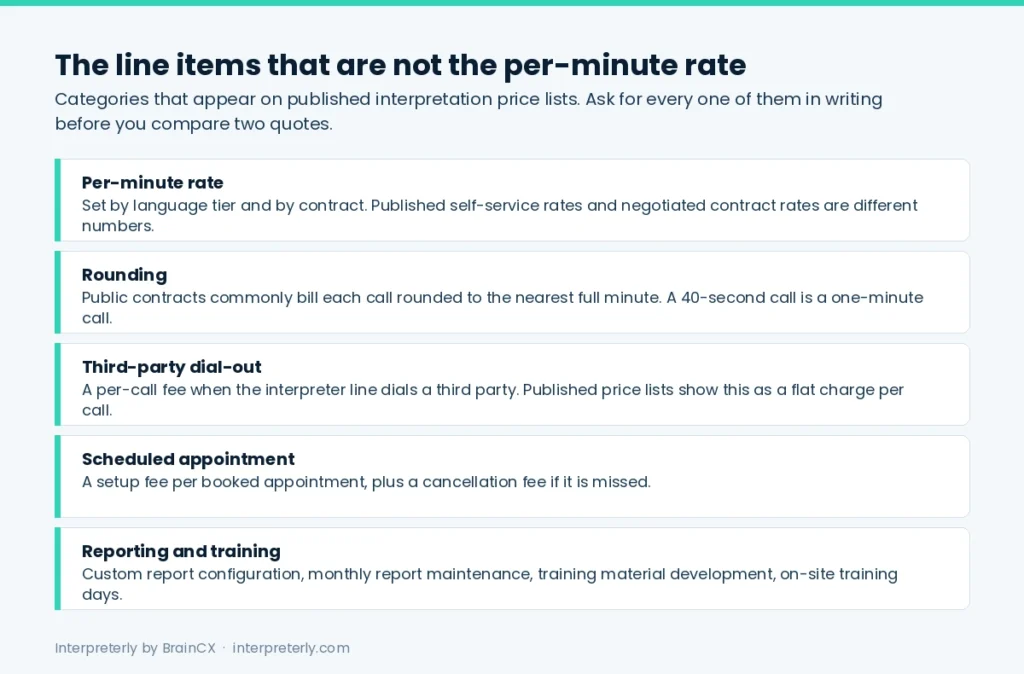
Ask for every one of these in writing before you put two quotes next to each other. A $2.10 rate with a per-call dial-out fee and minute rounding can cost a short-call front desk more than a $2.60 rate without them.
Where the per-minute model stops working
Per-minute pricing is well matched to a particular kind of call. Long, infrequent, high-stakes conversations where you need a qualified human interpreter and you need them in a language you cannot plan for. A thirty-minute consent conversation in Karen is exactly what that model is built for, and it is worth the money.
It fits badly where most business language volume actually lives. A clinic front desk confirming an appointment. A dealership BDC returning a missed call. A leasing office answering a maintenance question. Those calls are short, constant and repetitive, and a metered model prices them as if each one were an event.
Run your own numbers before you take anyone’s word for that. You can work out what per-minute interpretation is costing you against your real call volume in a couple of minutes, including the rounding rule your contract uses.
The three ways teams buy, and what each one costs
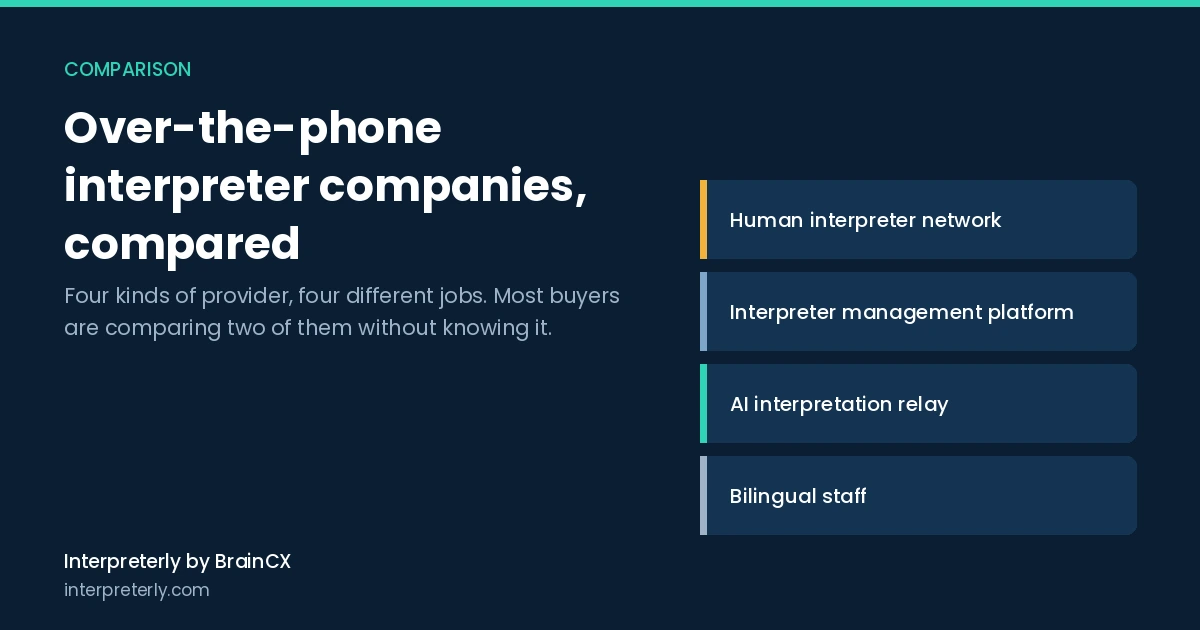
Per minute, metered. You pay for interpretation time, with rounding and per-call fees on top. Strong on language breadth, usually 200 or more languages. Weak on short calls, because the meter does not care that the call was forty seconds.
Hiring bilingual staff. You pay a salary, benefits and the cost of the shifts that person does not cover. One bilingual receptionist is one language on one shift, and the coverage disappears on holidays, during lunch and on the day they resign. We put both columns side by side in the true cost of relying on bilingual staff, including the lines most people leave off the envelope.
Flat monthly. You pay a fixed amount for a block of minutes and the meter stops being a factor in how your team behaves. Flat monthly pricing starts at $147 a month for 500 minutes on the Starter plan, with 60 free minutes to use within 30 days and no card required to start.
The honest version of this is that most organisations end up with two of the three. Routine volume on something predictable, and a human interpreter vendor kept in place for rare languages, complex consent, ASL and anything a law or a court requires. That is not a compromise. That is the correct shape.
What this looks like at a front desk
Traditional interpreter companies add a third person to the phone call. AI companies replace the employee entirely. We do neither. The employee stays on the call and we carry the language.
That difference shows up on the invoice as well as on the call. Your receptionist is already on the line, already knows the schedule and already has the chart open. What they do not have is the language. Carrying only the language is a smaller job than staffing a third participant into every call, and it prices accordingly.
Interpreterly interprets live in Spanish and Brazilian Portuguese, with Haitian Creole coming soon. We are deliberately narrow and deeply tuned rather than broad and shallow, because the calls our buyers actually make are overwhelmingly in those languages, and tuning is what decides whether a surname, a phone number or an insurance ID survives the call. You can see how clinics handle LEP patient calls with the employee still on the line.
For everything outside that set, keep a human OPI vendor. We say so on our own pricing page.
Frequently asked questions
How much does a phone interpreter cost per minute? Published rates run from roughly $0.68 per minute on a public volume contract to $3.95 per minute on a published self-service rate. Spanish is typically the lowest tier on a rate card. Rare languages, certified work and after-hours calls are priced higher.
Is there a minimum charge on every interpreted call? It depends on the contract. LanguageLine’s published pay-as-you-go service states no contracts and no monthly minimums. Separately, public interpretation contracts commonly round each call to the nearest full minute, which has a similar effect on very short calls. Ask for the rounding rule in writing.
What fees are not included in the per-minute rate? Published interpretation price lists show categories including third-party dial-out charges per call, one-time setup fees for scheduled appointments, cancellation fees for missed appointments, custom report configuration and maintenance, training materials and on-site training, and pass-through regulatory surcharges.
Why is video interpreting more expensive than phone? Published video rates sit above audio rates with the same providers. LanguageLine lists $4.95 per minute for video against $3.95 for audio. Video is the right tool for ASL and for visual clinical situations, and it carries a platform cost that audio does not.
Is a flat monthly plan always cheaper? No. If your interpreted volume is genuinely low and unpredictable, and spread across many rare languages, a metered vendor is likely cheaper and is certainly simpler. Flat monthly wins where volume is steady, calls are short and the language set is narrow.