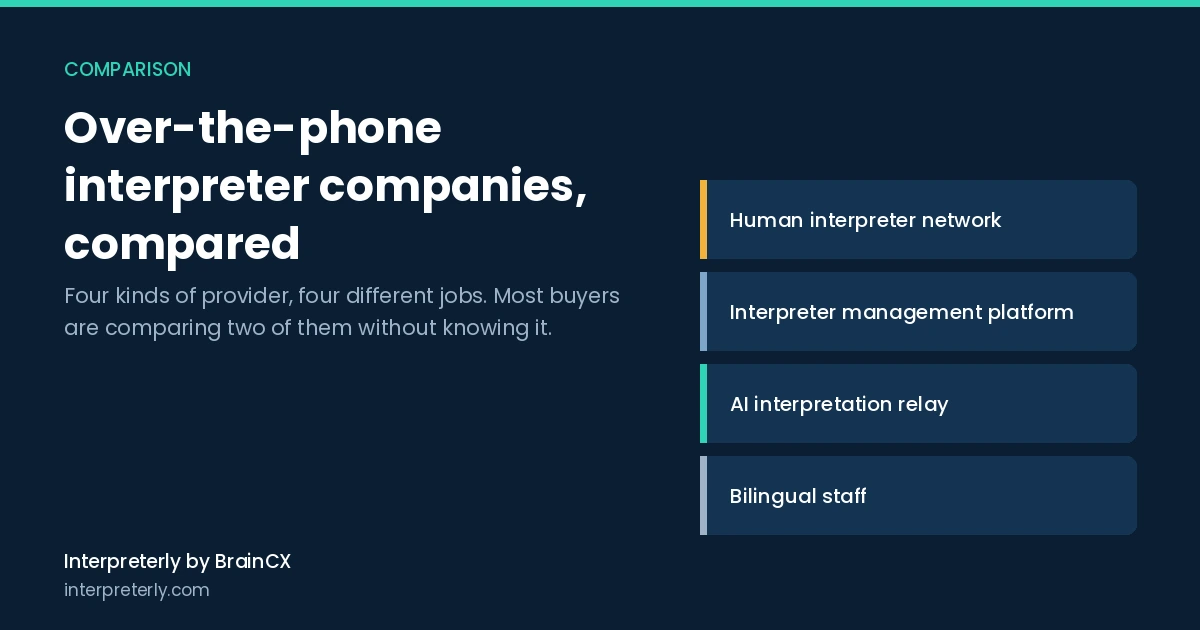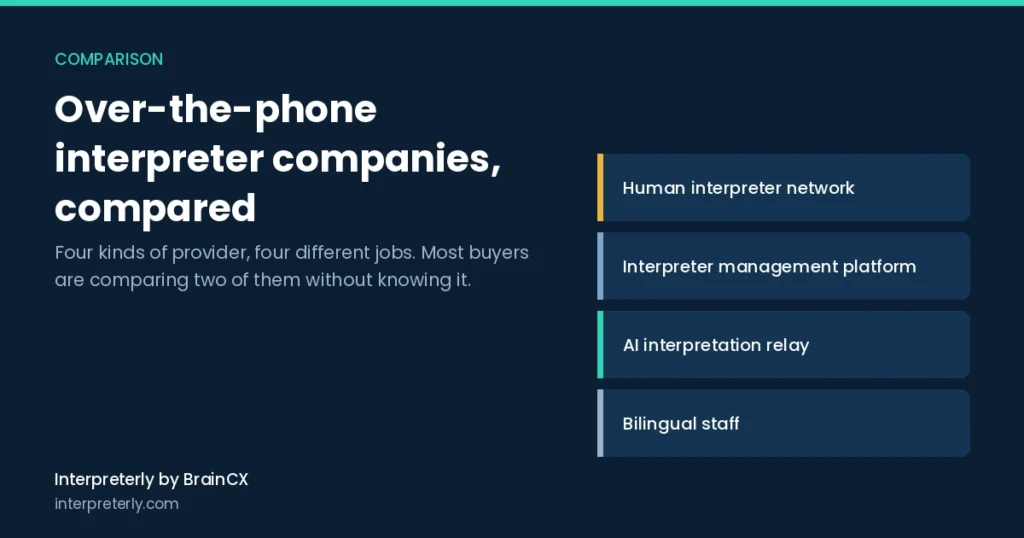
Over-the-phone interpreter companies fall into four categories, and most buyers compare two of them without realising the two do different jobs. Human interpreter networks supply qualified people. Interpreter management platforms schedule and bill those people. AI interpretation relays carry language on routine calls. Bilingual staff are an internal option that behaves like none of the three.
Pick the category first. Comparing vendors across categories is how procurement ends up with a quote it cannot evaluate.
Four kinds of company, not one
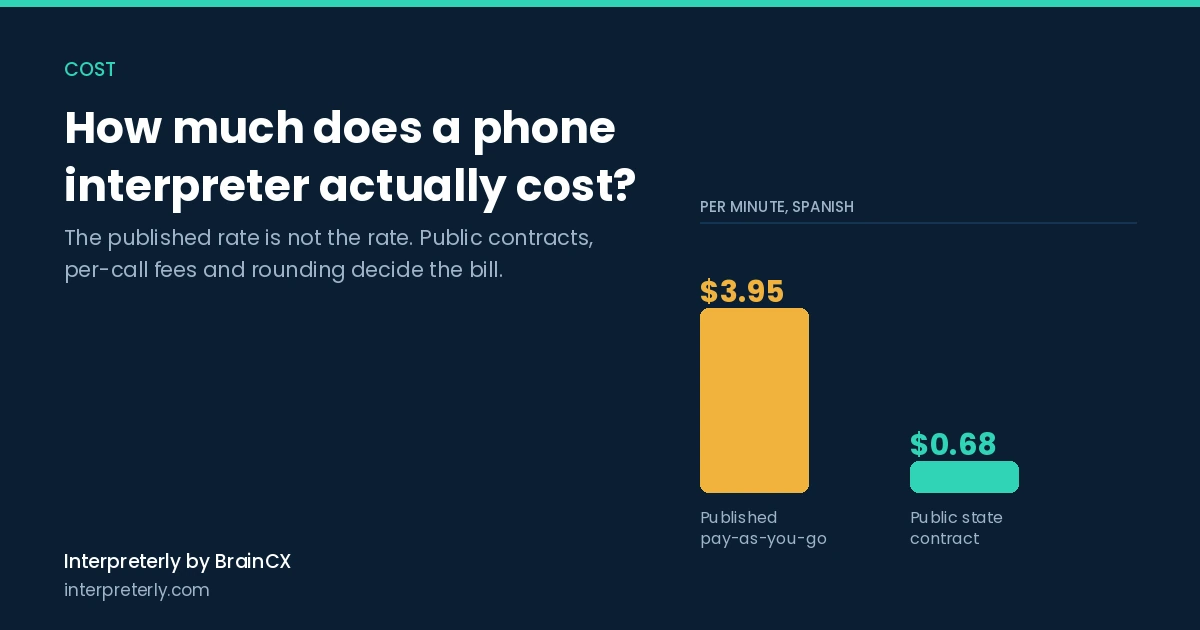
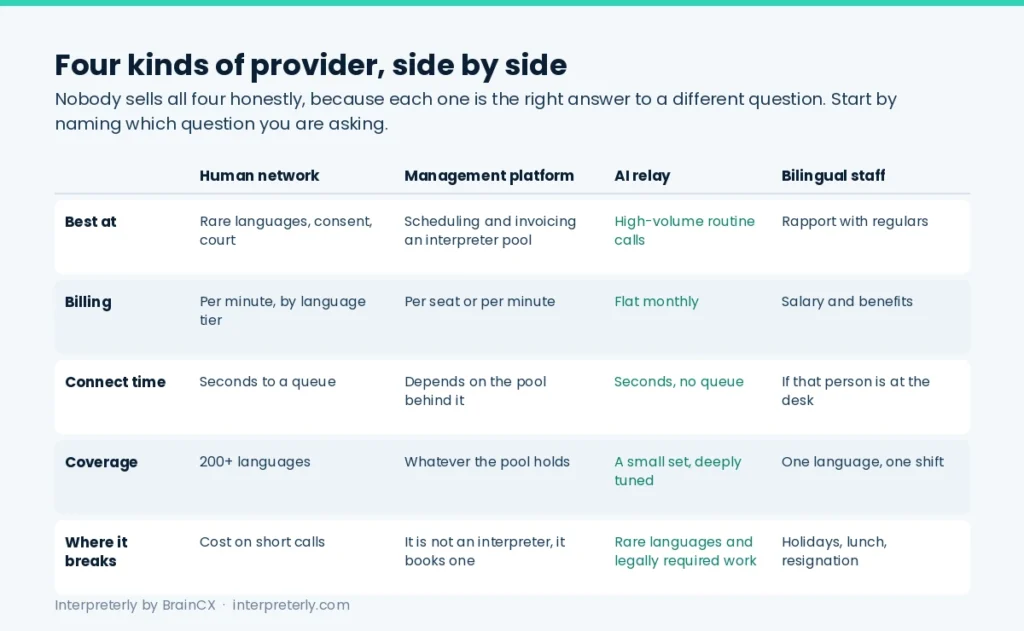
Human interpreter networks. LanguageLine, CyraCom and Propio are the names a US buyer meets first. You dial in, you reach a qualified interpreter, you are billed per minute by language tier. LanguageLine publishes $3.95 a minute for audio and lists 240 or more languages on its pay-as-you-go service. This is the right answer for rare languages, for informed consent, for court, and for anything where a law or an accreditation standard requires a qualified human. It is an expensive way to confirm a Tuesday appointment.
Interpreter management platforms. Boostlingo is the clearest example. The platform schedules interpreters, routes audio and video, handles signatures, invoicing and reporting. Boostlingo lists a 13-second average connect time, 300 or more languages for over-the-phone interpreting, 45 or more for video, and in late 2025 it extended its own AI Interpreter into phone call workflows, now listing 23 active AI languages. The thing to understand is that a management platform is not itself an interpreter. It is the system that gets you to one, and whoever is behind it still has to answer.
AI interpretation relays. Software that interprets live on the call. This category barely existed three years ago and now includes the AI products inside the incumbents as well as standalone vendors. Billing is usually a subscription rather than a meter. Language coverage is narrower than a human network by a wide margin, and it should be, because quality on a specific language pair is a function of how hard it has been tuned.
Bilingual staff. The option most practices try first, because it is already in the building. One bilingual receptionist covers one language on one shift, and your coverage ends when they take lunch, take a holiday or take another job.
What is the best over-the-phone interpreter company?
There is no single best one, because the four categories answer different questions. For rare languages and legally required interpreting, a human interpreter network is the right choice and no AI product should be sold to you as a substitute. For high-volume routine calls in a small number of languages, a metered human network is usually the most expensive option on the table. For teams that need scheduling, credentialing and invoicing across a pool of interpreters, a management platform is doing the job neither of the others does.
Start by writing down which of those three sentences describes your actual call volume. Most organisations find that two of them do, and the answer is two vendors rather than one.
The eight questions that separate providers
Roundup pages list logos. These are the questions that change a quote.
- What is the rate, by language tier, in writing? Published price lists are organised by tier. Your highest-volume language decides most of your bill.
- How is a call rounded? Public interpretation contracts commonly bill each call rounded to the nearest full minute. On a front desk making forty short calls a day, the rounding rule matters more than a ten-cent rate difference.
- What are the per-call fees? Third-party dial-out charges, appointment setup fees and missed-appointment cancellation fees all appear on published price lists and none of them show up in a per-minute comparison.
- What is the connect time, and is it measured or promised? Boostlingo publishes an average. Ask any vendor whether their number is an average, a median or a target, and what happens at 4pm on a Monday.
- Which languages are actually covered, and how well? A 300-language catalogue and a 300-language guarantee are different things. Ask which languages are available on demand and which need scheduling.
- Who is on the call, and what is their standard? For a human network, ask about qualification and specialisation. For an AI product, ask what it does with names, phone numbers and ID numbers, because that is where interpreted calls break.
- What record do you get? A transcript with a timestamp, language pair and duration is useful six months later when somebody asks what was said. Ask whether it is included or priced separately.
- What happens to the contract if your volume halves? Annual commitments and minimums are easy to agree to in a growth year.
If you want the overview rather than one head-to-head, we keep a full comparison hub with each provider type broken out.
Where Interpreterly sits, said plainly
Interpreterly is an AI interpretation relay. Traditional interpreter companies add a third person to the phone call. AI companies replace the employee entirely. We do neither. The employee stays on the call and we carry the language.
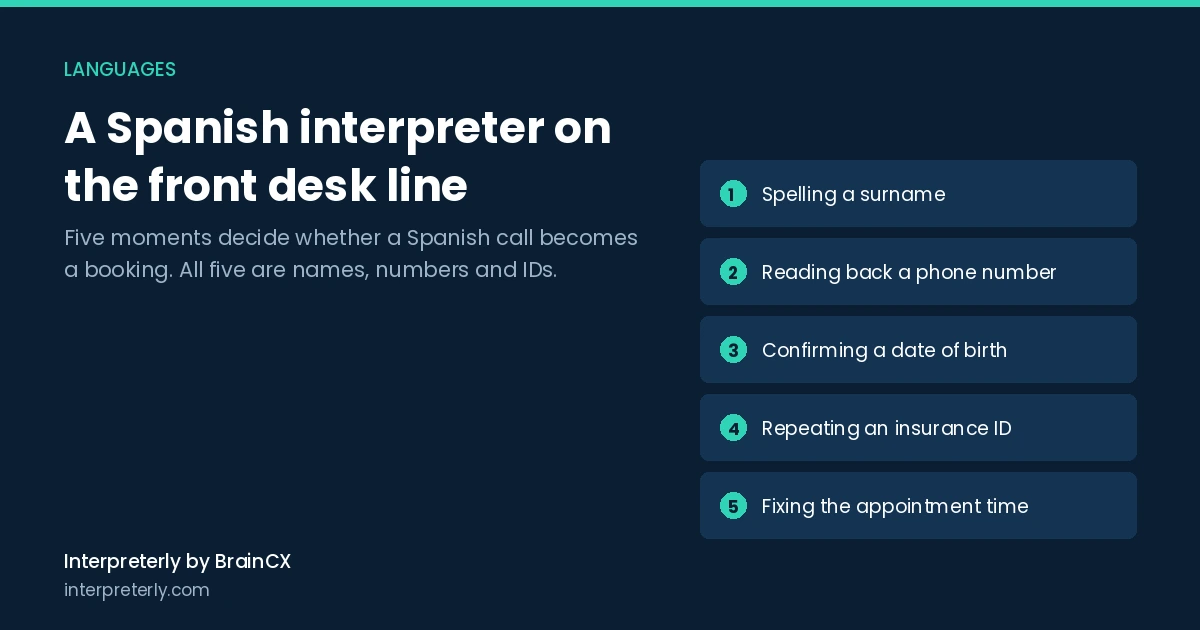
We interpret live in Spanish and Brazilian Portuguese, with Haitian Creole coming soon. That is a deliberately short list. Against a 240-language human network, breadth is not an argument we can win or want to make. What we can argue is depth on the languages that make up the overwhelming majority of US business call volume, and accuracy on the part of the call that actually fails: the surname, the callback number, the insurance ID. Read-back confirmation on those is the capability we would put in front of any buyer first.
Pricing is flat monthly with no per-minute meter, which is the whole commercial difference. If you are already pricing a metered vendor, Interpreterly vs LanguageLine on cost and setup puts the two models next to each other. If you are evaluating a management platform, a Boostlingo alternative covers where the two overlap and where they do not.
For rare languages, ASL, informed consent and anything legally requiring a qualified human interpreter, keep a human OPI vendor in place alongside whatever else you buy. We say that on our own pricing page and we mean it.
What this costs
Pricing with no per-minute fees starts at $147 a month for 500 minutes, with 60 free minutes to use inside 30 days and no card to start. Published human-network self-service rates sit at $3.95 a minute for audio. Which of those is cheaper depends entirely on your minutes, and the only honest way to answer it is with your own call volume rather than ours.
Frequently asked questions
Who are the main over-the-phone interpreter companies?
The largest US human interpreter networks are LanguageLine, CyraCom and Propio. Boostlingo is the best known interpreter management platform. AI interpretation relays are a newer category and now include AI products built inside the incumbents as well as standalone vendors such as Interpreterly.
What is the difference between an interpreter network and an interpreter management platform?
A network supplies qualified interpreters and bills you for their time. A management platform schedules, routes, credentials and invoices interpreters, usually for an organisation that is running its own pool or buying from several sources. A platform is not itself an interpreter.
Can an AI interpreter replace a human interpreter company?
Not for the work that requires a qualified human. Courts, informed consent, ASL and rare languages all need a credentialed human interpreter, and an AI product should not be sold as a substitute for them. AI relays are built for routine, high-volume conversation, and most organisations run both.
How fast should an interpreter connect?
Published figures from providers run from a few seconds to tens of seconds for on-demand human interpreting. Ask whether the number quoted is an average or a guarantee, and ask what it looks like at peak hours in your highest-volume language.
How do I compare two interpretation quotes fairly?
Normalise them. Same language tier, same rounding rule, same per-call fees, same reporting, same contract length, applied to your own twelve months of call data. Two quotes with different rounding rules are not comparable as headline rates.