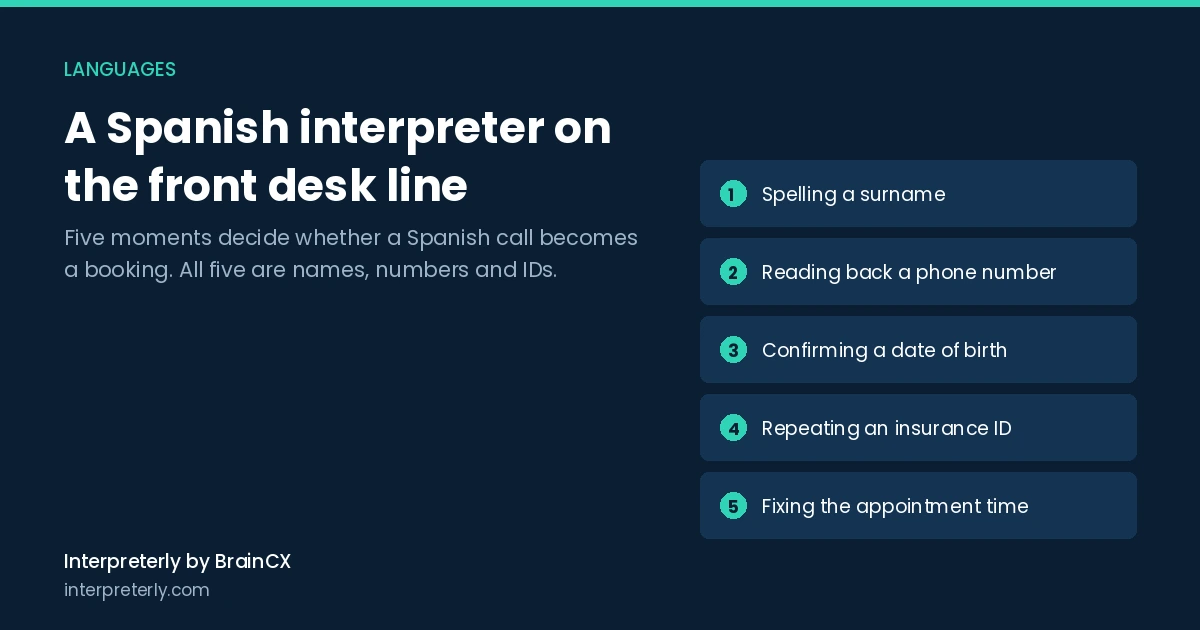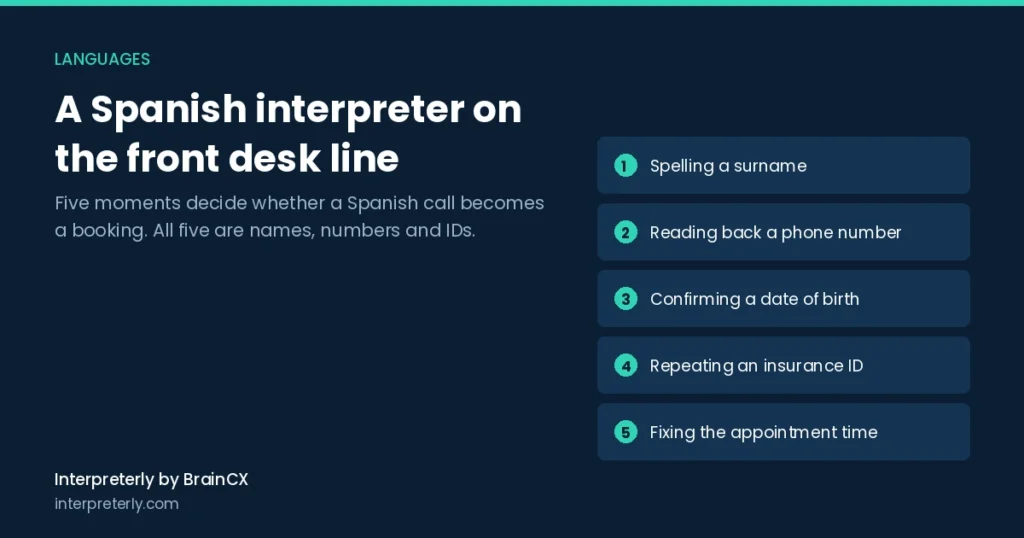
A Spanish-speaking caller does not need a perfect translation of your conversation. They need their surname spelled correctly, their callback number written down right, their date of birth confirmed, their insurance ID read back and an appointment time both sides agree on. Those five things are where interpreted calls fail, and none of them are hard sentences.
About 45 million people in the United States speak Spanish at home. If your front desk is English-only, every one of those calls is a booking you might be losing on a detail.
The five moments a Spanish call is won or lost
Sit with a front desk for an hour and the pattern is obvious. The conversational part of a Spanish call goes fine, or goes approximately fine, and nobody notices the damage until later.
Spelling a surname. Hernández, Fernández and Hernandes are three different people in your system. A letter wrong at the front desk becomes a duplicate chart, a failed insurance check and a patient who is not in the schedule when they arrive.
Reading back a phone number. One transposed digit and your reminder goes nowhere. The caller is not no-showing. They were never reminded.
Confirming a date of birth. Day-month order differs by country of origin, and 03/04 is ambiguous in a way that nobody flags out loud.
Repeating an insurance ID. Letters and digits, often read out quickly, often over a bad connection. The verification fails three days later and the front desk calls back to ask for it again.
Fixing the appointment time. Tuesday at two is not a complicated sentence. It is still the one that produces a patient in the lobby on Wednesday.
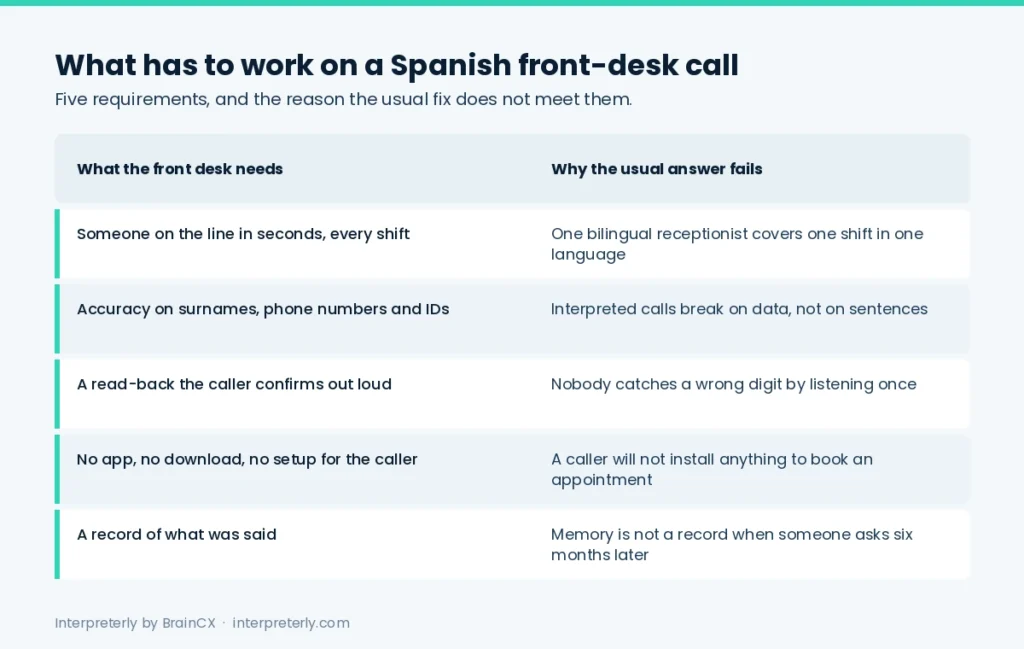
Every one of those is data, not language. That is why “we have someone who speaks a bit of Spanish” solves less of this than it looks like it should.
Why the usual answers fall short
The bilingual receptionist. The most common fix, and a genuinely good one while that person is at the desk. One person covers one language on one shift. Coverage ends at lunch, on holiday, on the Tuesday they are out sick and permanently on the day they resign. There is also a quieter cost: the bilingual staff member becomes the interpreter for the whole practice, gets pulled off their own work to translate for colleagues, and burns out faster than anyone tracks.
A family member on speakerphone. Fast and free and not accountable for accuracy. An adult son reading an insurance ID has no reason to get it wrong and no training to get it right, and in a healthcare setting there are rules about this that go well beyond accuracy.
Translation apps. Built for a traveller asking where the station is. They are not built for a two-way phone call where one party is on a landline, there is background noise on both ends, and the critical content is a string of digits.
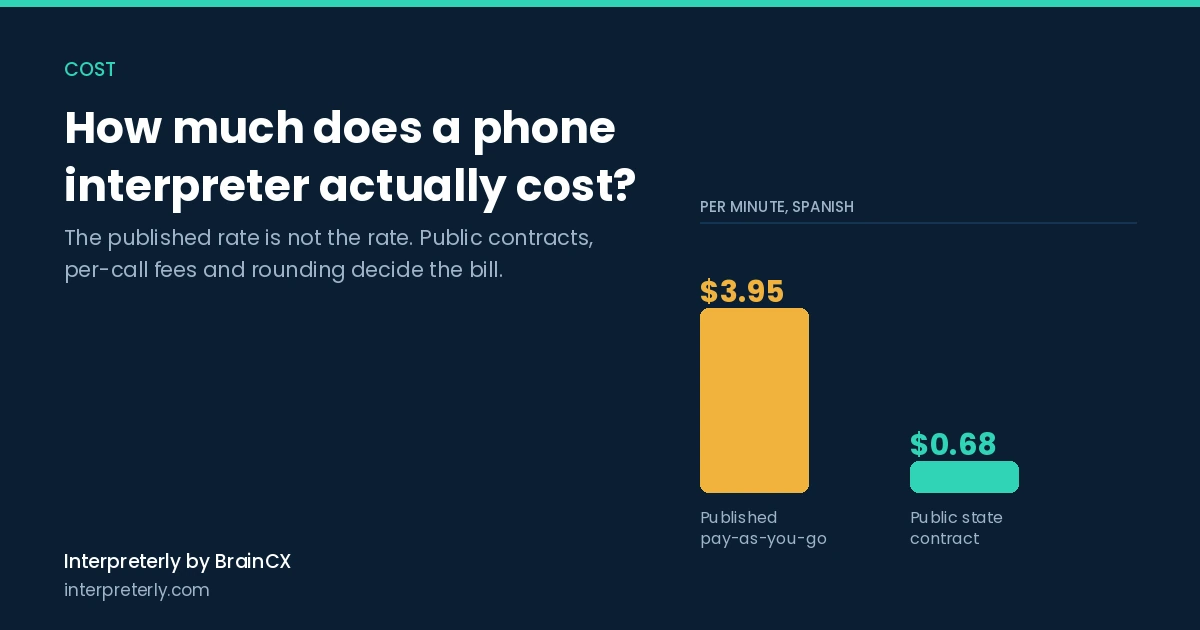
A per-minute interpreter line. Accurate and appropriate, and it is the right answer for long, complex or legally required conversations. On a front desk making forty ninety-second calls a day it is an expensive way to confirm a Tuesday. You can work out what per-minute interpretation is costing you against your own volume.
What good looks like on a front-desk call
Five requirements. If a product cannot do all five, it is not solving the front-desk problem.
Someone on the line in seconds, on every shift. Not a queue, not a callback, not “when María is back from lunch”.
Accuracy on names, numbers and IDs. Not general fluency. The specific, boring, high-stakes strings.
A read-back the caller confirms out loud. This is the one almost nobody markets and it is the one that works. The number gets repeated back in the caller’s language, the caller says yes or corrects it, and the error is caught on the call rather than three days later. Read-back confirmation is the single most under-marketed capability in this category.
Nothing for the caller to install. A patient calling to book will not download an app. If your language solution requires anything of the person on the other end, it will not be used.
A record of what was said. Not because anyone expects a dispute, but because six months later somebody will ask, and memory is not a record.
How Interpreterly handles it
Traditional interpreter companies add a third person to the phone call. AI companies replace the employee entirely. We do neither. The employee stays on the call and we carry the language.
In practice that means your receptionist takes the call as normal and conferences Interpreterly in. They speak English, the caller speaks Spanish, and both sides hear their own language in real time. There is no app and no download for the caller, no hardware, and no PBX project. It runs on your existing line, whether that is a desk phone, a mobile or a VoIP system.
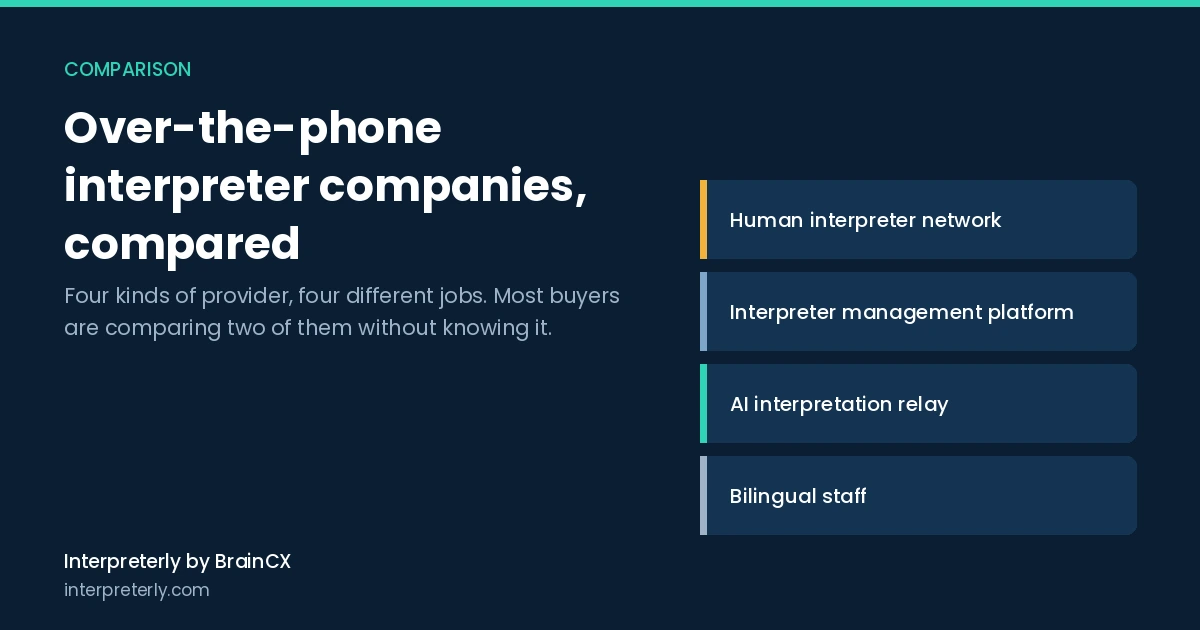
We are live in Spanish and Brazilian Portuguese, with Haitian Creole coming soon. That is a short list on purpose. A 240-language human network wins on breadth and we do not pretend otherwise. What a narrow, deeply tuned set buys you is performance on the exact calls your front desk makes, including read-back confirmation on emails, phone numbers and ID numbers, which is where interpreted calls actually break.
If most of your Spanish volume is one language and most of your Portuguese volume is the other, the same setup in Brazilian Portuguese works identically on the same line. For Spanish specifically, a Spanish phone interpreter for business calls covers the detail.
Keep a human interpreter vendor for rare languages, for ASL, and for any conversation where a qualified human interpreter is legally required. This is for the routine volume, which is most of it.
If you want to see the mechanics rather than read about them, here is how the interpreter joins your call.
Frequently asked questions
How do I get a Spanish interpreter on a phone call?
Conference an interpretation service into the call you are already on. With a relay service the employee stays on the line, the caller stays on the line, and the interpretation runs between them in real time. With a traditional interpreter line you dial a number, give an account code, choose the language and wait for an interpreter to join as a third participant.
Can a Spanish-speaking employee act as the interpreter?
They can and often do, and for routine conversation it works. In healthcare there is a separate standard for what qualifies someone to interpret, and being bilingual is not enough on its own. Operationally, one bilingual employee covers one language on one shift, which is why practices that rely on it find the coverage disappears at lunchtime and on holidays.
Do Spanish-speaking callers need an app to use a phone interpreter?
No, and any service that requires one will not be used. A caller ringing to book an appointment will not install software. The interpretation should run entirely on your side of the call.
What usually goes wrong on an interpreted Spanish call?
Data, not conversation. Surnames, callback numbers, dates of birth and insurance ID numbers. The way to prevent it is read-back confirmation, where the detail is repeated to the caller in their own language and confirmed out loud before the call ends.
What languages does Interpreterly support?
Spanish and Brazilian Portuguese are live, with Haitian Creole coming soon. The language set is deliberately narrow and deeply tuned. For languages outside that set, keep a traditional over-the-phone interpretation vendor in place.