If you run a busy front desk, you know the feeling: the phone rings, a patient or customer starts speaking in Spanish or Haitian Creole, and your workflow grinds to a halt. You want to provide excellent service to your limited English proficiency (LEP) callers, but the traditional way of handling these calls, Over-the-Phone Interpretation (OPI), often brings a frustrating mix of long hold times and unpredictable monthly bills.
For decades, traditional OPI was the only real option for businesses needing on-demand language support. But as call volumes increase, paying by the minute is draining operational budgets.
This guide breaks down exactly what OPI is, how traditional per-minute billing works (and hides costs), and how modern offices are using AI voice technology to dramatically cut their language access bills without sacrificing caller experience.
What is Over-the-Phone Interpretation (OPI)?
Over-the-Phone Interpretation (OPI) is a language access service that connects a live interpreter to a telephone call to facilitate two-way communication between individuals who do not speak the same language.
In a traditional OPI setup, the process looks like this:
- Your receptionist answers a call from a non-English speaker.
- The receptionist places the caller on hold, dials a toll-free number for an interpreter agency, and enters a specialized account PIN.
- The receptionist waits in a queue for a human interpreter who speaks the requested language.
- Once connected, the receptionist merges the calls. The interpreter listens to a sentence, translates it to the caller, listens to the caller’s response, and translates it back to the receptionist.
OPI is an essential service for bridging language barriers. It is heavily utilized across healthcare, dental groups, behavioral health centers, and automotive dealerships.but, the manual nature of routing calls to human call centers makes it both slow and expensive.
How Much Does Traditional OPI Cost Per Minute?
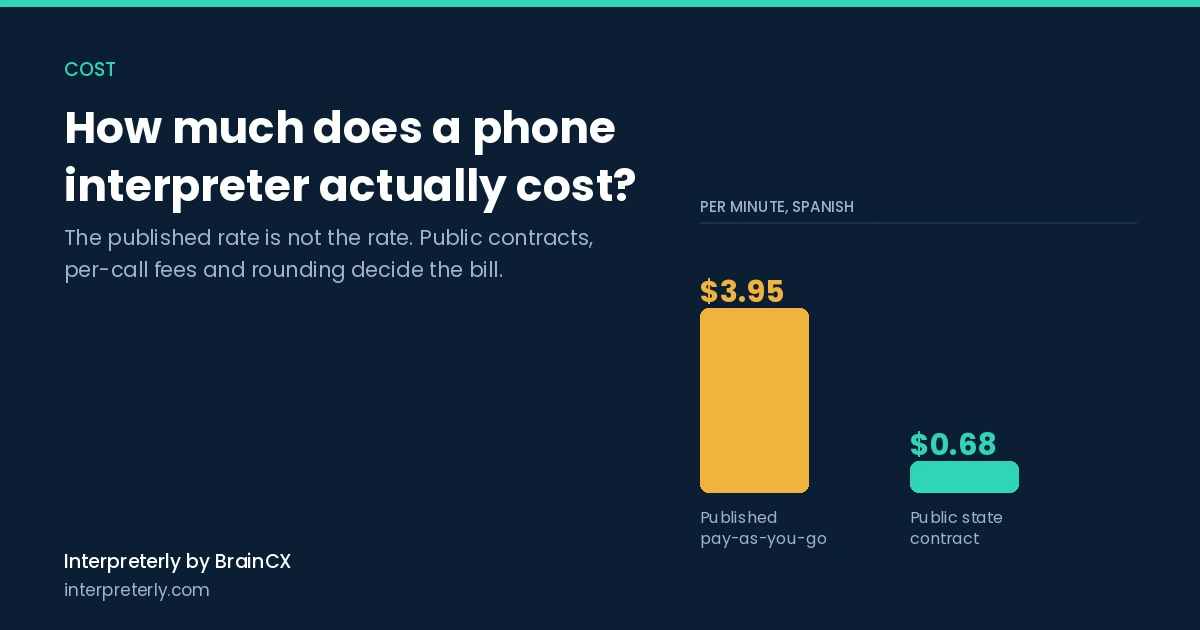
Traditional human OPI typically costs between $1.50 and $3.95 per minute. This rate fluctuates based on the language requested, the time of day, and the volume commitment in your contract.
While $2.00 a minute might not sound exorbitant at first glance, practice managers quickly discover that their language access bills are much higher than anticipated. That is because the per-minute rate is the baseline.
The Anatomy of an OPI Bill
When you review an invoice from a legacy human OPI provider, you are usually paying for:
- The Base Per-Minute Rate: The standard fee for common languages like Spanish during normal business hours.
- Premium Language Fees: If you need less common dialects or languages, the per-minute rate often surges past the $3.00 mark.
- Hold Time Penalties: With many agencies, the billing clock starts the second the interpreter joins the line. If you put the interpreter on hold to look up a patient’s chart or ask a doctor a question, the meter keeps running. You are still paying $3.00 or more a minute to have them listen to hold music
- Call Minimums: This is the biggest budget drain. Many agencies enforce a minimum billing block per call (for example, a 5-minute minimum).
Imagine a Spanish-speaking patient calls simply to confirm that their appointment is at 2:00 PM. The actual conversation takes 90 seconds. That 90-second call costs your office $12.50, once you apply a $2.50 rate and a 5-minute minimum. Multiply that by dozens of calls a day, and the strain on your language access budget adds up fast.
The AI Alternative: Moving from Per-Minute to Flat-Rate
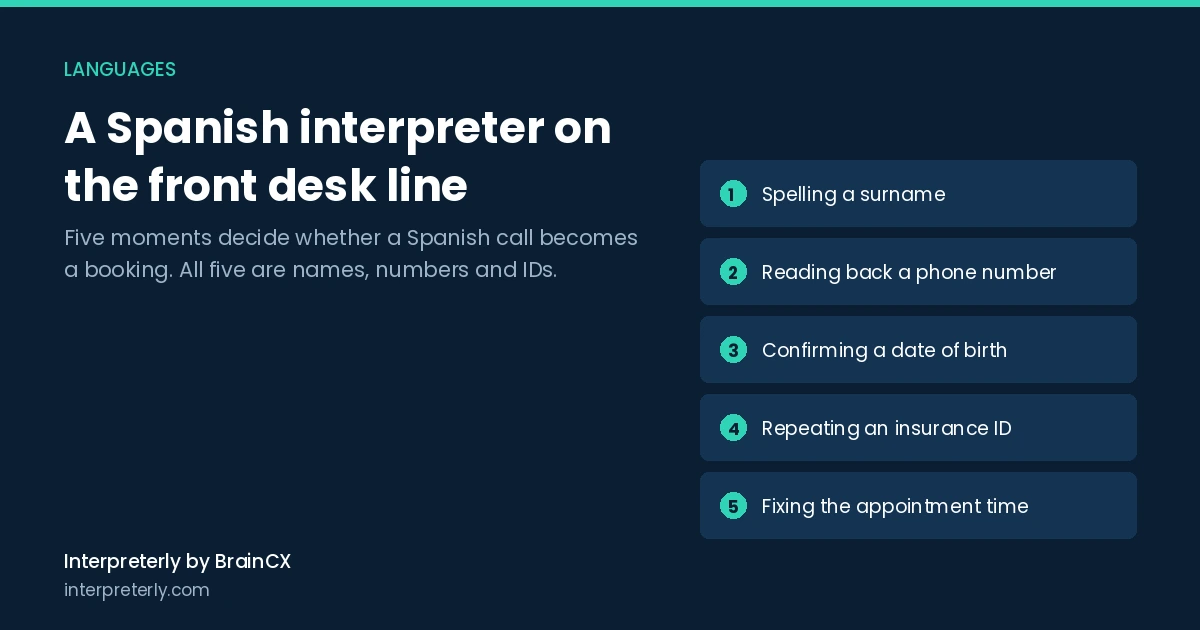
Because 80% of front-desk calls are highly routine scheduling appointments, asking for office hours, checking basic insurance eligibility, or getting directions paying premium human OPI rates for every single interaction is no longer the smartest business move.
Today, operational leaders are switching to a real-time AI phone interpreter to handle the bulk of their daily call volume.
The biggest operational shift here is the business model: software does not bill by the minute. Instead of dealing with fluctuating invoices, businesses pay a predictable subscription. For example, Interpreterly offers pricing from $147 a month on its Starter tier. Because it is a software platform, there are no call minimums and no penalties if a call takes a little longer than expected.
If your office is tired of rationing interpreter minutes to save money, switching to AI serves as a flat-rate alternative to LanguageLine and other legacy providers. You can easily plug your current call volume into an ROI tool to see exactly what you’d save versus per-minute interpretation.
The 80/20 Rule: When to Use AI vs. Human Interpreters
Adopting AI does not mean firing your human interpreter network. The most effective language access strategy follows the 80/20 rule. Use AI to handle the routine 80% of calls. Save your human OPI budget for the complex 20%
When an AI Voice Interpreter Excels:
- Scheduling and Rescheduling: AI handles calendar confirmations without a hold queue. .
- Basic Intake: Modern AI systems are incredibly precise; Interpreterly achieves ~99% accuracy on capturing emails, phone numbers, and patient IDs by using read-back confirmation.
- High-Volume Languages: Deeply tuned AI models handle high-traffic languages like Spanish, Brazilian Portuguese, and Haitian Creole with ease.
When Human OPI is Still Required:
- Delivering Diagnoses: Nuanced medical news requires a human touch.
- Behavioral Health Therapy: Deeply emotional or complex psychiatric evaluations require a human interpreter who can read subtle tone shifts.
- Legal Mandates: Situations where a legally certified human is strictly required by state or federal law.
A Critical Note on Healthcare Compliance
If you are deploying an AI phone interpreter for medical clinics, understanding where technology fits into your compliance framework is mandatory.
Under the 2024 Section 1557 final rule, machine translation alone does not satisfy the “qualified interpreter” requirement in covered healthcare settings. Interpreterly is designed to support your language access goals for routine administrative front-desk tasks, but it does not replace a qualified human interpreter where one is legally mandated for complex medical care. Always confirm your facility maintains HIPAA and language-access compliance by keeping a human OPI account active as a fallback for those critical interactions.
How AI Phone Interpretation Works (No IT Required)
A major reason offices hesitate to change their OPI process is the fear of complicated technology. Nobody wants to force a caller to download a third-party app or wait for an IT department to install new desk phones.
Fortunately, modern platforms are built for the end-user. When you look at how AI phone interpretation works, it is functionally identical to adding a third person to a standard conference call.
Your front desk answers the phone, hits “add call,” and dials your dedicated Interpreterly number. The AI joins the line instantly. It listens, translates, and speaks with sub-300ms latency, making the conversation feel natural. There is no app required for the other party, and it works on your existing cell phones, landlines, or VoIP systems.
Most offices can go live in about 12 minutes. Split your language access strategy. Route the heavy volume of simple calls to a flat-rate AI. Reserve human experts for complex medical interactions. Your team reduces hold times to zero, eliminates per-minute billing anxiety, and gives LEP callers faster, more consistent service .
Frequently Asked Questions (FAQ)
What does OPI stand for in customer service?
OPI stands for Over-the-Phone Interpretation. It refers to the process of using a live interpreter via a telephone connection to translate conversations between two parties who speak different languages.
Why is traditional OPI so expensive?
Traditional OPI relies on human call centers, which means you are paying for labor by the minute. Costs inflate quickly due to base per-minute rates (often $1.50 to $3.95+), time spent waiting on hold, and mandatory call minimums that charge you for 5 minutes even if your call only lasted 30 seconds.
Can an AI replace an OPI interpreter entirely?
No. The most effective approach is the 80/20 rule. AI is perfect for replacing human OPI on routine, high-volume administrative calls (like scheduling and basic intake) to save money. but, human interpreters should still be used for complex, sensitive, or legally required medical conversations.
Does using an AI phone interpreter require downloading an app?
No. With platforms like Interpreterly, the AI simply conferences into your existing phone system (cell phone, landline, or VoIP). The LEP person on the other end of the line does not need a smartphone, an app, or an internet connection to use it.
How long does it take to set up an AI phone interpreter?
Traditional human OPI contracts require complex onboarding. Modern AI voice interpreters do not. You can create an account and go live on your first call in about 12 minutes.
What languages do AI phone interpreters support?
Interpreterly specifically focuses on deeply vertical-tuned models rather than broad, surface-level coverage. Currently, the platform supports real-time translation for Spanish, Brazilian Portuguese, and Haitian Creole, which covers the majority of high-volume LEP calls in the US.
Are AI interpreters accurate for medical intake?
Yes, for routine intake tasks. AI platforms use read-back confirmation features to achieve ~99% accuracy when capturing specific details like email addresses, phone numbers, and patient IDs.
Is AI phone interpretation HIPAA compliant?
Yes. Enterprise-grade AI interpreters like Interpreterly are HIPAA-compliant, SOC 2 Type II certified, and offer a Business Associate Agreement (BAA). but, covered entities must still adhere to Section 1557 rules, meaning AI should be used for administrative calls, while a legally qualified human interpreter must be used for complex medical diagnoses.