Here is the uncomfortable version of this question. In most states it is perfectly legal for a borrower’s adult daughter to interpret the loan terms at a real estate closing. There is no rule to point to and no box left unchecked.
That is exactly why it is a risk, and why title and settlement companies are the ones carrying it. A practice that is legal but unaccountable is the kind that looks fine until the day it does not.
Can a family member interpret at a real estate closing?
In most states, yes, it is legal. Unlike healthcare, where Section 1557 restricts relying on a family member, there is generally no equivalent federal rule barring a relative from interpreting at a residential closing.
But “legal” and “safe” are different questions, and the gap between them is where the settlement agent’s exposure lives. The absence of a rule telling you not to do it is not the same as protection when it goes wrong.
Why a relative at the closing table is a risk
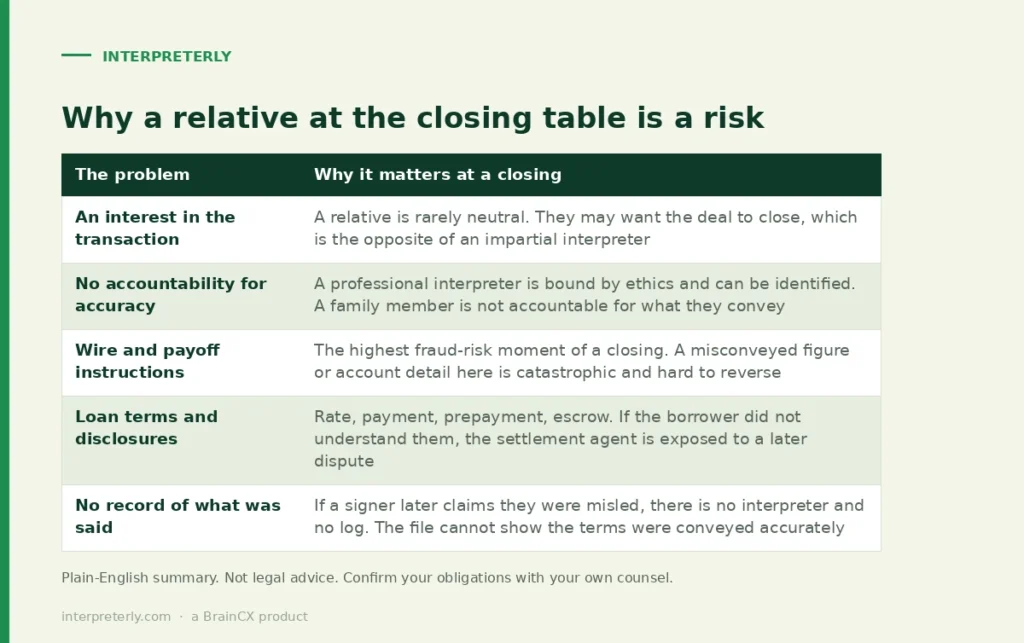
Five problems, and they compound at a closing in a way they do not elsewhere.
An interest in the transaction. A professional interpreter is impartial by obligation. A family member usually wants the deal to close, which is the opposite of impartiality. A relative who has been encouraging the purchase for months is not a neutral conduit for bad news about the terms.
No accountability for accuracy. A qualified interpreter is bound by ethics, can be identified, and can be asked afterward what was said. A family member is accountable to nobody. If they simplify, soften or skip something, there is no professional standard they have breached and no record that it happened.
Wire and payoff instructions. This is the one that should stop a settlement agent cold. The closing is where the largest wire transfers of most people’s lives are arranged, and it is a prime target for fraud. A figure or an account detail misconveyed through a relative, innocently or otherwise, is catastrophic and extremely hard to reverse.
Loan terms and disclosures. Rate, monthly payment, prepayment penalty, escrow, the total of payments over the life of the loan. If the borrower did not actually understand these because the interpretation was casual, the settlement company is exposed to a dispute that lands on it, not on the relative.
No record of what was said. If a borrower later claims they were misled or did not understand, there is no interpreter to ask and no log to produce. The file cannot demonstrate that the terms were conveyed accurately, which is precisely what the settlement agent would want to show.
The SCIF form makes this worse, not better
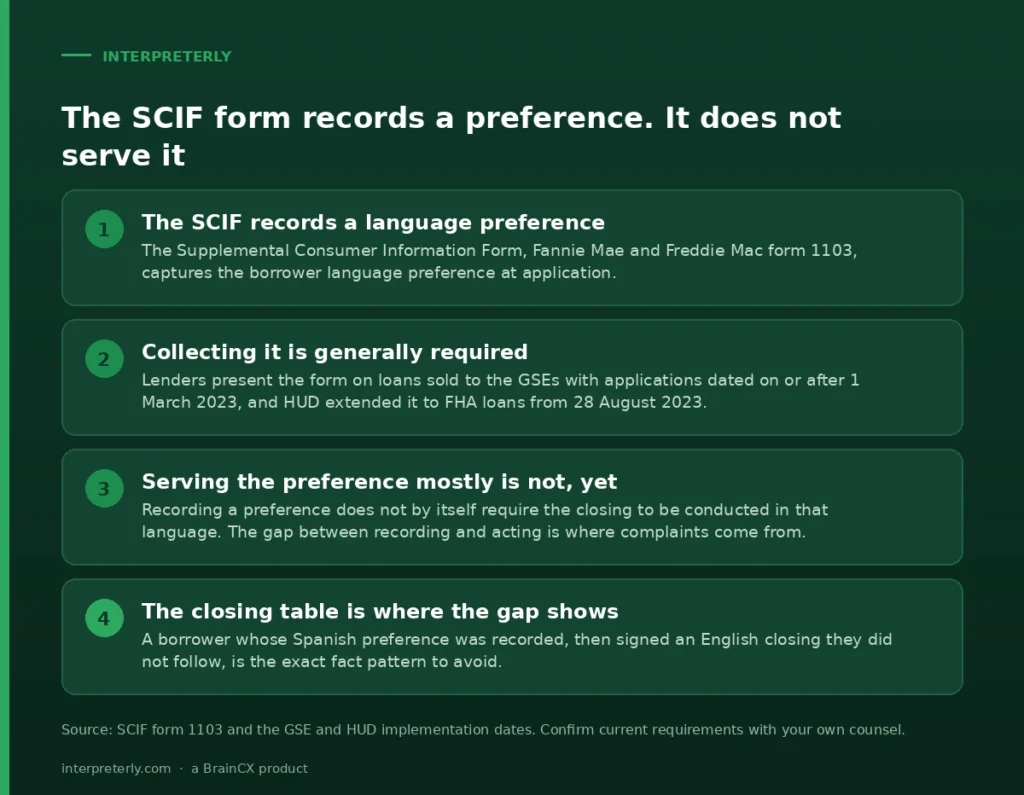
Lenders now routinely capture a borrower’s language preference, and many settlement agents assume that collecting it discharges some obligation. It does not, and the gap it creates is the thing to understand.
The Supplemental Consumer Information Form, Fannie Mae and Freddie Mac form 1103, records the borrower’s language preference at application. Lenders present it on loans sold to the government-sponsored enterprises with applications dated on or after 1 March 2023, and HUD extended it to FHA loans from 28 August 2023.
Here is the gap. Collecting the preference is generally required. Serving it, mostly, is not, yet. A lender can dutifully record that a borrower prefers Spanish and then conduct the entire closing in English without breaking the SCIF requirement.
That is worse than it sounds, because the file now contains a documented record that the borrower’s preferred language was Spanish, sitting next to an English-only closing the borrower signed. If a dispute arises, that recorded preference is not a shield. It is the first exhibit. The gap between recording a preference and acting on it is exactly where complaints come from.
Why this lands on the title company specifically
The settlement agent runs the signing. When a Spanish-speaking buyer arrives at a table of English documents and the only available interpreter is the relative who drove them there, it is the title or settlement company that decides what happens next, and it is the title or settlement company left holding the file if the closing is later disputed.
The lender has moved on. The real estate agents have moved on. The settlement agent is the party whose name is on the conduct of the closing, which is why this risk belongs to them more than to anyone else in the transaction.
What a defensible closing looks like instead
The goal is simple to state. Every signer understood the terms in a language they are comfortable in, and the file can show it.
Use a neutral interpreter, not an interested party. A qualified interpreter, by phone where an in-person one is not practical, keeps an impartial, accountable voice in the room for the terms and the wire instructions. The relative can still be present for support. They just should not be the channel for the material terms.
Treat wire and payoff instructions as the highest-stakes moment. Convey them through the neutral interpreter, and confirm the figures and account details with a read-back. Getting an account number or an amount right on the first pass is the whole game here.
Record that it happened. Note in the file that a neutral interpreter was used, for which parts of the closing, and that key terms and wire details were confirmed. That record is what turns a later dispute from a swearing match into a documented process.
Mind the document question separately. Some states, California through Civil Code 1632, require translated documents for covered transactions negotiated in certain languages. Whether a particular closing triggers a translated-document rule is a question for counsel, and it is separate from having an interpreter in the room.
Where a language tool fits at the closing table
Traditional interpreter companies add a third person to the phone call. AI companies replace the employee entirely. Interpreterly does neither. The employee stays on the call and we carry the language, in Spanish and Brazilian Portuguese today, with Haitian Creole coming soon. At a closing that means your settlement officer can keep control of the signing and still serve a Spanish-speaking borrower directly, with an impartial channel for the terms rather than an interested relative.
The limits matter here as much as anywhere. Interpreterly is a language assistance tool, not a certified interpreter service, and it does not replace a qualified human interpreter where one is legally required or genuinely warranted by the complexity of the transaction. It is not a document translation service, so any translated-document requirement is handled separately with counsel. For higher-value or higher-complexity closings, a qualified human interpreter remains the right call, and the honest version of that trade-off is in AI interpreter vs human interpreter.
If a BAA, data handling or a record of the call is the concern, our compliance approach covers the audit-ready transcript, and you can talk to our team about how it works at a signing table.
A short checklist for settlement agents
- Stop treating a relative as the default interpreter at closings, even where it is legal.
- Have a neutral interpreter route ready before the signing, not improvised at the table.
- Convey wire and payoff instructions through the neutral interpreter, with a read-back on every figure and account detail.
- Note in the file that an interpreter was used and that key terms were confirmed.
- Where the loan file records a non-English language preference, make sure the closing does not contradict it.
- Ask counsel whether any transaction you handle triggers a state document-translation requirement.
Frequently asked questions
Is it legal for a family member to interpret at a closing?
In most states, yes. There is generally no federal rule barring it at a residential closing, unlike the healthcare restrictions under Section 1557. The risk is practical and legal exposure, not a specific prohibition.
Why is a family member interpreting a risk for the title company?
A relative is not impartial, is not accountable for accuracy, and creates no record. At a closing, where wire instructions and loan terms are conveyed, a misunderstanding can be catastrophic and the settlement agent is the party left holding the disputed file.
What is the SCIF form?
The Supplemental Consumer Information Form, Fannie Mae and Freddie Mac form 1103, records a borrower’s language preference. Lenders present it on GSE-sold loans with applications dated on or after 1 March 2023, and HUD extended it to FHA loans from 28 August 2023.
Does the SCIF require the closing to be in the borrower’s language?
Generally no. Collecting the preference is required, but serving it mostly is not, yet. That gap, a recorded Spanish preference next to an English-only closing, is where complaints arise.
What should a settlement agent do instead? Use a neutral, accountable interpreter for the terms and wire instructions, confirm figures with a read-back, document that an interpreter was used, and handle any state document-translation requirement separately with counsel.