Of all the calls a healthcare front desk handles, the intake call is where a language barrier does the most damage. A scheduling call is short and forgiving. An intake call is long, dense with detail, and it’s often a patient’s very first real interaction with your practice. When that patient doesn’t speak English well, the whole thing wobbles: names get misspelled, insurance IDs get transposed, medical history gets thinned out, and the patient walks away unsure whether they’re actually booked. Some never come back.
This is exactly the problem real-time AI phone interpretation was built for, and also exactly the place where it’s most important to be honest about its limits. Here’s how an AI interpreter changes a multilingual intake call, and where a qualified human interpreter still has to step in.
Why intake is the hardest LEP call
Think about what an intake call actually collects. Demographics: legal name, date of birth, address. Contact details: phone numbers, email, preferred contact method. Insurance: carrier, member ID, group number. Medical basics: reason for visit, current medications, allergies, sometimes a brief history. And often, consent, permission to treat, to bill, to share records.
That’s ten or more minutes of high-detail information exchange where nearly every field has to be exactly right. Now add a language barrier. For a patient with limited English proficiency (LEP), a front desk today usually falls back on one of three bad options. They stumble through it in broken English and hope for the best. They pull a per-minute human interpreter onto the line for the entire long call, which is accurate but expensive precisely because intake takes so long. Or they rush it, skip the nuance, and make mistakes. All three cost you, in rework, in no-shows, in patients who don’t come back, and in compliance exposure.
The intake call concentrates every weakness of the old model: it’s long (so per-minute billing hurts), it’s detailed (so errors are costly), and it’s early in the relationship (so a bad experience loses the patient before they’ve even been seen).
The intake call, handled by AI
Now picture the same call with a real-time AI phone interpreter conferenced in. The patient speaks their language, your staff speaks English, and the interpretation happens live, both directions, fast enough that the conversation actually flows instead of stalling. There’s no app for the patient to download and nothing to install on their end. You can see the mechanics on the how it works page, but the short version is that you add the interpreter to the call and it’s simply there.
The administrative body of the intake, the demographics, the contact details, the insurance capture, the scheduling, all of it runs in the patient’s language in real time. And the parts most likely to go wrong on any interpreted call, the specific data points, are exactly what the tool is built to protect.
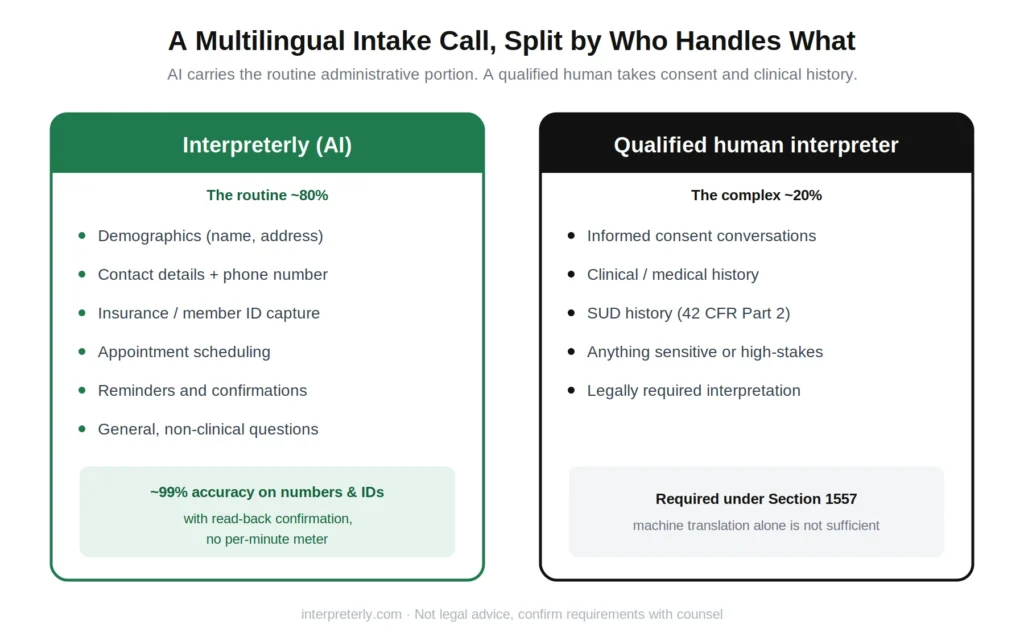
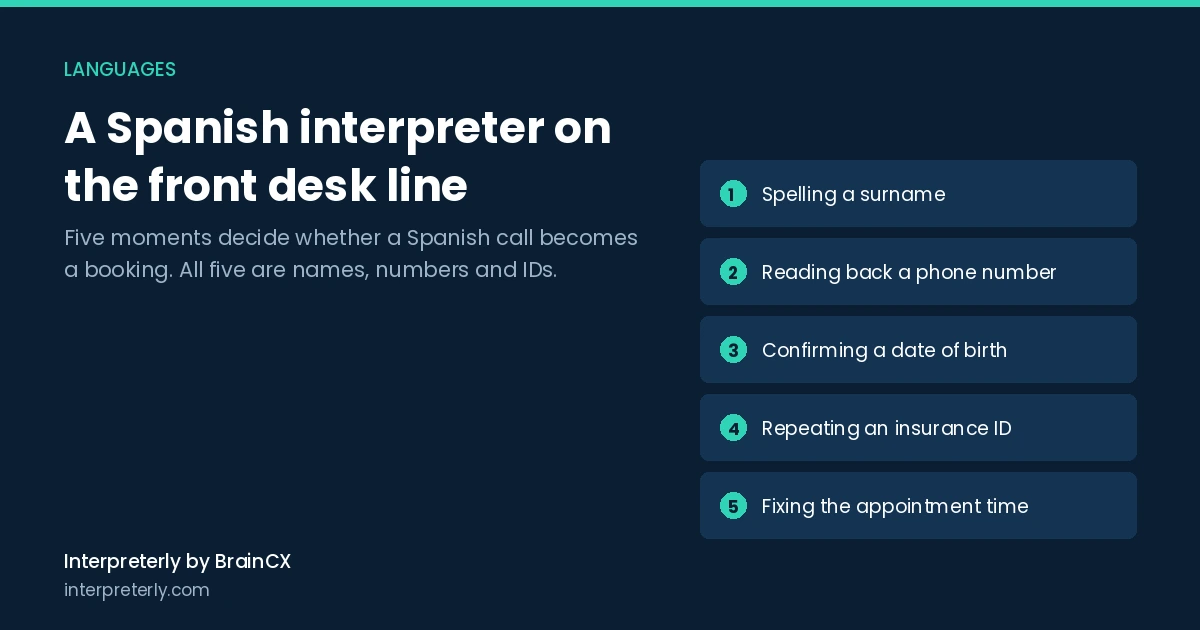
This is where accuracy on the details earns its keep. Interpreterly is tuned for around 99% accuracy on the fields that break intake calls, patient names, dates of birth, phone numbers, and insurance member IDs, and it confirms them with read-back: repeating the number or spelling back to make sure it landed correctly. That’s the same discipline a careful human interpreter uses, built into the tool. A misheard digit in a member ID isn’t a small thing; it’s a denied claim and a callback three weeks later. Getting the boring details right is most of the job.
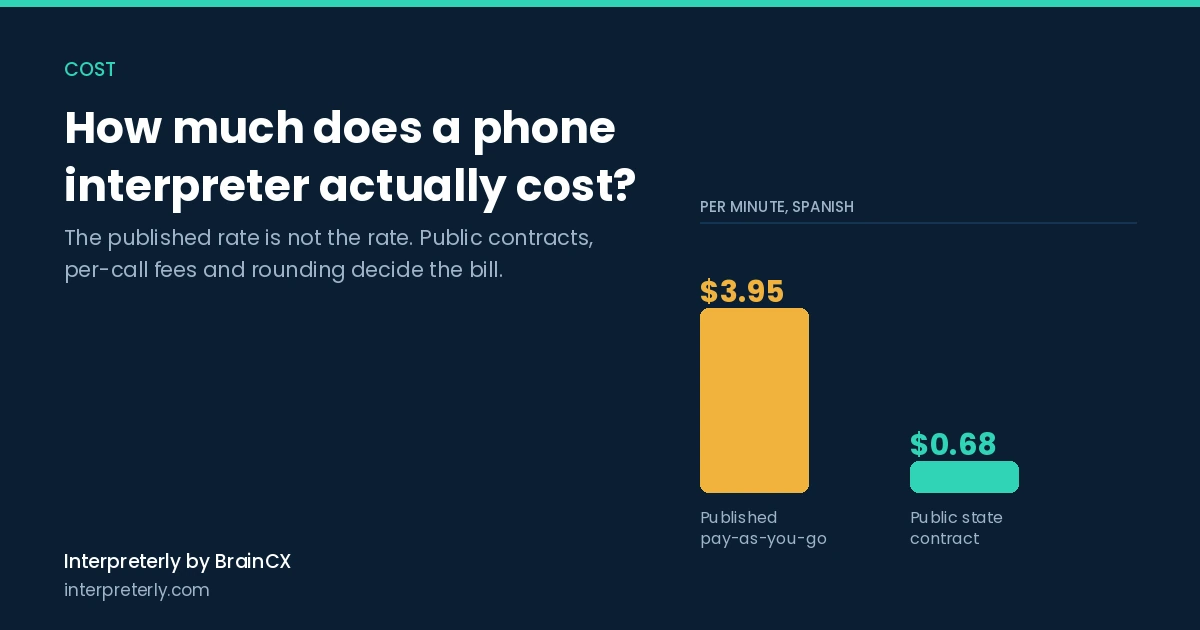
And because it’s priced as a flat monthly subscription rather than per minute, a ten-minute intake call doesn’t come with a ten-minute meter. The length of the call, which is the whole problem with intake under a per-minute model, stops being a cost consideration.
Where the human still comes in, and why that’s non-negotiable
Here’s the part a responsible vendor has to say out loud. An intake call isn’t only administrative. It often includes consent, and in behavioral health it can include sensitive history. Those pieces are not a job for AI.
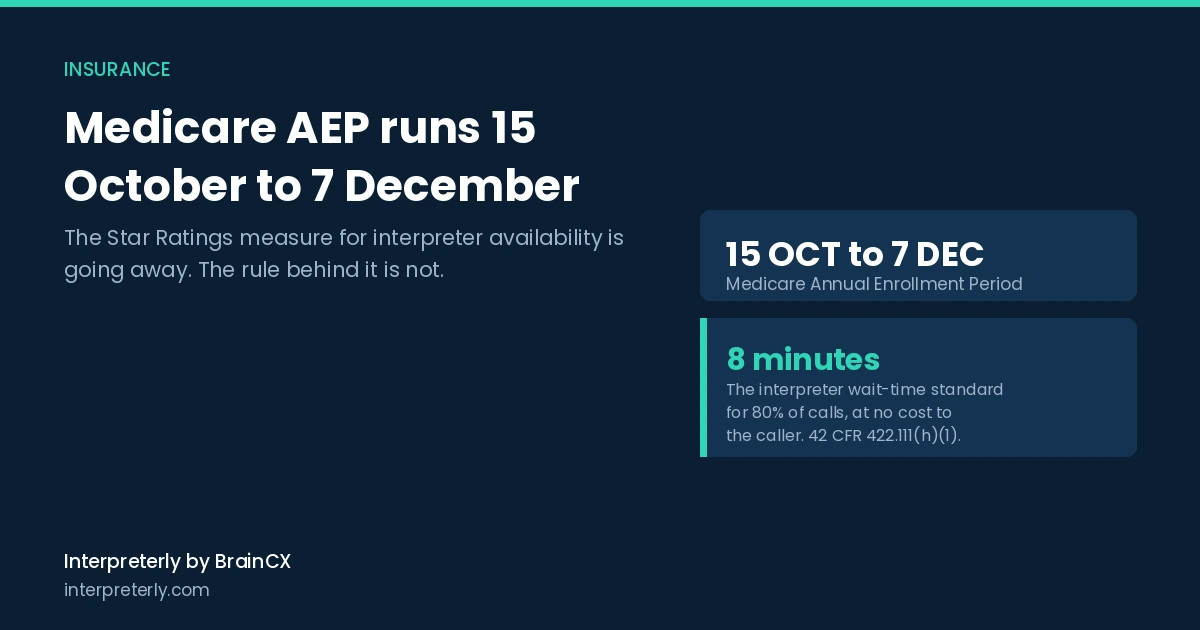
Under Section 1557 of the Affordable Care Act, informed-consent conversations and clinical discussions are the kind of consequential communications that require a qualified human interpreter. The 2024 final rule is explicit that machine translation alone does not meet that standard. And if your practice handles substance use disorder records, 42 CFR Part 2 layers on additional consent requirements that make a human interpreter the right and safe choice for those conversations. We go deeper on both in the compliance material, and for behavioral health specifically the 42 CFR Part 2 considerations matter a great deal.
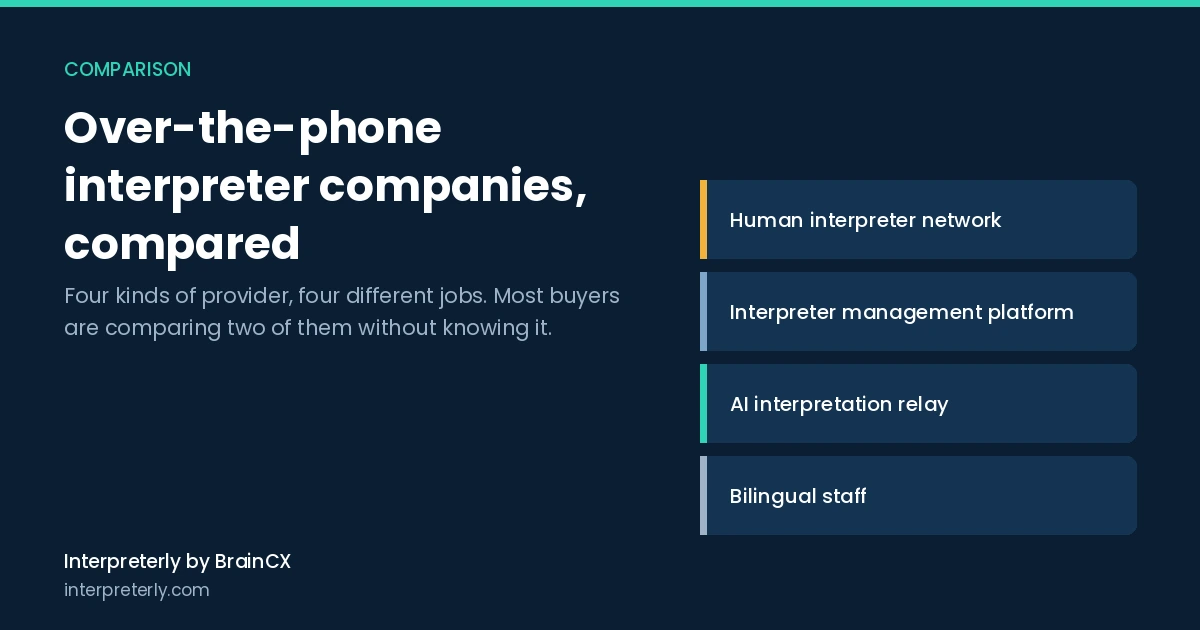
So the workable model, the one the infographic above lays out, is a split. AI carries the routine administrative portion of intake and all the scheduling around it. A qualified human interpreter handles the consent and clinical pieces. You’re not choosing between AI and humans; you’re using each for what it’s actually good at. That hybrid approach is what keeps you compliant and keeps your interpreter budget sane at the same time.
What this looks like on a real front desk
Concretely, imagine a Spanish-speaking patient calling a multi-site clinic to become a new patient. The front desk conferences in the AI interpreter and works through the administrative intake in Spanish: full name (spelled and read back), date of birth (confirmed), address, phone number (read back), insurance carrier and member ID (read back digit by digit), and the reason for the visit. The appointment gets booked, the confirmation gets communicated clearly, and the patient hangs up knowing exactly when and where to show up. None of that needed a human interpreter, and none of it ran up a per-minute bill.
When the same patient comes in and the clinician needs to discuss a diagnosis or obtain informed consent, that’s when a qualified human interpreter is brought in, in person, by video, or by phone, because that conversation legally and ethically requires one. The AI never pretended to cover it, and the practice never expected it to.
That’s the difference between a tool used honestly and a tool oversold. Used this way, AI doesn’t reduce the quality of care or dodge compliance, it expands access on the calls that make up most of the volume, and frees your qualified interpreters to focus on the conversations that genuinely need them. For a multi-site or PE-backed group, that shift compounds across every location. The AI medical interpreter for clinics page has more on how that plays out across a portfolio.
Frequently asked questions
Can AI handle a full patient intake call?
It handles the routine administrative portion, demographics, contact details, insurance capture, and scheduling, in the patient’s language, in real time. Consent conversations and clinical or substance use history should use a qualified human interpreter, because Section 1557 requires a qualified interpreter for those consequential communications and machine translation alone does not meet that standard. In practice, AI carries most of the intake and a human takes the consent and clinical pieces.
How accurate is AI on insurance IDs and phone numbers?
Interpreterly is tuned for about 99% accuracy on numbers and IDs, and it uses read-back confirmation, repeating the digits or spelling back to verify them, which is the same technique a careful human interpreter uses. On intake calls, where a single wrong digit in a member ID causes denied claims and rework, this is the capability that matters most.
Does an AI interpreter cost per minute like a human interpreter line?
No. Interpreterly is a flat monthly subscription with no per-minute fees, which is what makes it practical for long intake calls. Under a per-minute human model, a ten-minute intake is expensive precisely because it’s thorough; a flat rate removes that penalty.
Is using AI for intake compliant with HIPAA?
Interpreterly is HIPAA compliant with a BAA available, which covers how patient data on the call is protected. HIPAA is separate from Section 1557, which governs providing a qualified interpreter. You need both: a HIPAA-compliant tool for data handling, and qualified human interpreters for the consent and clinical conversations the law requires.
What languages does it support for intake?
Spanish, Brazilian Portuguese, and Haitian Creole today, the languages most common in U.S. patient intake volume, with more on the roadmap. The focus is on deeply tuned languages so accuracy on real intake detail stays high, rather than a long, shallow language list.
The bottom line
Intake is the call where multilingual communication matters most and fails most often. Real-time AI phone interpretation changes that for the administrative heart of the call, the demographics, insurance, and scheduling that make up most of the conversation and most of the errors, while keeping the cost predictable and the details accurate. The consent and clinical pieces stay with a qualified human interpreter, where they belong.
If your front desk islosing time and patients to the language barrier on intake calls, start a free 30-day trial and hear it on a real call, or talk to our team about your intake workflow and the languages your patients speak.