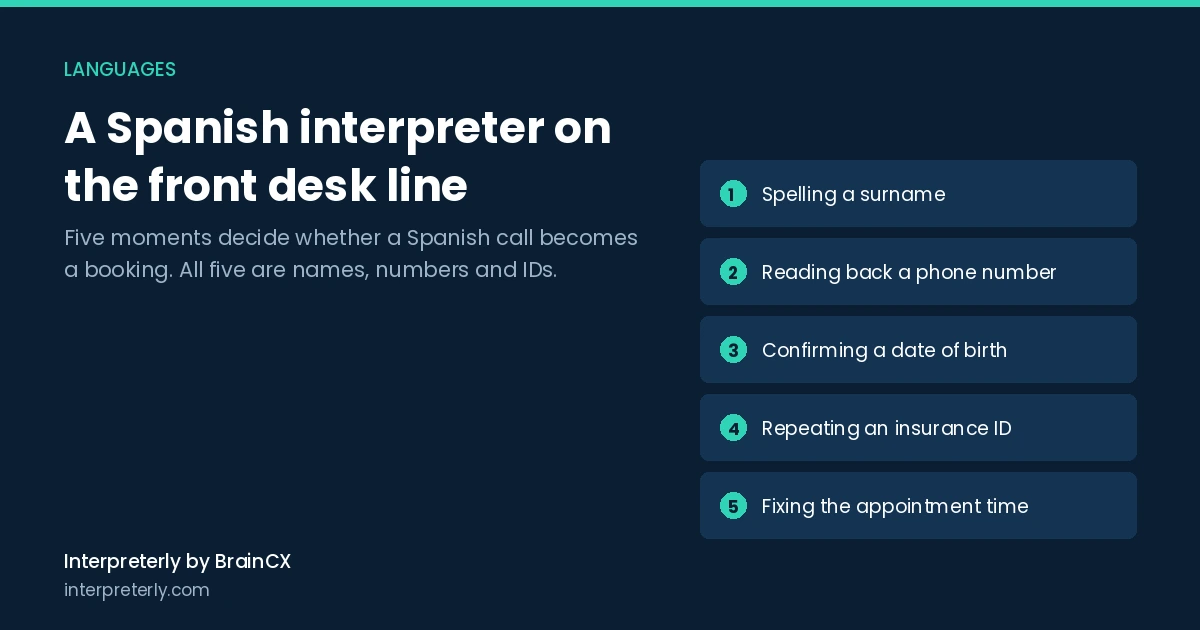
Almost every practice has one. The receptionist who speaks Spanish at home, who gets called over whenever a Spanish-speaking patient is on the line, and who has quietly become the practice’s entire language access plan.
They are probably excellent at their job. That is not the question. The question is whether the arrangement meets the standard the rule sets, and whether it survives the day she takes annual leave.
Can bilingual staff act as interpreters?
Only if they are qualified bilingual staff as the rule defines the term. Being bilingual is not enough on its own. Under 45 CFR 92.4, qualified bilingual staff means a member of the workforce designated by the covered entity to provide in-language assistance as part of their assigned job, who has demonstrated proficiency to the entity in English and the other language, including specialized vocabulary, and who can communicate effectively, accurately, and impartially with patients in their primary language.
Four elements, all of which have to be true. Most informal arrangements fail on the first two.
The four elements, read carefully
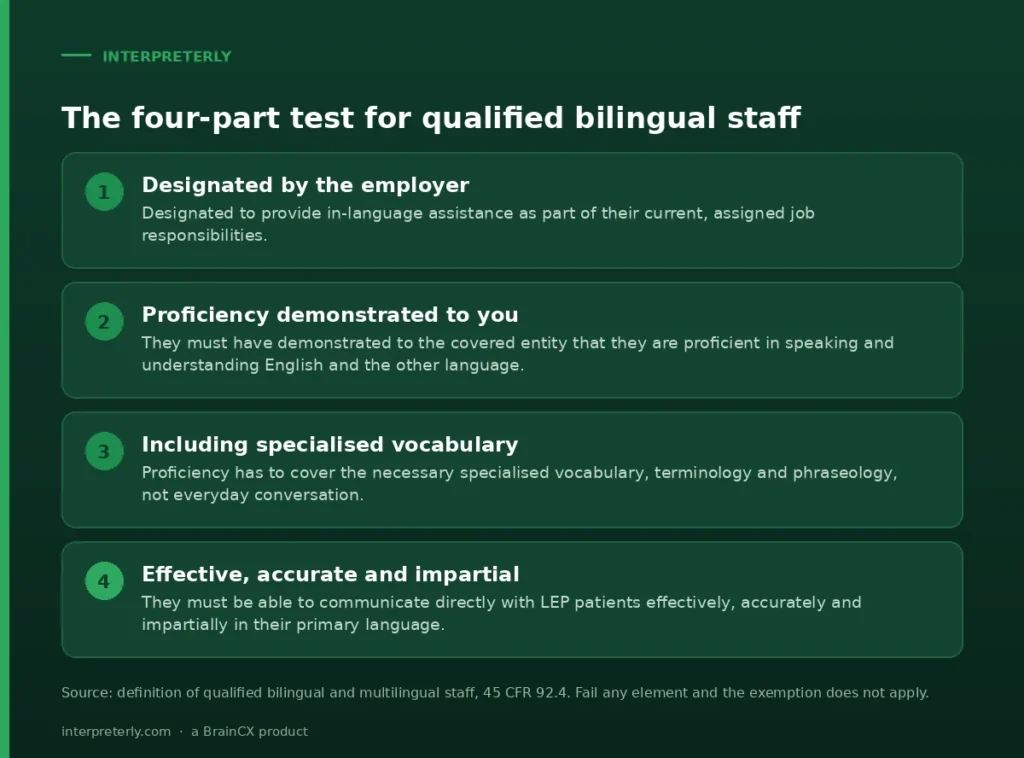
Designated. The staff member has to be designated by the practice to provide in-language assistance as part of their current, assigned job responsibilities. That means it is in the job description, not in the culture. An employee who gets waved over when Spanish is needed has not been designated. They have been volunteered.
Demonstrated proficiency to you. The rule places the burden on the covered entity. The employee must have demonstrated to the practice that they are proficient. Self-reported fluency is not a demonstration, and neither is the fact that they grew up speaking the language. Practices that take this seriously use a language proficiency assessment and keep the result on file.
Including specialized vocabulary. The definition specifies necessary specialised vocabulary, terminology and phraseology. Household Spanish and clinical Spanish are different registers. Somebody can be perfectly fluent and still not have a reliable word for anticoagulant, deductible, prior authorisation or biopsy.
Effective, accurate and impartial. The same accuracy standard the rule applies to interpreters applies here.
Fail any element and the exemption does not apply, which puts you back on 45 CFR 92.201(e)(4). A covered entity must not rely on staff other than qualified interpreters, qualified translators or qualified bilingual staff to communicate with patients who have limited English proficiency.
One distinction that trips people up
Qualified bilingual staff communicate directly with the patient in their own language. That is a different activity from interpreting between a clinician and a patient.
If your Spanish-speaking receptionist books an appointment by speaking Spanish to the patient herself, that is direct communication, and the qualified bilingual staff standard is the one that applies. If she stands next to a physician and carries the conversation both ways, she is interpreting, and the interpreter standard applies. Practices routinely slide from one into the other without noticing.
Where the accreditors sit on this
The Joint Commission takes a similar line through its human resources standards rather than a language-specific rule. Under HR.01.01.01 a hospital defines and verifies staff qualifications, and the accompanying note states that qualifications for interpreters and translators may be met through language proficiency assessment, education, training and experience.
Its own standards FAQ is worth reading directly, because it is more nuanced than the summaries suggest. There is no standard prohibiting a bilingual practitioner from speaking with a patient in their language while providing care. What is recommended is that the organization has a process to make sure the communication is effective, which may include a proficiency assessment or using an interpreter to validate the patient’s understanding.
The direction of both frameworks is the same. Both frameworks are asking whether you can show your bilingual staff meet a standard.
The cost nobody counts
Set the rule aside for a moment, because the operational case usually lands harder with an administrator than the regulatory one.
When your bilingual receptionist is interpreting, she is not answering the phone. A twelve-minute interpreted conversation is twelve minutes during which the other lines ring out, the check-in queue builds, and the front desk falls behind. The cost is real, it recurs every day, and it never appears on any invoice, which is exactly why it never gets counted.
None of that is an argument for having fewer bilingual staff. Bilingual employees are an asset and patients prefer them. It’s an argument against a single person being the plan.
What to do instead
Start by separating the calls. Informed consent, complex clinical discussion, behavioural health assessment and anything where a misunderstanding changes a decision belongs with a qualified interpreter, human, every time. Scheduling, reminders, insurance verification, billing questions and directions to the office are routine, high-volume, and they are where the front desk is drowning.
For the qualified half of that split, keep your interpreter vendor. For the routine half, there are three honest options.
The first is to formalize what you already have. Assess your bilingual staff, designate them properly, write them into the job description, and record the assessment. If they meet the standard, use them and say so in your written language access procedure.
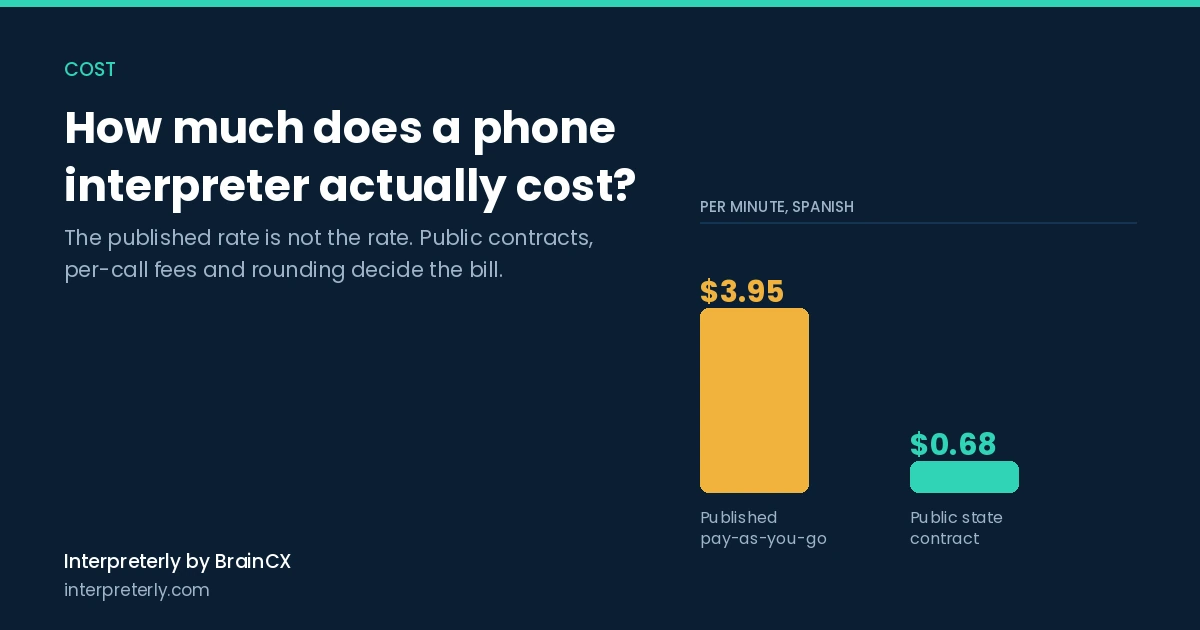
The second is to keep running routine calls through a per-minute interpreter line, which works but bills a two to five minute minimum on every call, so a thirty-second scheduling question still costs you the minimum. You can work out what per-minute interpretation is costing you against your own volume.
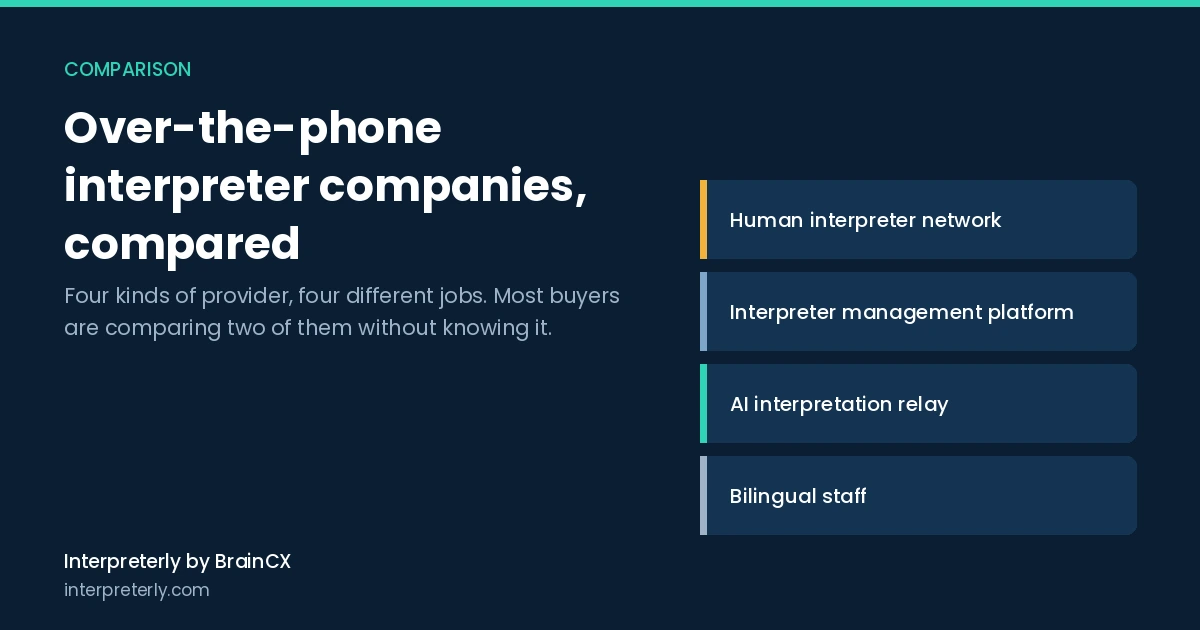
The third is to give the existing front desk live language support. Traditional interpreter companies add a third person to the phone call. AI companies replace the employee entirely. Interpreterly does neither. The employee stays on the call and we carry the language, which keeps your staff member in the conversation rather than pulling somebody off the desk to translate for her.
Interpreterly is a language-assistance tool, not a certified interpreter service, and it does not provide qualified human interpreters. Where the law requires one, use one. If you want the fuller trade-off, we set it out in the true cost of relying on bilingual staff, and our compliance approach covers HIPAA, the BAA and audit-ready transcripts.
What to write down this week
- List every person who currently interprets or communicates in a non-English language with patients.
- For each, answer two questions: is it in their job description, and have we assessed them.
- Run a proficiency assessment for anyone you intend to keep in the role, and file the result.
- Update the written language access procedure required by 45 CFR 92.8(d). It has to name your qualified bilingual staff members.
- Decide what happens when that person is out, and write that down too. That is the sentence most procedures are missing.
- Tell the front desk which call types they must not handle themselves, in plain language, with examples.
The broader picture of what the rule requires is in our guide to Section 1557 language access requirements, and the related question of what happens when a patient brings a relative is covered in the family member question.
Frequently asked questions
Can a bilingual nurse interpret for another provider’s patient?
Only if they meet the qualified bilingual staff standard or the qualified interpreter standard, depending on whether they are communicating directly or interpreting between two other people. The Joint Commission recommends that organizations define and verify those qualifications rather than assuming them.
Does the practice have to certify its bilingual staff?
The rule does not require certification. It requires the staff member to have demonstrated proficiency to the covered entity, which most practices evidence through a language proficiency assessment. Certification is one way to show it.
What if a bilingual employee refuses to interpret?
Interpreting is only part of their job if the practice designated it as such. If it was never in the role, the practice cannot rely on them for it, and the rule’s own logic supports that.
Is it acceptable for bilingual staff to handle scheduling calls but not clinical ones? Splitting call types is a sensible operational approach, and many practices do exactly that. The qualification standard still applies to whatever they do handle, so document the split in your language access procedure.
Can an AI interpreter replace bilingual staff?
No, and it is not designed to. Interpreterly carries the language so an English-speaking employee can handle routine calls without pulling a bilingual colleague off their own work. Qualified human interpreters remain necessary where the law requires them.