Bilingual call center staffing is the one lever that will not move when you need it most. If you cannot hire fast enough to cover a surge, that is not a recruiting failure, it is the structure of the problem, and no staffing plan solves it inside the window that matters.
Every workforce manager has had this week. Spanish volume jumps, hold times go vertical, and the English queue is fine. Somebody asks why you cannot move people across, and somebody else asks how fast you can hire.
Neither question has a useful answer, because the constraint is not seats. It is the language skill sitting in those seats.
Why Spanish volume does not behave like English volume
English capacity is elastic. You can offer overtime, cross-train from an adjacent queue, move staff off a lower-priority line for a day, or lean on a partner site. The lever exists because the skill is widely held across your workforce.
Spanish capacity is not elastic in the same way. Only the people who already speak Spanish can take a Spanish call, which means every one of those levers narrows to the same small group. Overtime is available only from that group. Cross-training does not apply, because you cannot cross-train a language in a week. Moving staff between queues just moves the same scarce people around.
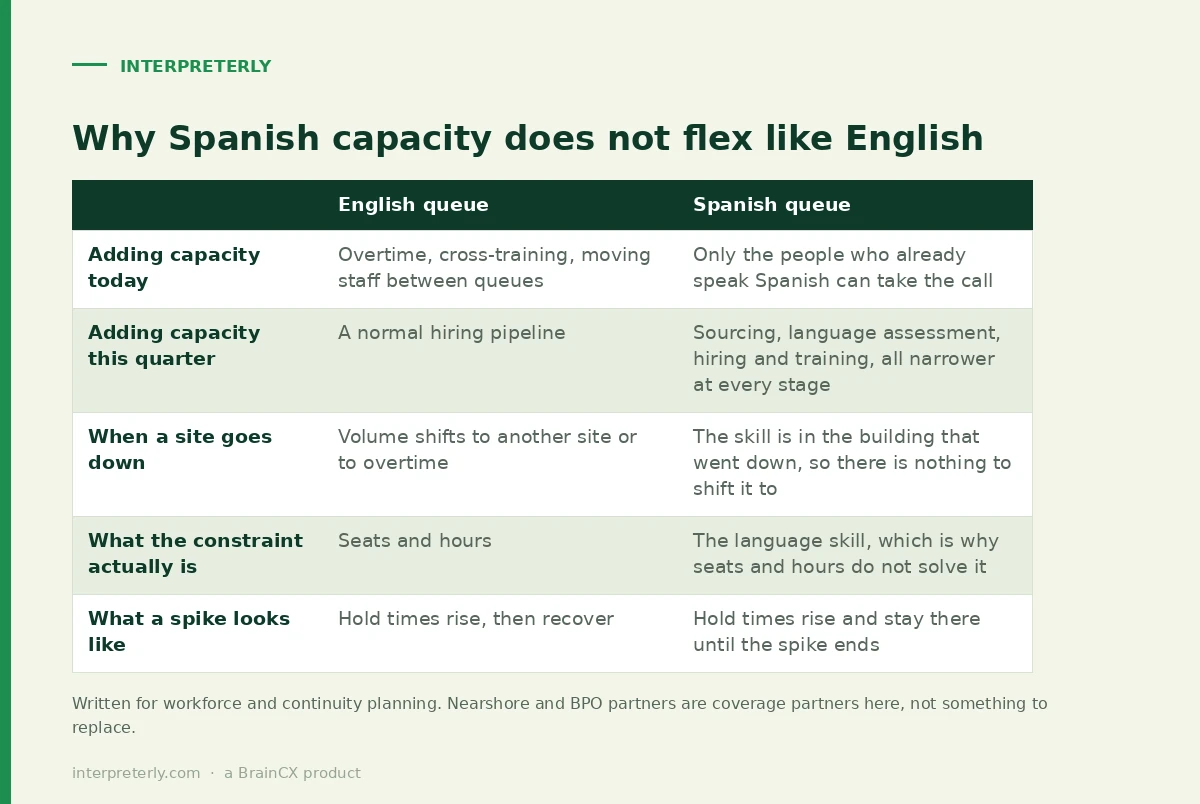
That asymmetry is the whole problem, and it shows up at four moments: a seasonal enrolment window, a storm or outage in a service territory, a billing or policy change that generates calls, and ordinary attrition in a bilingual team that is always harder to backfill than an English one.
The hiring maths does not work inside a spike
A bilingual hiring pipeline is not a slower version of an English one. It is narrower at every single stage.
The applicant pool is smaller. A language assessment is an extra step, and it fails candidates who passed everything else. The offer competes with every other employer in your market who needs the same scarce skill. Then there is onboarding and training before the new hire is productive on live calls.
Run that end to end and you are measuring in weeks. A spike is measured in days. By the time a requisition becomes a productive agent, the event that caused the spike is over, and you are carrying permanent cost for a temporary problem.
This is why “we are hiring for it” is the answer that sounds responsible in a meeting and solves nothing in the queue.
The three levers that actually exist
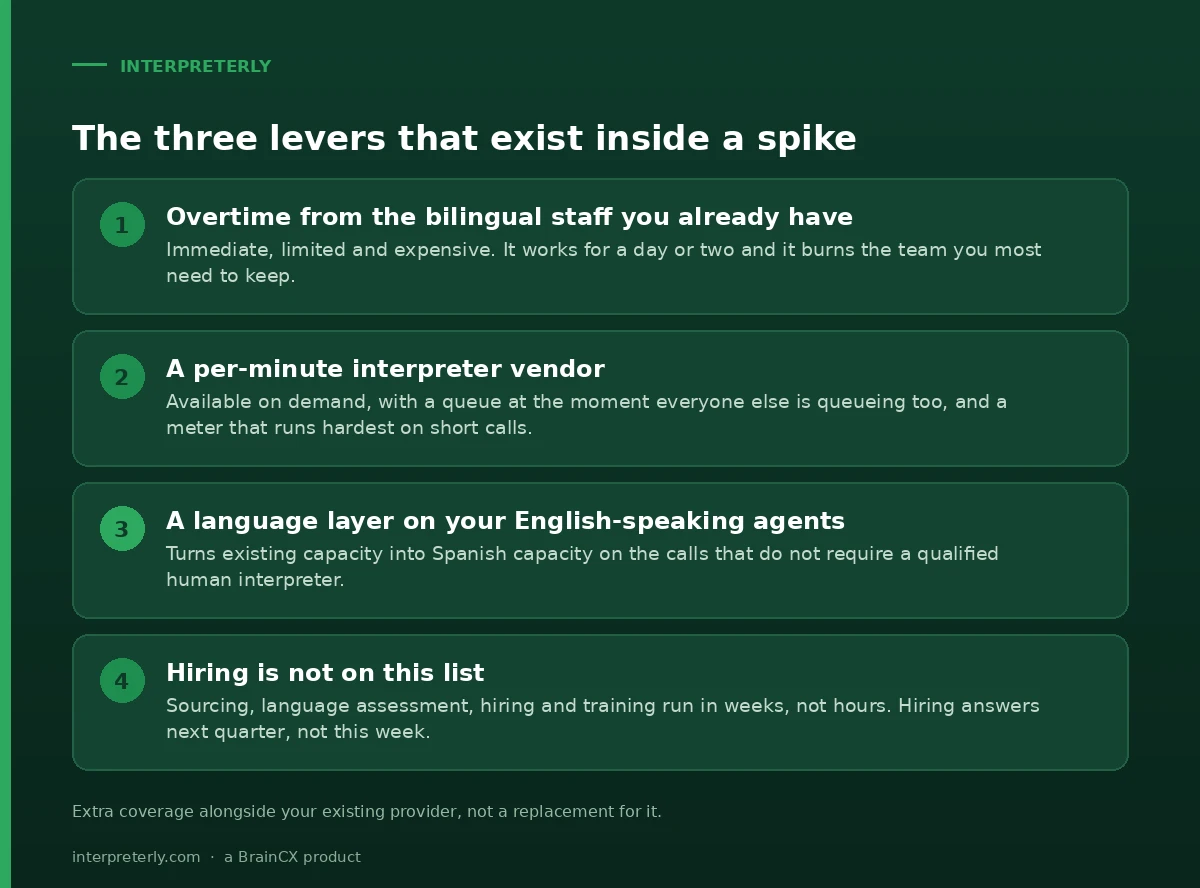
Overtime from the bilingual staff you already have. It is immediate and it is finite. It also lands hardest on the people you can least afford to lose, which is worth weighing before you lean on it for a second week.
A per-minute interpreter vendor. Genuinely available on demand, with two caveats. Everyone else hits their queue at the same moment you do, so connect times during a regional event are not the connect times in the sales deck. And a per-minute meter with a per-call minimum is punishing on short calls, which is what most spike volume is.
A language layer on the agents you already have. This turns existing English-speaking capacity into Spanish-capable capacity for the calls that do not require a qualified human interpreter. It is the only lever that scales with the headcount you already employ rather than the headcount you wish you had.
Hiring is not on the list. It is the right answer to a structural volume increase and the wrong answer to a spike.
This is a continuity question, not just a staffing one
If your Spanish coverage depends on one site, one vendor or one country, that is a single point of failure in your business continuity plan, and it is usually not written down as one.
Most continuity plans name systems, buildings and vendors. Very few name languages. The test is simple: if the site that handles your Spanish queue went offline this afternoon, where does that volume go? For English the answer is another site or overtime. For Spanish, unless a second delivery path exists, the answer is that the queue goes unanswered.
Four lines worth adding to the plan. Name which languages sit in a single site, vendor or country. Set a recovery time objective for each. Define a second delivery path that is not in the same building or the same weather system. Test the failover on a schedule, rather than discovering it during an event.
What to do between spikes
Everything useful happens before the event. Once hold times are climbing, your options are the three levers above and nothing else.
Forecast the language, not just the volume. Most workforce forecasts project total contacts and then assume the language mix holds. It often does not. Enrolment windows, billing cycles and weather events do not distribute evenly across language groups, and a service territory with a large Spanish-speaking population will see the mix shift inside a spike, not just the total.
Measure the Spanish queue separately. Blended service level hides the problem. If English is answering in 30 seconds and Spanish in nine minutes, a blended number can still look acceptable while one group of customers receives materially worse service than the other.
Know your single points of failure by name. Which languages depend on one site. Which depend on one vendor. Which depend on fewer than five people. That last one is more common than most operations teams expect, and it is the one that fails during an ordinary flu season.
Decide in advance which calls do not need a qualified human interpreter. Account balance, payment date, appointment confirmation, address change. Write that list down before a surge, because a surge is a bad time to be making policy.
Test the second path quarterly. A failover nobody has exercised is a plan, not a capability.
Where this sits next to your nearshore provider
Being direct about this, because it matters. If you run Spanish support through a nearshore partner in Colombia, Mexico or the Caribbean, that is a sound delivery model and this is not an argument to replace it.
The risk in nearshore delivery is not quality, it is concentration. A large share of nearshore Spanish capacity sits in a small number of countries and buildings, so a single weather event, power cut or outage can affect an entire language programme at once. A second delivery path that is not in the same building is exactly what a continuity plan is supposed to provide.
That is the role this plays: extra coverage for surges, outages and the gap between a resignation and a replacement. Traditional interpreter companies add a third person to the phone call. AI companies replace the employee entirely. We do neither. The employee stays on the call and we carry the language, which means your existing agents take the calls and your existing provider keeps the work it already does.
Interpreterly is a language assistance tool, not a certified interpreter service, and it does not replace a qualified human interpreter where one is required. It currently carries Spanish coverage on your existing lines and Brazilian Portuguese, with Haitian Creole coming soon. If you want to see the mechanics, here is how to conference an interpreter into a call, or talk to our team about your language mix.
Frequently asked questions
How long does it take to hire a bilingual call centre agent?
Longer than an English-only role at every stage, because the applicant pool is smaller, a language assessment screens out otherwise qualified candidates, and the offer competes with every other employer needing the same skill. Measure your own time from requisition to productive agent, then compare it with how long your spikes last.
What can we do about a Spanish call spike right now?
Three levers exist once a spike has started: overtime from existing bilingual staff, a per-minute interpreter vendor, and a language layer that lets English-speaking agents take the calls that do not require a qualified human interpreter. Hiring is not a lever inside a spike.
Why can we move staff between English queues but not Spanish ones?
Because the constraint is the language skill rather than the seat. Cross-training works for processes and systems. It does not work for a language, which is why Spanish coverage cannot flex the way English coverage does.
Should we replace our nearshore provider?
No. Nearshore delivery is strong and widely used. The risk is concentration rather than quality, so the useful addition is a second delivery path that is not in the same building or weather system, not a replacement for the provider.
What should a continuity plan say about language?
Name the languages that sit in a single site, vendor or country, set a recovery time objective for each, define a second delivery path outside that location, and test the failover on a schedule rather than during an event.