Two patients arrive at the same front desk on the same morning. One speaks only Spanish. One is Deaf and uses American Sign Language. Most organisations have a single policy covering both, and that single policy is the reason one of them gets served badly.
Effective communication and language access are different legal obligations, with different standards, different remedies and different right answers operationally. Treating them as one thing is the most common structural mistake in language access programmes.
Effective communication and language access, in one paragraph
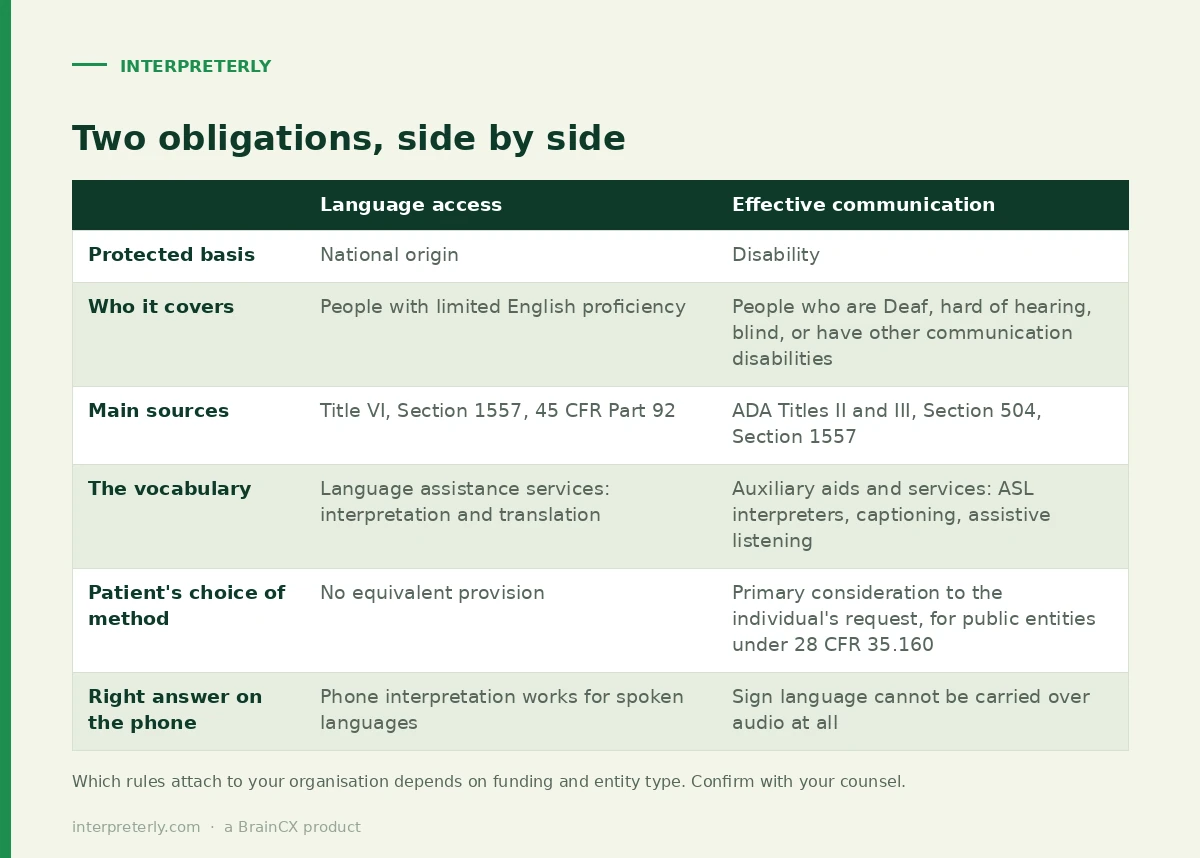
Effective communication and language access split along one line: language access is about national origin, effective communication is about disability. The first comes from Title VI of the Civil Rights Act and, in healthcare, from Section 1557. The second comes from the Americans with Disabilities Act and Section 504 of the Rehabilitation Act, and also appears inside Section 1557.
A Spanish-speaking patient is not a person with a disability. A Deaf patient is not a person with limited English proficiency, and many Deaf Americans read and write English perfectly well. Collapsing the two produces policies that offer a written handout to someone who needs an ASL interpreter, and an ASL service to someone who needed a phone interpreter in Spanish.
Where each obligation comes from
Language access. Title VI prohibits discrimination on the basis of national origin by recipients of federal financial assistance. The link to language is that treating people worse because of the language they speak can be national origin discrimination. In healthcare, Section 1557 and 45 CFR Part 92 set this out specifically, including the qualified interpreter standard and the modality requirements at 45 CFR 92.201.
Effective communication. The ADA requires public entities and places of public accommodation to furnish appropriate auxiliary aids and services where necessary to ensure effective communication with individuals with disabilities. The Department of Justice regulations are at 28 CFR 35.160 for state and local government and 28 CFR 36.303 for public accommodations. Section 504 applies to recipients of federal funding, and Section 1557 pulls the disability obligations into healthcare alongside the language ones.
So a hospital can be carrying all of these at once. A private dental practice that takes no federal money may be outside Title VI and Section 1557 entirely while still being a place of public accommodation under ADA Title III. Which rules attach to your organisation is a question for your counsel, and the answer genuinely varies.
The standards are not the same
This is where the practical difference bites.
The effective communication standard asks whether communication with the person with a disability is as effective as communication with others. The ADA regulations also require giving primary consideration to the request of the individual with a disability as to which auxiliary aid or service to use, for public entities under Title II.
Language access has no equivalent primary-consideration rule. A covered entity must provide meaningful access and use a qualified interpreter where required, but the patient does not get to select the modality in the same way.
That single difference changes front-desk behaviour. If a Deaf patient tells you they need an on-site ASL interpreter rather than video, that request carries specific weight under the ADA framework. If a Spanish-speaking patient expresses a preference between a phone interpreter and an in-person one, the analysis is different.
Where the two rules meet: video
Video remote interpreting is the place the two obligations physically overlap, and Section 1557 sets a demanding bar for it.
Under 45 CFR 92.201(f), a covered entity using video remote interpreting must provide real-time full-motion video and audio over a dedicated high-speed, wide-bandwidth connection, a sharply delineated image large enough to display the interpreter’s face, clear and audible transmission of voices, and adequate training for the people using it, free of lags, choppiness, blur and graininess. The audio-only standard at 92.201(g) is narrower.
The operational implication is blunt. A VRI deployment running over congested clinic wifi may not meet the standard the rule describes, and the rule names training as a requirement rather than an extra. We go through the cost and fit question in video remote interpreting cost versus phone.
What this means for the phone line
Here is the part that matters for anyone choosing phone-based language support.
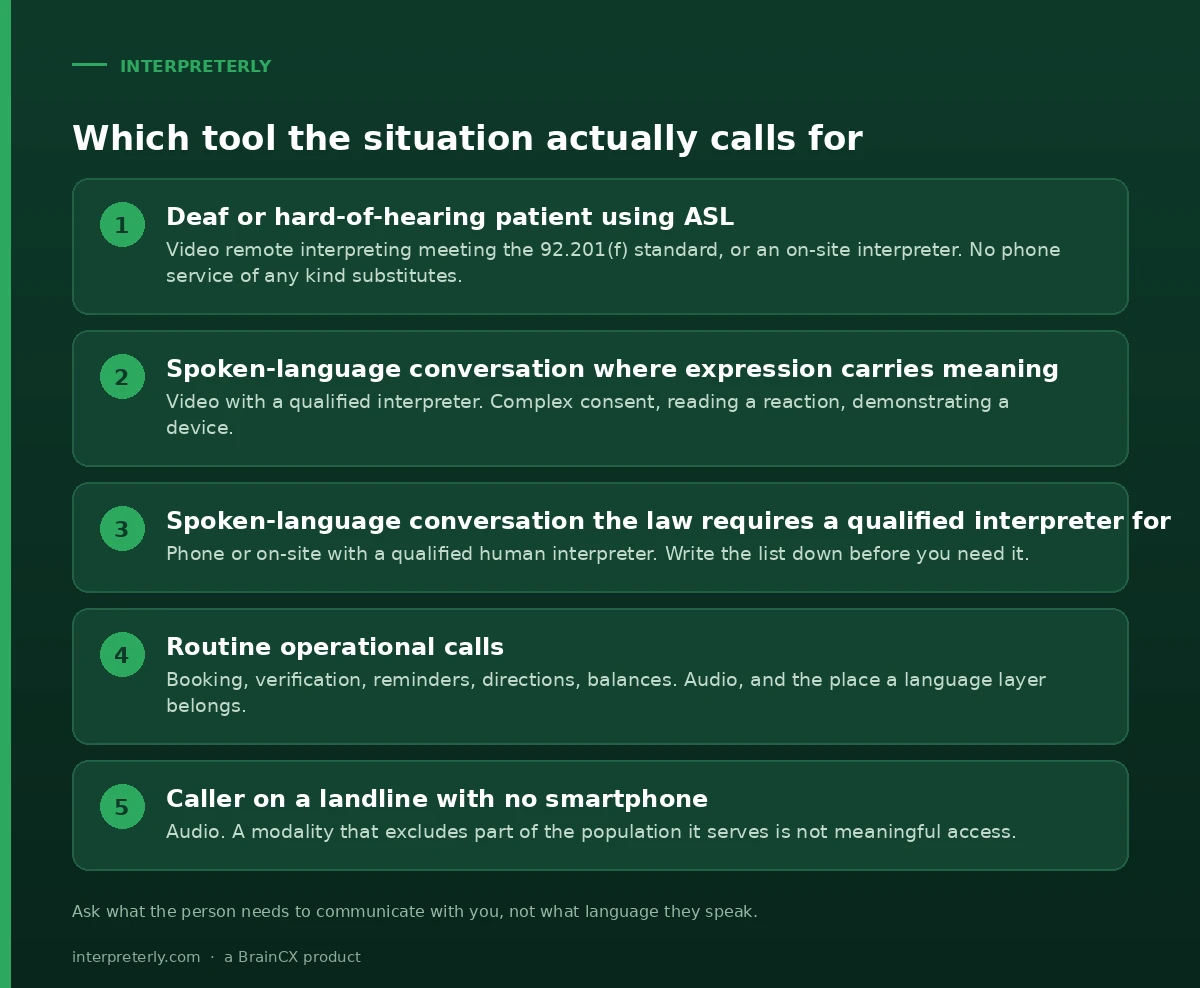
Sign language cannot be carried over an audio connection. No phone service of any kind, human or AI, is an answer for a Deaf or hard-of-hearing patient who uses ASL. That is not a limitation to work around, it is the wrong tool for the job, and a vendor who implies otherwise is selling you a finding.
Equally, video is not a better answer for a Spanish-speaking caller on a landline. It adds a device requirement and a cost for no gain, and it excludes part of the population it is supposed to serve.
The vocabulary problem
Some of this confusion is linguistic, and fixing the words fixes a surprising amount of the behaviour.
Auxiliary aids and services is disability vocabulary. It covers ASL interpreters, real-time captioning, assistive listening systems, written materials, screen reader access and more.
Language assistance services is national origin vocabulary. It covers oral interpretation and written translation for people with limited English proficiency.
Interpreter appears in both and means different things. A qualified interpreter for an individual with limited English proficiency and a qualified interpreter for an individual with a disability are defined separately in 45 CFR 92.4.
When your policy uses one word for both, staff apply one process to both. When the policy separates them, staff ask the right first question, which is not “what language do you speak” but “what do you need to communicate with us.”
What to fix in your own documents
Four things, all of them cheap.
Split the policy. One section for language assistance, one for auxiliary aids. They can live in the same document. They should not share a paragraph.
Split the intake question. Preferred language and communication needs are two fields, not one. An organisation that records only language cannot serve a Deaf patient from its own records.
Name the modality rules. Say in writing that ASL requests go to video or on-site, that primary consideration applies, and that spoken-language routine calls go to the phone route.
Train the first question. The person who picks up should be asking what the caller needs, not guessing from an accent or a name.
Our walkthrough on building a language access plan covers where both sections sit, and the regulatory overview is on our compliance overview.
Being plain about where we fit
Traditional interpreter companies add a third person to the phone call. AI companies replace the employee entirely. We do neither. The employee stays on the call and we carry the language.
Interpreterly is a language assistance tool for spoken languages on phone calls. It is not a certified interpreter service, it does not replace a qualified human interpreter where one is required, and it is not an auxiliary aid for a patient who uses sign language. Those are different needs and they need different provision, which should be named in your policy rather than left for the front desk to work out at the counter.
What it changes is the routine spoken-language volume: scheduling, verification, reminders, balance questions. You can see the mechanics in how the interpreter joins an existing call, and the honest comparison with human interpreters is in AI interpreter versus human interpreter.
This is a plain-English summary of two legal frameworks and not legal advice. Which of them applies to your organisation depends on your funding, your entity type and your state. Confirm your obligations with your own counsel.
Frequently asked questions
What is the difference between language access and effective communication?
Language access addresses national origin discrimination and covers people with limited English proficiency, through Title VI and Section 1557. Effective communication addresses disability and covers people who are Deaf, hard of hearing, blind or have other communication disabilities, through the ADA, Section 504 and Section 1557.
Is a Deaf patient covered by language access rules?
Deaf patients are covered by the disability framework and its auxiliary aids and services requirements. Many Deaf Americans are fluent English readers, so treating them as limited English proficient is both legally and practically wrong.
Can a phone interpreter be used for a Deaf patient?
No. Sign language cannot be carried over an audio-only connection. A Deaf patient who uses ASL needs video remote interpreting or an on-site interpreter, and the video standard at 45 CFR 92.201(f) sets specific quality requirements.
What does primary consideration mean under the ADA?
Under the Department of Justice Title II regulation at 28 CFR 35.160, a public entity must give primary consideration to the request of the individual with a disability as to which auxiliary aid or service to furnish. Language access rules contain no equivalent provision.
Does the ADA apply to a practice that takes no federal money?
A private healthcare practice is generally a place of public accommodation under ADA Title III, which carries effective communication obligations regardless of federal funding. Title VI and Section 1557 turn on federal financial assistance. Confirm your own position with counsel.
Should language preference and communication needs be separate fields?
Yes. They describe different things, trigger different obligations and lead to different services. Recording only language means your records cannot tell you that a patient needs an ASL interpreter.
Regulatory citations were checked against the published Code of Federal Regulations on the date of writing. This article is not legal advice. Confirm your specific obligations with your own counsel.