Most of what is written about an interpreter for dental office use is really written for hospitals. Dental is a different operation, and the difference is the phone.
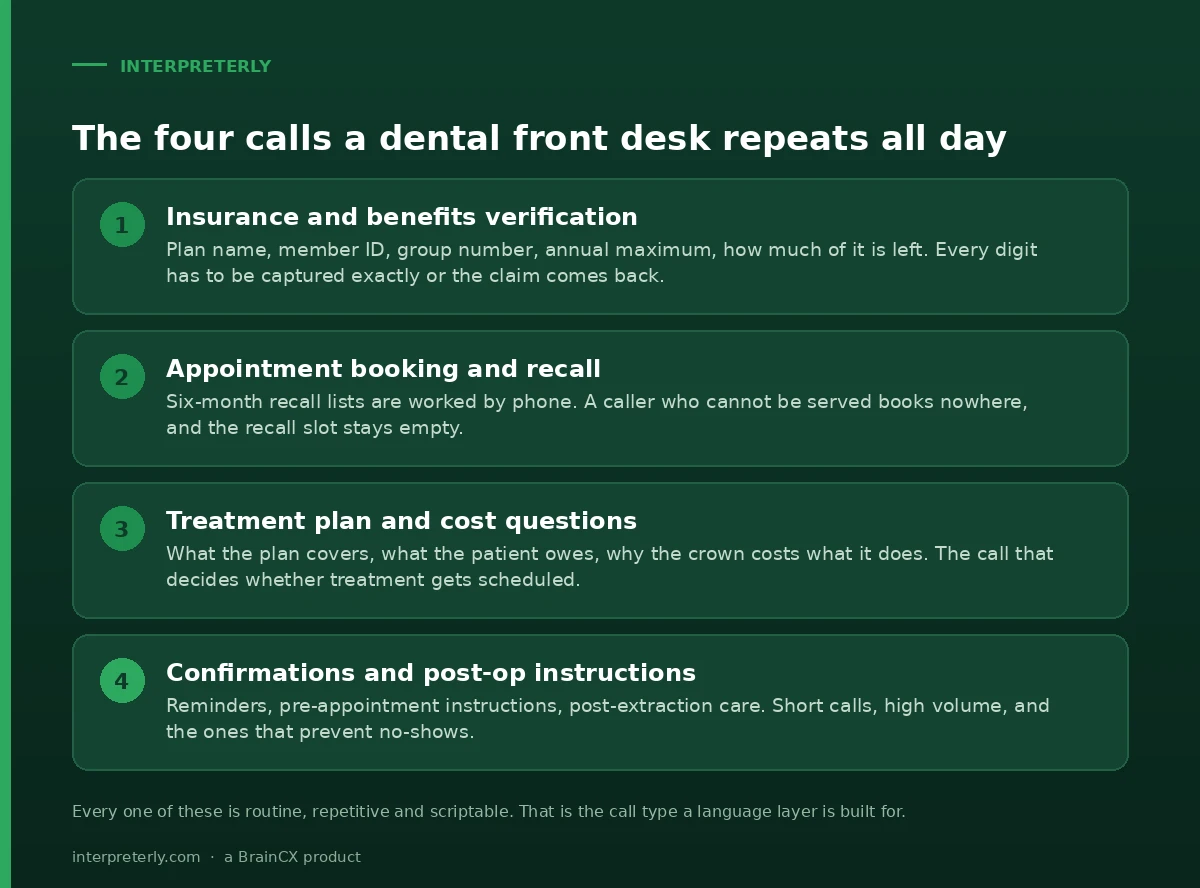
A dental front desk runs on the phone. Benefits verification, recall lists, treatment plan questions, confirmations. None of it is clinical, all of it is repetitive, and every one of those calls has to be handled correctly or the chair sits empty.
When a Spanish-speaking patient calls a practice with an English-only front desk, none of that work can happen. The call ends in a promise to call back, and the appointment is lost before anyone sits down.
Why dental gets hit harder than general medical
Three things make a dental practice unusual, and all three make the language problem worse.
The benefits call is a data-entry exercise. Plan name, member ID, group number, annual maximum and how much of it is left. Every character has to be captured exactly. A misheard digit does not fail on the call, it fails as a rejected claim weeks later, and the practice ends up chasing a balance the patient did not expect.
Recall is the business model. Six-month recall lists are worked by phone. Each caller your front desk cannot serve is a hygiene slot that stays open, and recall revenue is the most predictable revenue a practice has.
Treatment plans are sold on the phone. A crown, a bridge, an implant. The conversation about what the plan covers and what the patient owes is the conversation that decides whether treatment gets scheduled at all. That is a hard conversation in a second language and an impossible one through a language barrier.
Where the appointment is actually lost
It is rarely a single dramatic failure. It is five small ones, and each has a fix that costs nothing clinically.
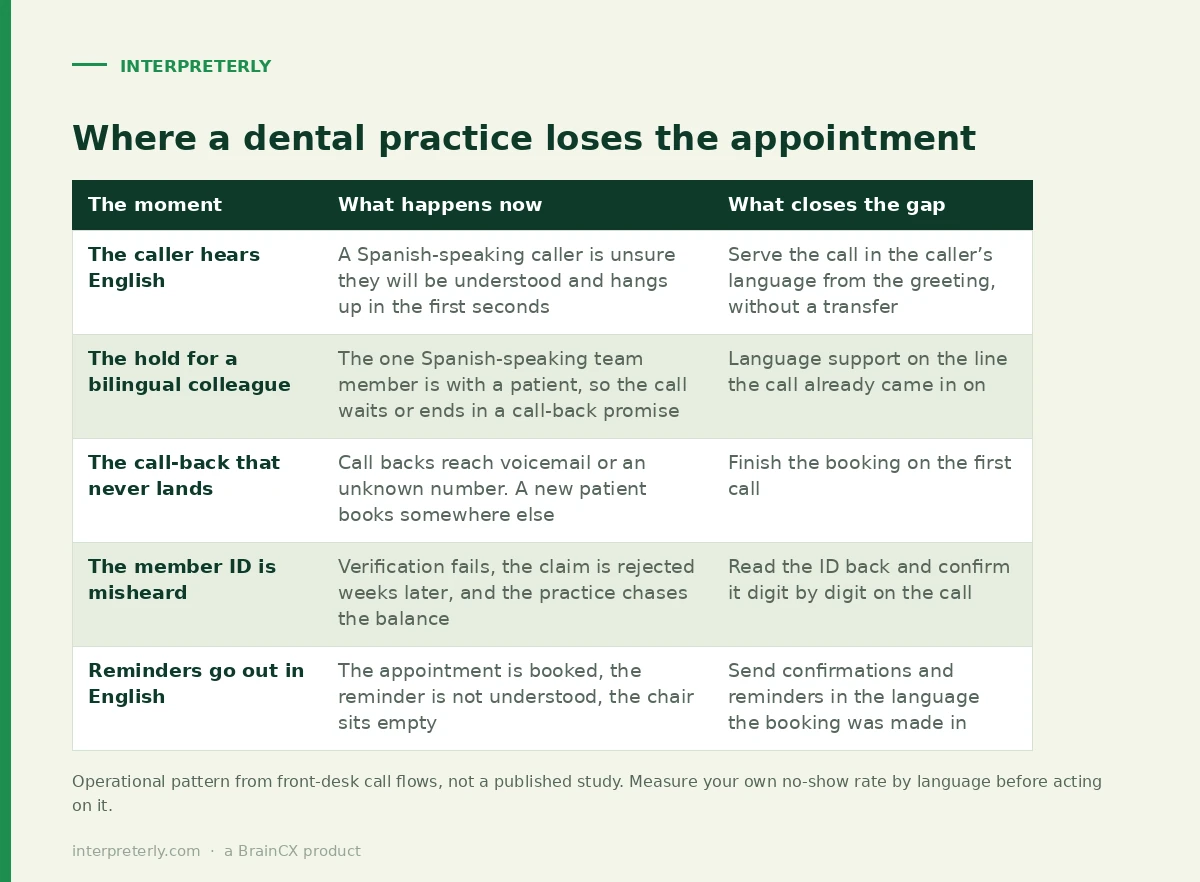
The pattern worth paying attention to is the call-back promise. It is made in good faith, it feels like service, and it is where most new patients disappear. A caller who was told someone would ring back does not wait. They call the practice down the road that answered them in Spanish.
The bilingual team member is not a strategy
Most practices in a Spanish-speaking area already have one person who takes the Spanish calls. That person is usually excellent, and they are also a single point of failure.
They cover one shift, at one location, in one language. When they are with a patient, the call waits. When they are on holiday, there is no coverage at all. And when they leave, the practice discovers it had a person rather than a plan.
There is a compliance dimension too, and it is worth knowing even though dental practices rarely think of themselves as being in scope. A practice that receives federal financial assistance is a covered entity under Section 1557 of the Affordable Care Act, and the rule sets a standard for qualified bilingual staff: the employee has to be designated to provide in-language assistance as part of their job and have demonstrated proficiency to the practice, including specialised vocabulary. Conversational fluency on its own does not meet it. We cover that in detail in the true cost of relying on bilingual staff. This is a plain-English summary, not legal advice, so confirm your own position with your counsel.
What the numbers look like on a dental desk
Run your own arithmetic before anyone sells you anything. Three figures tell the whole story.
Calls per day in your second language. Pull last month’s log. Add the calls that ended in a call-back promise, because those are the ones nobody counts.
Average call length. On a dental front desk this is typically short. Confirmations and recall calls run under two minutes, which matters enormously for how you pay for language support.
What you pay per call, not per minute. This is the figure that exposes the problem with per-minute interpretation on a dental desk. LanguageLine publishes $3.95 per minute on its self-service tier, and where a contract carries a per-call minimum, a forty-second confirmation call bills at the minimum every time. You can estimate your savings against your own volume in a couple of minutes.
What changes when you run more than one location
A single practice can sometimes get away with the bilingual-coordinator arrangement. A group cannot, and the reason is arithmetic rather than policy.
Across ten locations you do not need one bilingual coordinator, you need ten, on every shift, which is a hiring problem nobody solves. Central scheduling teams hit the same wall from the other direction: one pooled phone team serving every location means the Spanish-speaking caller is routed to whoever is free, and whoever is free usually cannot help them.
There is also a reporting problem. Group operators are measured on conversion from call to booked appointment, and on recall effectiveness by site. If language is the reason one location underperforms on both, nothing in the standard report will say so. The call simply does not convert, and the dashboard shows a low number with no cause attached.
Three things worth adding to your own reporting before you decide anything: calls by language, call-back promises made versus appointments actually booked, and no-show rate split by the language the booking was made in. Those three numbers turn an anecdote into a business case.
What good looks like on a dental front desk
The target is simple. Every caller is served on the first call, in the language they called in, by the person who picked up.
That means no transfer, no hold for a colleague, and no call-back. It means the member ID is read back and confirmed digit by digit before the call ends. It means the confirmation and the reminder go out in the language the booking was made in, because a reminder nobody can read does not prevent a no-show.
Traditional interpreter companies add a third person to the phone call. AI companies replace the employee entirely. We do neither. The employee stays on the call and we carry the language. For a dental desk that is the point: your coordinator keeps the relationship with the patient and keeps control of the booking, and the language stops being the thing that ends the call.
Interpreterly is a language assistance tool, not a certified interpreter service, and it does not replace a qualified human interpreter where one is required. Clinical consent conversations belong with a qualified interpreter. Booking, verification, recall and reminders are the routine volume this is built for. If you want the mechanics, see AI interpreter for dental offices, or see current pricing.
A week-one checklist
None of this requires a vendor decision. Do it first and the decision gets easier.
Count the calls. Last month’s log, calls in your second language, plus the ones that ended in a promise to call back. The second figure is usually the larger problem and it is never in a report.
Time the workaround. How long does the current process take from a Spanish-speaking caller reaching your desk to someone who can help them being on the line? Measure it at 8am and at 4pm, not at a quiet moment.
Check the reminder pipeline. If a patient books in Spanish, what language is the confirmation in? What language is the reminder in? This is often a five-minute fix in your practice management software and it moves the no-show rate on its own.
Write down who interprets today. Name them, check it is in their job description, and confirm whether their proficiency has ever been formally assessed and recorded. That record is what the qualified bilingual staff standard turns on.
Divide last month’s interpretation invoice by the number of calls. That single figure, cost per call rather than cost per minute, is the one to compare against anything you are offered.
Frequently asked questions
Do dental offices need an interpreter for Spanish-speaking patients?
A dental practice that receives federal financial assistance is a covered entity under Section 1557 of the Affordable Care Act and must take reasonable steps to provide meaningful access to patients with limited English proficiency, free of charge. Whether a specific practice is covered is a question for your own counsel.
Can our bilingual dental assistant interpret for patients?
Only if they meet the qualified bilingual staff standard, which requires the practice to designate them for in-language assistance as part of their job and to have confirmed their proficiency, including specialised vocabulary. Being conversationally bilingual is not enough on its own.
What does an interpreter cost for a dental office?
Per-minute interpretation is commonly quoted around $3.95 per minute on published self-service rates, and many contracts add a per-call minimum that bills short calls at several times their length. On a dental desk, where most calls run under two minutes, the minimum usually matters more than the rate.
How do Spanish-speaking patients affect the no-show rate?
Confirmations and reminders sent in English to a patient who booked in Spanish are a common and avoidable cause of missed appointments. Measure your no-show rate by language before assuming the cause is anything else.
Does an AI interpreter work for insurance verification calls?
Verification calls are routine, repetitive and heavy on identifiers, which is the call type an AI language layer is designed for. The detail that matters is read-back confirmation on member IDs and numbers, so errors are caught on the call rather than in a rejected claim.