Most language access plans are written to be filed, not used. They run to thirty pages, they quote the regulation back at itself, and nobody at the front desk has read one.
The useful version is shorter than you think and answers one question: when a caller cannot be served in English, what happens next? If your document answers that in a way a new hire can follow on their second day, it is doing its job.
What a language access plan actually is
It is the written procedure that says how your organisation provides language assistance, who is responsible, and what staff do in the moment.
For healthcare organisations the requirement sits at 45 CFR 92.8, which obliges covered entities to have written policies and procedures, including language access procedures. That is the hook. But the reason to write a good one is not the regulation. It is that a language plan which lives only in one bilingual employee’s head stops working the day they take leave.
Two things a plan is not. It is not a vendor contract, and it is not a statement of intent. A paragraph saying the organisation is committed to serving diverse communities is not a procedure, because nobody can follow it.
The seven sections that earn their place
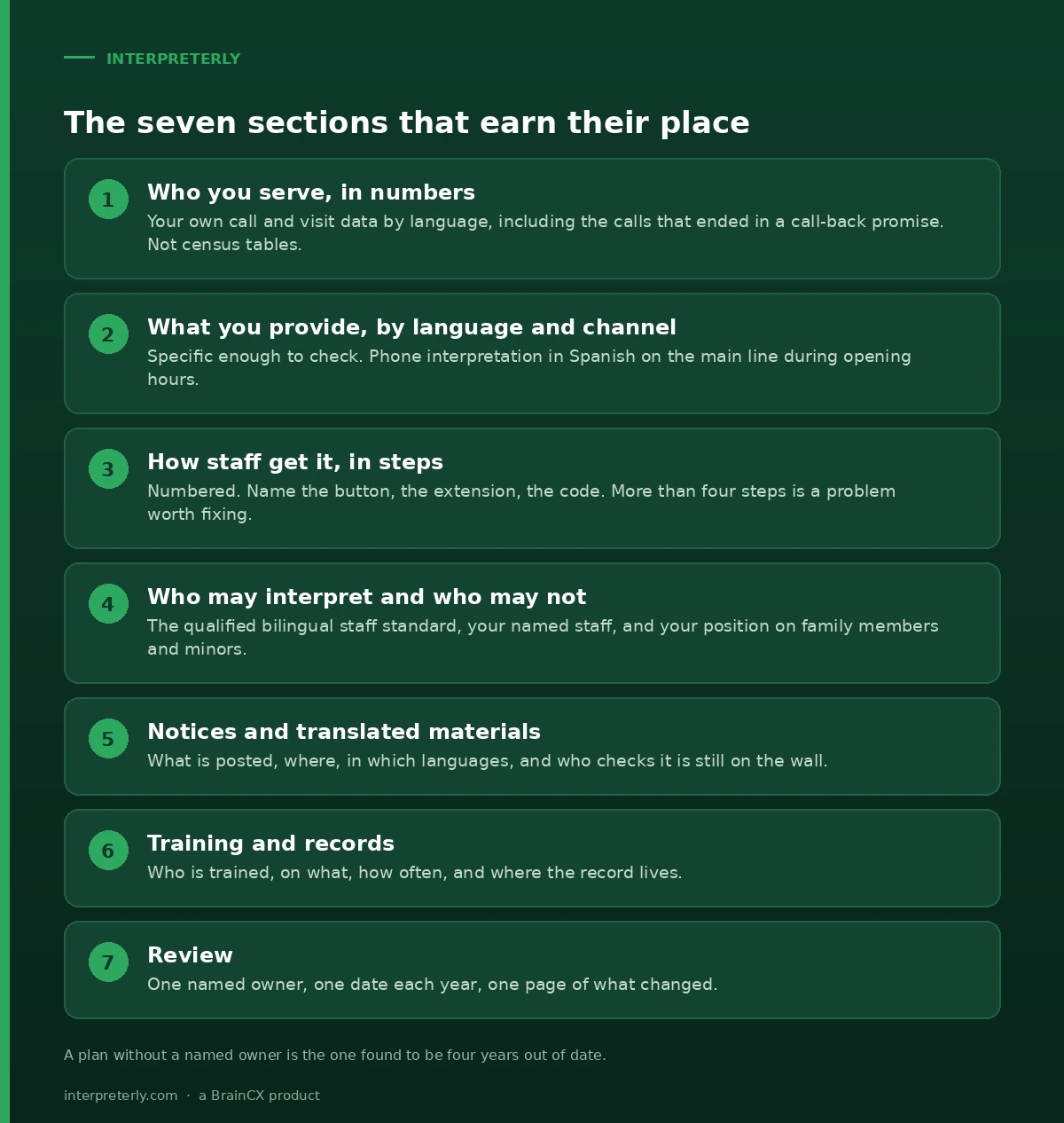
1. Who you serve, in numbers. Start with your own data, not census tables. Pull last quarter’s calls and visits and count them by language. Add the ones that ended in a call-back promise, because those are the encounters your systems did not record as language events. If you have never counted, that exercise alone will change the plan.
2. What you provide, by language and channel. Be specific. Phone interpretation in Spanish on the main line during opening hours is a statement someone can check. Language services available as needed is not.
3. How staff get it, in steps. This is the section people actually read. Number the steps. Name the button, the extension, the code. If it takes more than four steps, your plan has identified a problem worth fixing before you finish writing.
4. Who may interpret and who may not. Write down the qualified bilingual staff standard and name the people who meet it. Write down your position on family members and on minors. The rules on when a patient may bring their own interpreter have real exceptions, and your front desk needs the script, not the citation.
5. Notices and translated materials. What is posted, where, in which languages, and who checks it is still on the wall. The notice of availability requirement has specific content and placement rules.
6. Training and records. Who is trained, on what, how often, and where the record lives.
7. Review. One named owner, one date each year, one page of what changed.
The section everyone skips
After hours.
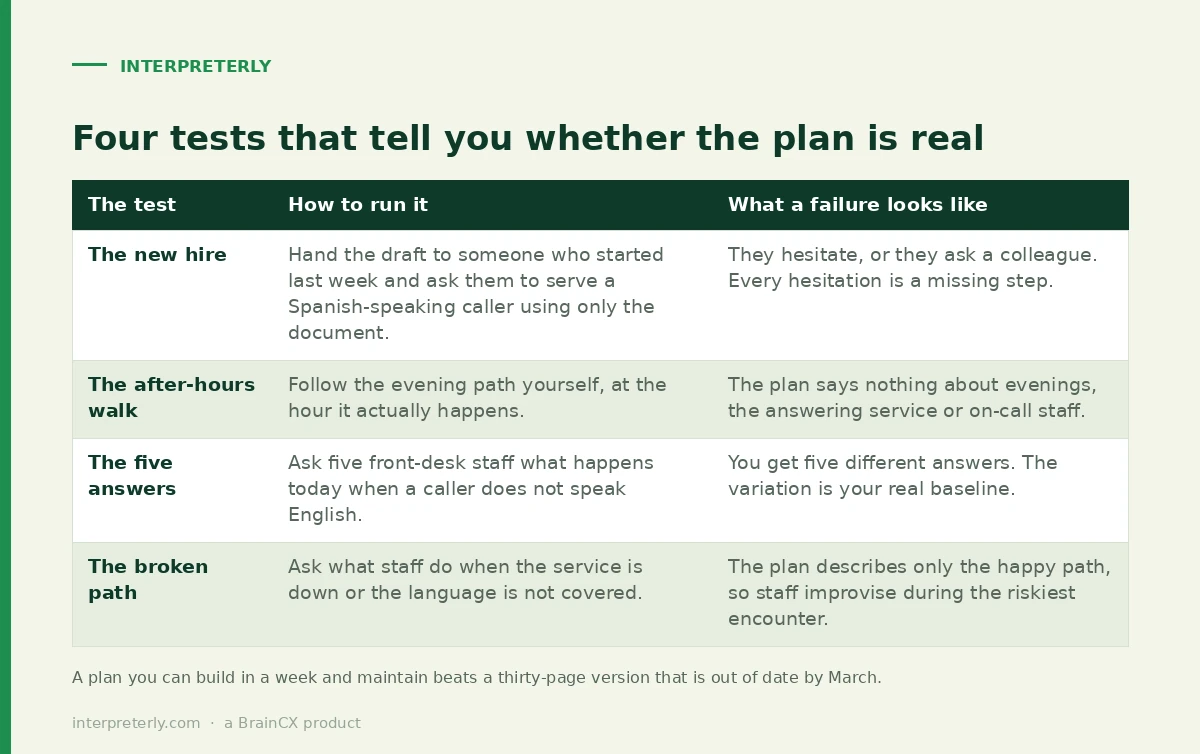
Almost every language access plan describes the daytime front desk. Almost none describes the 7pm call, the weekend line, the answering service, or the on-call clinician returning a message. Those are exactly the moments when the bilingual coordinator is not there, and they are disproportionately where the serious misunderstandings happen.
If your plan has one gap, this is it. Write the after-hours path explicitly, even if the path is “the answering service uses the interpretation line and logs the language.”
Write it so a new hire can follow it
A test worth applying before you circulate the draft. Hand it to someone who started last week and ask them to serve a Spanish-speaking caller using only the document. Watch where they hesitate.
Three habits that make the difference.
Use the words your staff use. If the team calls it “the language line,” call it that in the document and put the formal term in brackets once.
Put the steps where the work happens. The full plan can live in the policy folder. The four steps belong on a card at the desk and in the phone system’s help screen.
Say what to do when the normal route fails. The service is down, the language is not covered, the caller hangs up. A plan that only describes the happy path leaves staff improvising in the exact situation that creates risk.
Counting what you serve, honestly
The weakest part of most plans is the first section, because the data is harder to get than it looks.
Your practice management system probably has a preferred language field. It is probably mostly empty or mostly set to English by default. That is not a reason to skip the count, it is the first finding of the review.
Three sources that are usually available. Call logs, which tell you volume and time of day. Interpretation invoices, which tell you which languages were served and at what cost. And your staff, who can tell you in ten minutes which languages come up and which calls go badly, and who are almost never asked.
Once you have the count, the cost question becomes answerable rather than theoretical. Our interpretation cost calculator takes your own call volume, and the arithmetic behind it is in what phone interpretation actually costs per minute.
The staffing section needs to be honest
Most plans contain a sentence like “bilingual staff are available to assist.” It is the sentence most likely to be wrong.
The qualified bilingual staff standard requires that the employee is designated to provide language assistance as part of their job and has demonstrated proficiency to the organisation, including specialised vocabulary. Conversational fluency on its own does not meet it. We go through this in why a bilingual receptionist is not automatically a qualified interpreter.
So the honest version of that section names the people, states whether their proficiency has been assessed and recorded, and says what happens when they are not available. If the answer to the last part is “nothing,” you have found the gap your plan exists to close.
What a plan looks like when it is working
Traditional interpreter companies add a third person to the phone call. AI companies replace the employee entirely. We do neither. The employee stays on the call and we carry the language.
The practical signature of a working plan is that the number of call-backs for language reasons drops to near zero, because the person who picks up can finish the call. Interpreterly is a language assistance tool, not a certified interpreter service, and it does not replace a qualified human interpreter where one is required. Clinical consent conversations belong with a qualified interpreter and your plan should say so. Routine operational calls are the volume a language layer is built for, and you can see the setup in how the interpreter joins the call.
Whatever route you choose, the plan is the thing that survives staff turnover. The vendor is replaceable. The document is what makes the service repeatable.
This is a plain-English guide and not legal advice. Requirements differ by organisation type, funding source and state. Have your counsel review the finished plan.
A one-week build
Day one. Pull the call and visit data by language, including call-back promises.
Day two. Ask five front-desk staff what happens today when a caller does not speak English. Write down all five answers. The variation between them is your real baseline.
Day three. Draft sections one to four. Keep it to four pages.
Day four. Walk the after-hours path yourself, at the hour it actually happens.
Day five. Hand the draft to a recent hire and watch them use it. Fix what they stumble on, then send it to counsel.
The plan you can build in a week and actually maintain beats the thirty-page version that is out of date by March.
Frequently asked questions
What is a language access plan?
A written procedure setting out how an organisation provides language assistance to people with limited English proficiency: who you serve, what you provide, the steps staff follow, who may interpret, what is posted, how staff are trained, and when the plan is reviewed.
Is a language access plan required?
For covered entities under Section 1557, 45 CFR 92.8 requires written policies and procedures including language access procedures. Other obligations may apply depending on your funding and your state. Confirm your position with your counsel.
How long should a language access plan be?
Short enough to be used. Four to eight pages covering the seven sections is more effective than thirty pages of restated regulation, because the test of a plan is whether a new hire can follow it unaided.
Who should own the language access plan?
One named person, usually the compliance lead or practice administrator, with a fixed annual review date. Plans without a named owner are the ones found to be four years out of date.
What is the most common gap in a language access plan?
After-hours coverage. Most plans describe the daytime front desk and say nothing about evenings, weekends, the answering service or on-call staff, which is when the bilingual employee is least likely to be available.
Does a language access plan need to list every language?
It should state which languages you actively provide for and how you handle a language you do not cover. A plan that silently omits the second case leaves staff improvising during the encounter most likely to go wrong.
This article summarises public requirements in plain English and is not legal advice. Confirm your specific obligations with your own counsel.