Your telehealth platform has a three-way call feature. That is not a language access programme, and the gap between the two is where most virtual care organisations are quietly failing patients.
Telehealth language access got its own provision in the 2024 Section 1557 rule, and the quality standards for video and audio were tightened at the same time. Meanwhile the operational reality is that a patient who cannot complete the pre-visit technology check in their own language never reaches the appointment at all.
What the rule says about telehealth language access
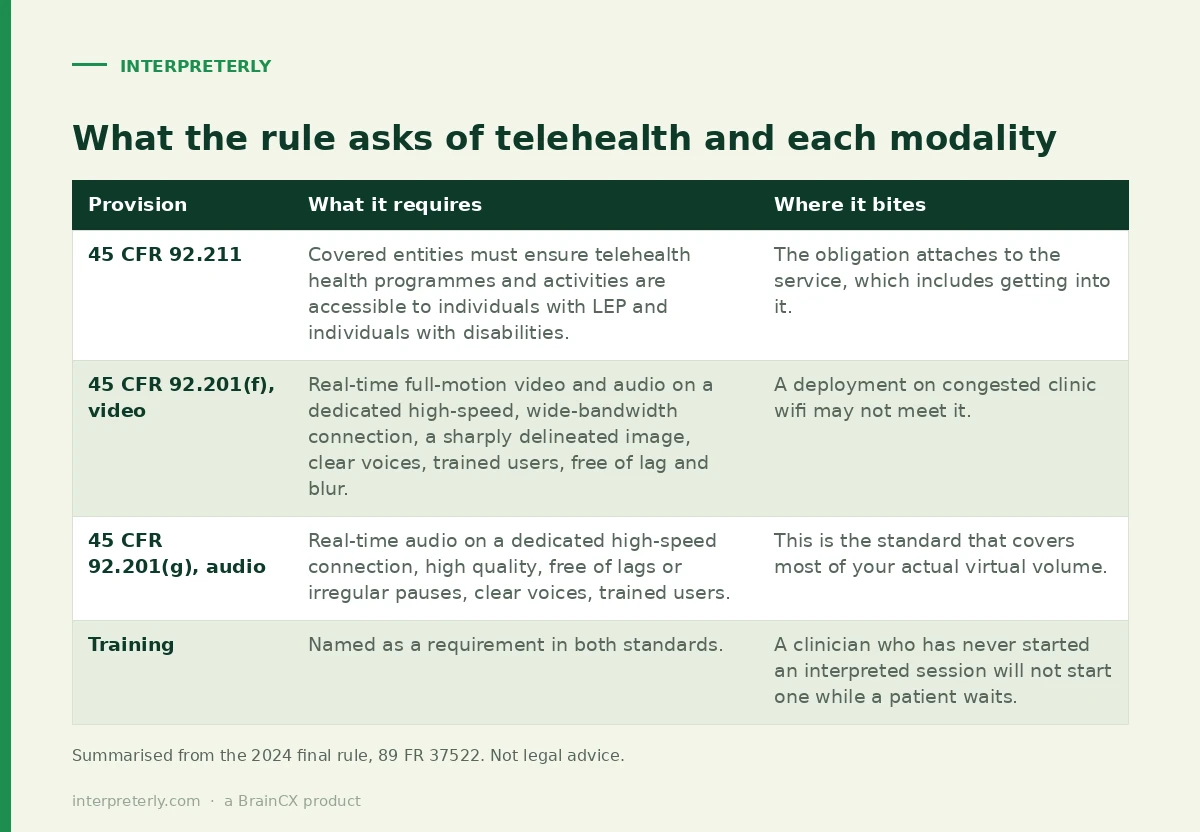
The 2024 final rule added 45 CFR 92.211, which addresses telehealth services and requires covered entities to ensure that the health programmes and activities they provide through telehealth are accessible to individuals with limited English proficiency and to individuals with disabilities, unless doing so would result in a fundamental alteration or undue burden.
Read that against how telehealth is actually deployed. The accessibility obligation does not attach only to the clinical encounter. It attaches to the service, which includes getting into it.
Alongside it, the modality standards at 45 CFR 92.201 still apply. Under 92.201(f), video remote interpreting requires real-time full-motion video and audio over a dedicated high-speed, wide-bandwidth connection, a sharply delineated image large enough to display the interpreter’s face, clear and audible transmission of voices, and adequate training for users, free of lags, choppiness, blur and graininess. Under 92.201(g) the audio-only equivalent is narrower but still requires a dedicated high-speed connection, clear transmission and trained users.
Training is a named requirement in both. That is worth sitting with, because it is the requirement telehealth deployments fail most often.
The five places telehealth loses a patient
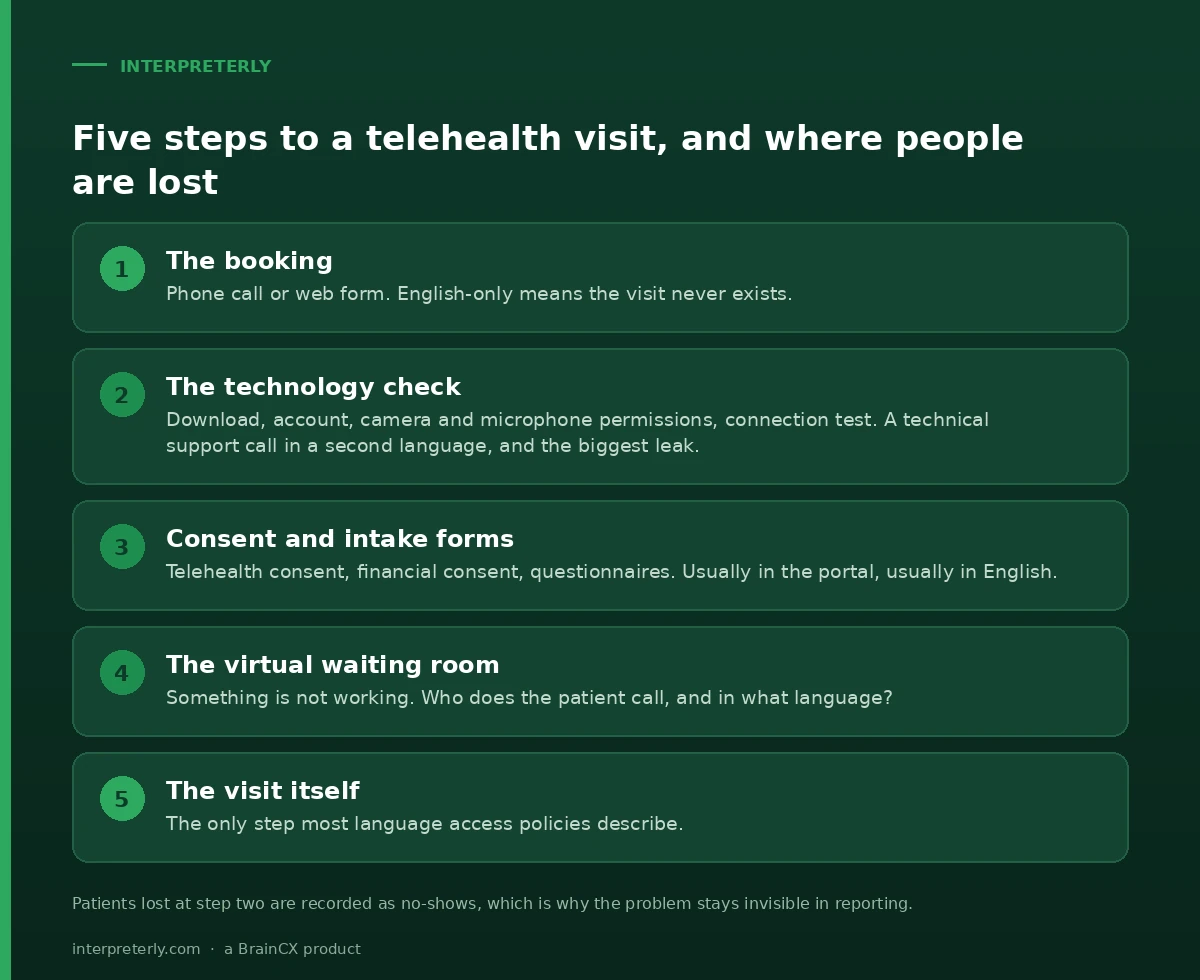
The clinical visit is the fifth of five. Everything upstream of it is where the attrition happens, and almost none of it is on the video platform.
1. The booking. Usually a phone call or a web form. If the form is English-only and the phone line cannot serve the caller, the visit never exists.
2. The technology check. Download the app, create an account, allow camera and microphone, test your connection. This is a technical support conversation conducted in a second language, and it is where most organisations lose people. It is also almost never counted, because a patient who gives up at this stage looks like a no-show rather than a language failure.
3. The consent and intake forms. Telehealth consent, financial consent, intake questionnaires. Usually in the portal, usually in English.
4. The waiting-room moment. The patient is in the virtual waiting room. Something is not working. Who do they call, and in what language?
5. The visit itself. The only step most language access policies describe.
Count your own funnel and the shape is usually the same: the failure is concentrated at step two, and the policy covers step five.
Why the platform’s interpreter feature is not the answer on its own
Most telehealth platforms can add a third participant. Some have an integrated interpreter marketplace. Both are useful and neither solves the problem, for three reasons.
It only works inside the visit. The booking call, the technology check and the waiting-room problem all happen outside the platform, usually on an ordinary phone line. A feature that lives inside the video session cannot help with the call where the patient is trying to work out why the camera will not turn on.
It assumes the patient got in. Every one of these features starts from a connected session. The patient who could not connect is invisible to it.
Video has a device floor. It needs a working camera, a screen large enough to be useful and enough bandwidth to hold a call. A meaningful share of any limited English proficiency population does not have all three, and some are on a landline. For spoken-language conversations, an audio route reaches people a video route cannot.
The audio-only exception people forget
A large share of telehealth is not video. Audio-only visits, nurse triage lines, follow-up calls, medication checks and results conversations are telephone encounters, and for many patients they are the only accessible form of virtual care.
That has two consequences. Telehealth language access has to cover ordinary phone calls, not just the video platform. And the audio standard at 92.201(g) is the one that applies to most of your actual virtual volume.
It also cuts the other way. For a Deaf or hard-of-hearing patient who uses sign language, audio is not an option at all and video or on-site interpretation is required. We set out why those are different obligations in why effective communication and language access are not the same rule.
What to fix, in order
Serve the booking line first. It is the cheapest fix and the largest leak. If a patient can book in their own language, you have at least created the appointment.
Put a human-answered number on the technology check. Not a chatbot, not an English-only help page. A number where someone picks up and can carry the conversation in the patient’s language while walking them through permissions.
Record the preferred language before the visit, not during it. If the clinician discovers the language need when the session starts, you have already lost the pre-visit steps.
Train the people who run the sessions. The rule names training. More practically, a clinician who has never started an interpreted video session will not start one while a patient waits.
Measure the drop-off by language. Booked, connected, completed. Split by preferred language. The gap between booked and connected is the number that will surprise you.
The hybrid pattern most organisations end up with
After a year or two of running virtual care, almost every organisation lands in the same place, usually without having planned it.
Video with a qualified human interpreter for the clinical visits that need one, and for every encounter with a patient who uses sign language. An audio route for the spoken-language conversations that do not require a qualified interpreter and for the large share of patients who cannot reliably hold a video call. And a written channel in the patient’s language for anything they need to keep, such as instructions, appointment details and after-visit summaries.
The organisations that arrive there deliberately save a great deal of money, because they stop paying the video rate for calls that never needed a camera. The ones that arrive there by accident usually have three disconnected contracts and no idea what any single encounter costs.
The question that sorts this out is narrow. Take last quarter’s virtual encounters, split them into the three buckets, and price each separately. The mistake that produces the wrong answer is pricing all three together and buying one modality for everything.
Where a phone-based language layer fits
Traditional interpreter companies add a third person to the phone call. AI companies replace the employee entirely. We do neither. The employee stays on the call and we carry the language.
For telehealth the useful place for that is the operational perimeter rather than the clinical centre: the booking call, the technology check, the reminder, the results call, the billing question. Those are high-volume, repetitive, and happen on an ordinary phone line that no video platform touches.
Interpreterly is a language assistance tool, not a certified interpreter service, and it does not replace a qualified human interpreter where one is required. It is also not an answer for sign language, which needs video or on-site provision. It carries Spanish, Brazilian Portuguese, Russian, Filipino/Tagalog, German, Hindi and Urdu on calls today. The mechanics are in how an interpreter joins an existing call, the modality trade-off is in video remote interpreting cost versus phone, and the side-by-side sits on our video versus phone comparison.
This is a plain-English summary of a regulation and not legal advice. Whether your organisation is a covered entity, and what that requires of your telehealth programme, depends on your funding and your state. Confirm your position with your own counsel.
Frequently asked questions
Does Section 1557 apply to telehealth?
The 2024 final rule added 45 CFR 92.211, requiring covered entities to ensure the health programmes and activities they offer through telehealth are accessible to individuals with limited English proficiency and individuals with disabilities, subject to fundamental alteration and undue burden limits.
Is the interpreter feature in our telehealth platform enough?
It covers the clinical session. It does not cover the booking call, the technology check, the virtual waiting room or the follow-up call, which is where most limited English proficiency patients actually drop out.
What are the video quality requirements for interpreting?
Under 45 CFR 92.201(f), real-time full-motion video and audio over a dedicated high-speed, wide-bandwidth connection, a sharply delineated image large enough to display the interpreter’s face, clear and audible voices, and adequate training for users, free of lags, choppiness, blur and graininess.
Do audio-only telehealth visits have language requirements?
Yes. Audio-only encounters are telehealth, and the audio standard at 45 CFR 92.201(g) applies: a dedicated high-speed connection, high quality, free of lags and irregular pauses, clear transmission of voices, and trained users.
Where do most limited English proficiency patients drop out of telehealth?
At the technology check, before the visit exists. Because they never connect, these patients are usually recorded as no-shows rather than as language failures, which is why the problem stays invisible in reporting.
Can an AI interpreter be used for a telehealth consultation?
Where the law calls for a qualified interpreter, use one. A language layer is built for the routine operational calls around the visit, such as booking, reminders, technical help and billing questions, rather than for the clinical encounter.
Regulatory citations were checked against the published rule on the date of writing. This article is not legal advice. Confirm your specific obligations with your own counsel.