An interpreter for property management calls is rarely on anyone’s priority list, right up until the afternoon a resident calls about a leak and nobody in the office can understand which unit they are in.
No competitor in this market writes for property management, which is strange, because the call profile is close to ideal for language support: high volume, low complexity, and the same residents calling back.
A leasing office is a phone operation. Enquiries about a vacancy, maintenance requests, questions about a balance, renewal conversations.
What HUD guidance actually says, and what it does not
Start here, because this is the part most property management content gets wrong in both directions.
Limited English proficiency is not a protected class under the Fair Housing Act. HUD’s Office of General Counsel said so directly in its guidance of 15 September 2016 on Fair Housing Act protections for persons with limited English proficiency.
That is not the end of the analysis, it is the beginning of it. The guidance explains that LEP is closely linked to national origin, which is protected, and that housing providers can run into the Act in several ways: using language as a pretext or a proxy for national origin, applying a language-related restriction selectively, or maintaining a neutral policy that has an unjustified discriminatory effect on a protected group.
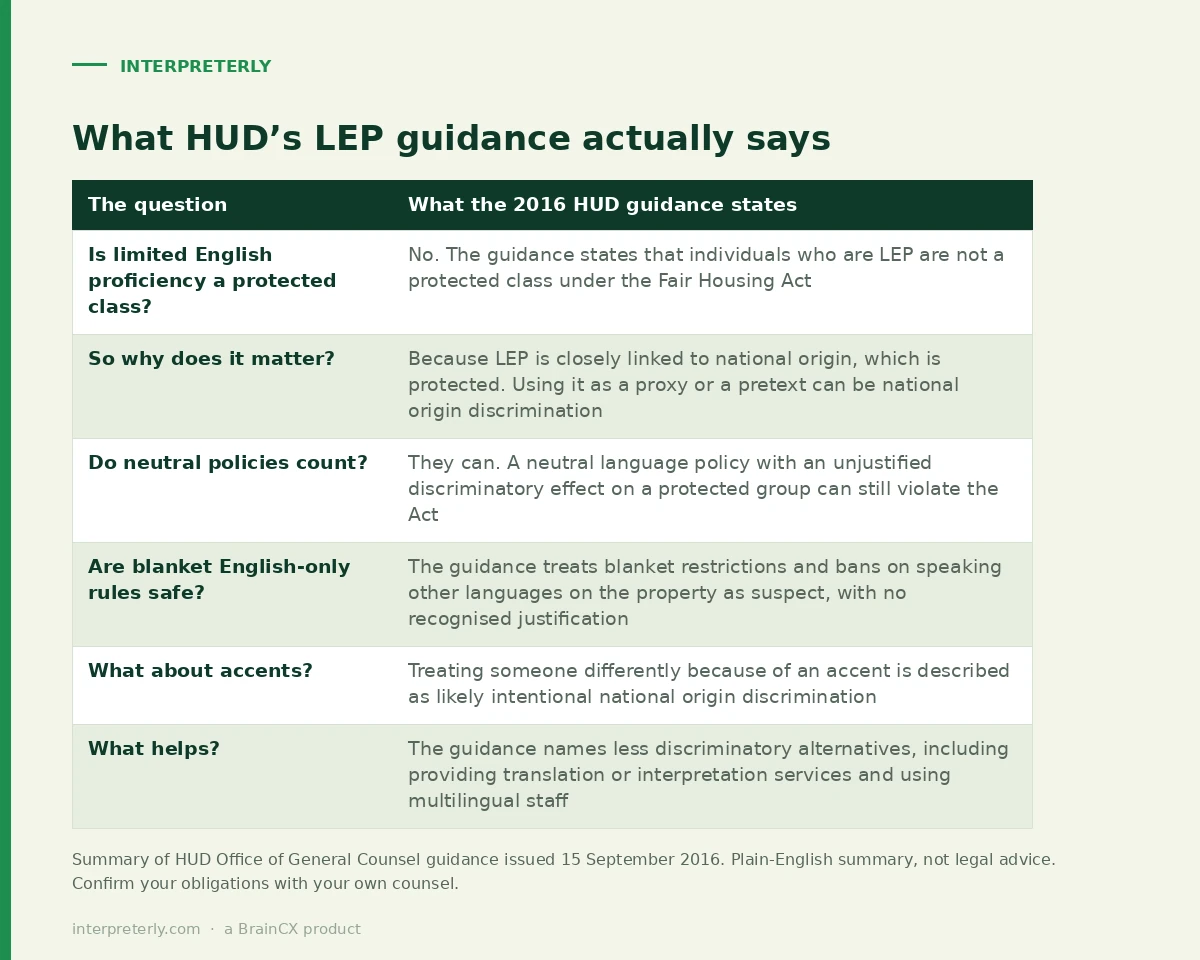
The guidance treats blanket restrictions with particular suspicion. Advertisements requiring English, policies that turn away applicants who are not fluent, and bans on speaking other languages on the property are all flagged, and the guidance notes there is no recognised justification for the last of those. It also describes treating someone differently because of an accent as likely intentional national origin discrimination.
Usefully for an operator, the guidance also names less discriminatory alternatives, and providing translation or interpretation services and using multilingual staff are on that list.
This is a plain-English summary rather than legal advice, and obligations differ for federally assisted housing, which carries greater duties under Title VI. Confirm your own position with your counsel.
The four calls where language actually breaks
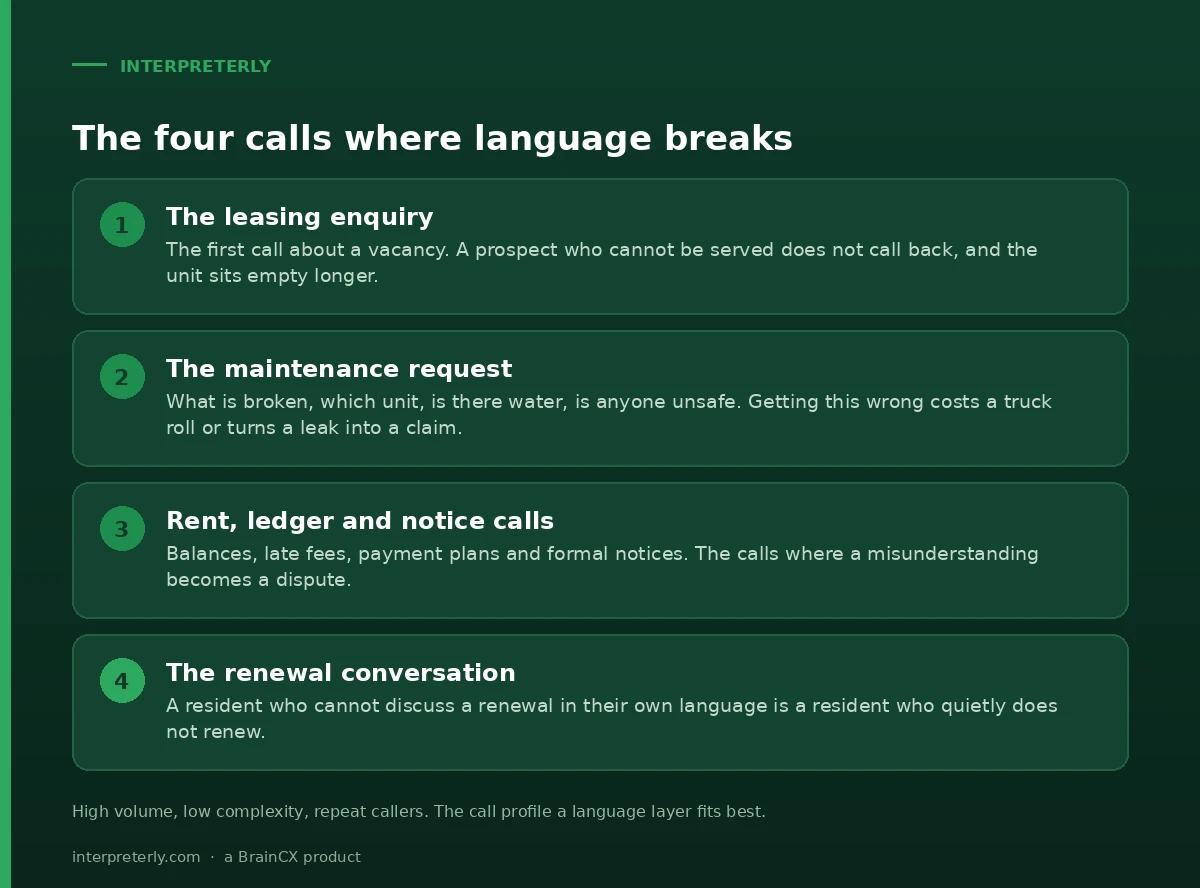
The leasing enquiry. The first call about a vacancy decides whether a tour happens. A prospect who cannot be served does not leave a message, they call the next listing. The cost is days of vacancy on a unit, which is the most expensive thing in this business.
The maintenance request. This is the one with real consequences. What is broken, which unit, is there water, is anyone unsafe. Get it wrong and you pay for a truck roll to the wrong address, or a slow leak becomes a mould claim because the urgency did not come through.
Rent, ledger and notice calls. Balances, late fees, payment plans, formal notices. These are the conversations where a misunderstanding turns into a dispute, and where a resident who did not follow the explanation says so later.
The renewal conversation. A resident who cannot discuss their renewal in their own language is a resident who quietly does not renew. Turnover costs are the second most expensive thing in this business, and this cause of it never appears in a report.
Why the usual workaround is a bad idea here
The common approach is to find somebody. A bilingual maintenance tech gets pulled off a job to translate. A leasing agent asks the resident’s child to explain what the notice says. A neighbour helps out.
Each of those creates a different problem. Pulling a technician off a work order costs you the work order. Relying on a resident’s child to interpret a notice about their family’s tenancy is a poor position for everyone in it, and the accuracy of the exchange is not something you can later evidence. And where the conversation concerns a lease obligation, a payment plan or a notice, you have no record that the terms were conveyed correctly.
A single bilingual staff member is the slightly better version of the same workaround, and it carries the same structural weakness: one person, one shift, one property, one language. When they are showing a unit, the call waits. When they leave, your language plan leaves with them.
What a fixed leasing line looks like
The goal is that whoever picks up can serve the call, in the caller’s language, without a transfer and without a call-back.
For maintenance that means capturing unit number, the nature of the problem and the urgency accurately on the first call, with the unit number read back and confirmed. For leasing it means the enquiry turns into a tour rather than a voicemail. For ledger calls it means the resident actually understands the balance and the options, and your team can show that the conversation happened in a language the resident uses.
Traditional interpreter companies add a third person to the phone call. AI companies replace the employee entirely. We do neither. The employee stays on the call and we carry the language, which keeps your leasing agent in the conversation and in control of it.
What to put in the call handling process
Five lines, and they belong in the same document your team already uses for after-hours and emergency maintenance.
Serve the caller on the first call. No transfer to a colleague who may be out on a tour, and no call-back promise. A call-back is where leasing enquiries die.
Read back the unit number and the callback number. Every maintenance call, every time. Those two details cause more wasted truck rolls than anything else on the line.
Classify urgency explicitly. Ask whether there is active water, no heat, no power, or anyone unsafe, as separate questions rather than one open question. Urgency is the thing most likely to be lost in a strained exchange.
Note the language the call was handled in. In the work order or the resident record. It costs nothing, it makes the next call better, and it is the only way you will ever be able to look at outcomes by language.
Send written follow-ups in the language of the conversation. Appointment windows, payment plan confirmations, work order updates. A confirmation nobody can read is not a confirmation.
Portfolios have a second problem: the tenth language
A single property usually has one dominant second language. A portfolio across several markets has a different one at each site, and the Spanish-speaking leasing agent at one property does nothing for the Brazilian Portuguese-speaking residents at another.
That is where staffing stops scaling and a language layer on the existing lines starts to make sense. Interpreterly currently carries Spanish phone interpretation and Brazilian Portuguese on the same line, with Haitian Creole coming soon. It is a language assistance tool, not a certified interpreter service, and it does not replace a qualified human interpreter where one is required, which for housing providers is a question to put to your counsel along with any translated-document obligations in your state. The operational detail sits on interpretation for property management calls.
Frequently asked questions
Do landlords have to provide an interpreter for tenants?
HUD’s 2016 guidance states that limited English proficiency is not itself a protected class under the Fair Housing Act. However, using language as a proxy or pretext for national origin, or applying a policy with an unjustified discriminatory effect on a protected group, can violate the Act. Federally assisted housing carries greater obligations under Title VI. Confirm your own position with your counsel.
Can we require that all communication be in English?
HUD’s guidance treats blanket English requirements and bans on speaking other languages on the property as suspect, noting there is no recognised justification for restricting the language people speak on the premises. Take advice before adopting any language-based policy.
Can a resident’s child interpret for them?
There is generally no rule in housing prohibiting it, but it is a poor practice. A child is not accountable for accuracy, the arrangement puts a minor in the middle of their family’s tenancy, and you have no record that lease terms or a notice were conveyed correctly.
What is the most expensive language failure in property management?
Usually the maintenance call, because an inaccurate report causes a wasted truck roll or lets an urgent problem wait. The leasing enquiry is a close second, since it converts directly into days of vacancy.
How do portfolios handle several languages across different markets?
Staffing one bilingual person per property stops scaling as soon as the second language differs by market. A language layer on the existing phone lines covers each site from the same system, which is why portfolio operators tend to reach for it before single-property operators do.