An ambulatory surgery center can do everything right in the operating room and still lose the case on a phone call three days earlier.
The pre-op call is where the fasting instruction is given, the medication hold is explained, the escort requirement is confirmed and the arrival time is set. Get any one of those wrong and the procedure is cancelled on the morning, with an anaesthetist, a surgeon, a nurse and a room all already paid for.
Now run that call through a language barrier.
Why an ambulatory surgery center is more exposed than a clinic
Three structural things make ambulatory surgery different, and all three raise the cost of a misunderstood call.
The schedule has no slack. A clinic that loses a 10am slot fills it from the waiting list. A surgery center that loses a 7:30am case loses the block. The room, the team and the anaesthesia cover were committed days earlier and cannot be redeployed at an hour’s notice.
The instructions are safety instructions. Nothing by mouth after midnight is not a preference. Holding an anticoagulant, or not holding it, is a clinical decision that has to survive translation intact. A patient who nods politely and has breakfast is a cancellation at best.
The patient is not a regular. Most ASC patients are referred in for one procedure. There is no existing relationship, no history of the front desk knowing how to reach them, and often no record of their preferred language anywhere in the chart you received.
The five calls that carry the risk
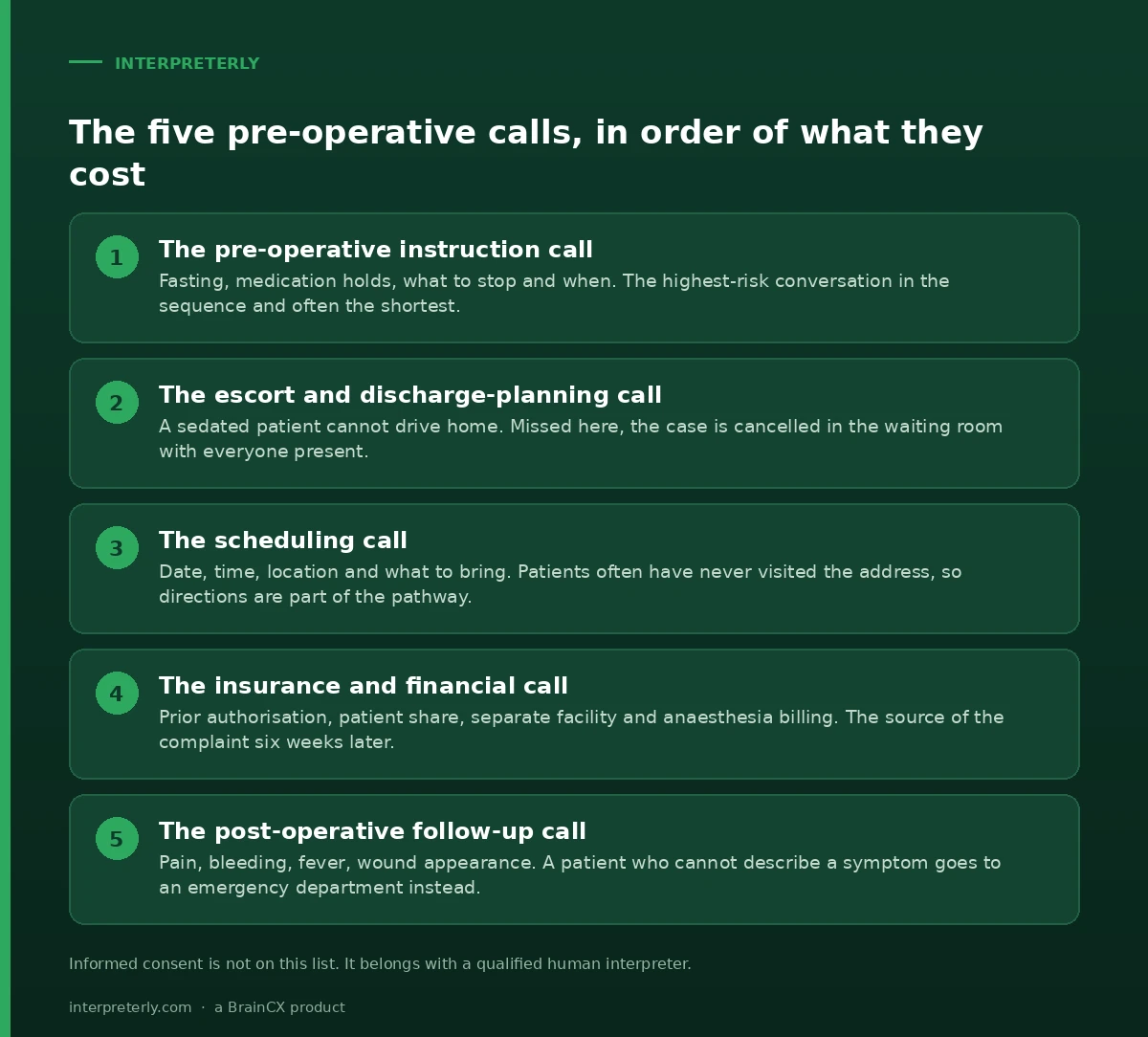
The scheduling call. Date, time, location and what to bring. Surgery centers frequently operate from an address the patient has never visited, which makes directions part of the clinical pathway rather than a nicety.
The insurance and financial call. Prior authorisation status, the patient’s share, whether the anaesthetist and the facility bill separately. This is the call that produces a complaint six weeks later from a patient who says nobody told them.
The pre-operative instruction call. Fasting, medication holds, what to stop and when, whether to take the morning blood pressure tablet. The highest-risk conversation in the sequence and often the shortest.
The escort and discharge-planning call. A patient receiving sedation cannot drive home and generally cannot leave alone. If this is not understood in advance, the case is cancelled in the waiting room with everyone present.
The post-operative follow-up call. Pain, bleeding, fever, wound appearance. A patient who cannot describe a symptom to you ends up in an emergency department instead, which is the outcome ambulatory surgery exists to avoid.
Where it actually breaks
Not in the operating room. In the forty-eight hours before it.
The usual failure pattern looks like this. The referring practice has a bilingual coordinator and a good relationship with the patient. The surgery center does not, and the chart that arrives contains no language field. Someone calls the day before, reaches a family member, delivers the fasting instruction to whoever answered, and records that the patient was contacted.
On the morning, the patient has eaten. Or arrived without an escort. Or taken the medication they were told to hold. The chart says the call was made, because it was.
That is the gap: contact was made, communication did not happen, and the record cannot tell the difference between the two.
What good looks like on a pre-op call
Four changes, none of which requires new clinical staff.
Serve the caller in their language on the first call. No transfer to a colleague who may be in a case, and no call-back promise. A call-back the day before surgery is a call-back that may not land.
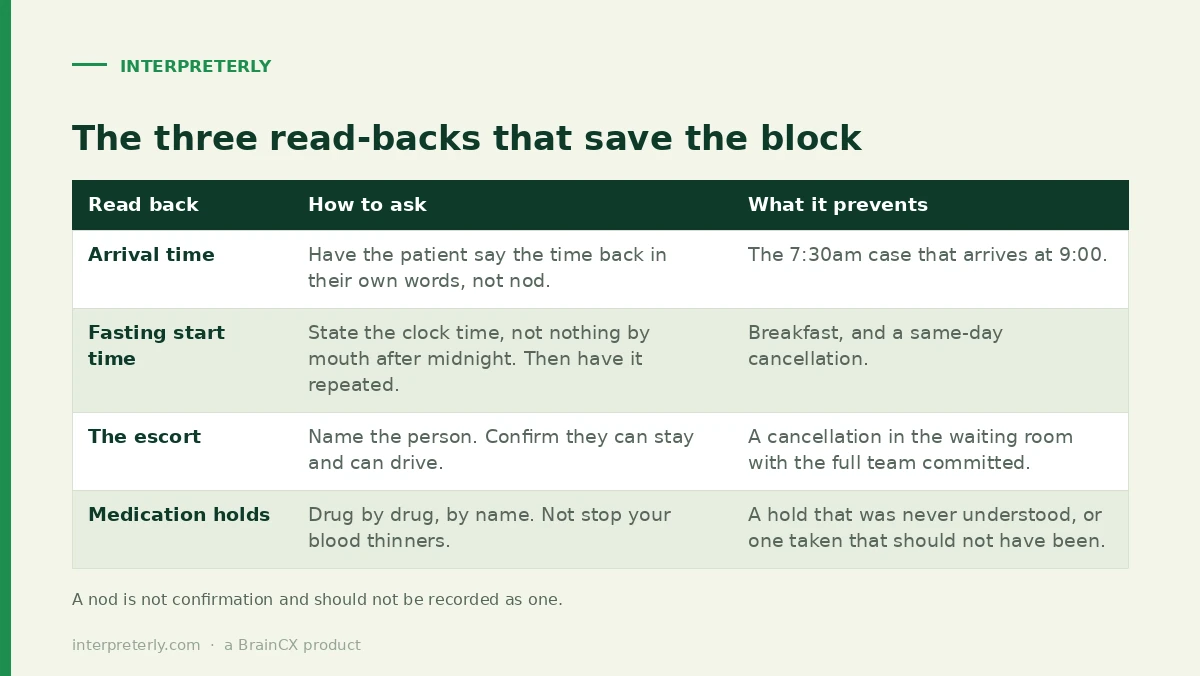
Read back the three things that cancel cases. Arrival time, fasting start time, and the escort. Read them back and have the patient say them in their own words. A nod is not confirmation and should not be recorded as one.
Confirm the medication hold explicitly, drug by drug. Not “stop your blood thinners,” which depends on the patient knowing which of their tablets that describes.
Send the written confirmation in the language of the conversation. A reminder nobody can read does not prevent a cancellation.
The compliance layer, briefly
Most ambulatory surgery centers that bill Medicare are covered entities for the purposes of Section 1557, and the language access provisions at 45 CFR Part 92 apply. That includes the qualified interpreter standard and the notice of availability requirement.
Two points worth knowing rather than worrying about.
The qualified bilingual staff standard is not met by having a Spanish-speaking scheduler. The employee has to be designated to provide language assistance as part of their job and have demonstrated proficiency to the organisation, including specialised vocabulary, and pre-operative instruction vocabulary is specialised by any reasonable reading.
And consent is not a routine call. An informed consent conversation about a surgical procedure belongs with a qualified interpreter, and your policy should say so in those words. The routine volume around it, scheduling, reminders, directions, insurance status, is a different category.
This is a plain-English summary and not legal advice. Whether your center is a covered entity, and what that requires, depends on your funding and your state. Confirm your position with your own counsel.
The number nobody calculates
Ask your scheduling team for last quarter’s cancellations and same-day no-shows, then ask them to split the list by the language the booking was made in.
Most centers cannot produce that split, which is the finding. Where it can be produced, the pattern is usually visible without statistics.
Put a value on it. A cancelled case is not a lost co-pay, it is a lost block: facility time, anaesthesia cover, nursing time and a surgeon’s morning. Against that, the cost of serving the pre-op call properly is small, and our cost calculator will run it against your own volume. The per-minute arithmetic that makes short operational calls expensive is in what phone interpretation actually costs per minute, and it bites hardest on exactly this kind of two-minute call.
Where a language layer fits
Traditional interpreter companies add a third person to the phone call. AI companies replace the employee entirely. We do neither. The employee stays on the call and we carry the language.
For a surgery center that matters more than usual, because the pre-op call is a clinical handover disguised as an administrative one. The nurse or scheduler doing it needs to stay in control of the conversation, hear the patient’s own words back, and judge whether the instruction landed. A third party relaying between two people makes that harder, not easier.
Interpreterly is a language assistance tool, not a certified interpreter service, and it does not replace a qualified human interpreter where one is required, including for consent. It carries Spanish, Brazilian Portuguese, Russian, Filipino/Tagalog, German, Hindi and Urdu on calls today. The setup for a surgical facility is on our page for ambulatory surgery centers, the scheduling workflow is covered under patient scheduling, and the same pattern on the intake side is in where Spanish-speaking patients drop out of the intake call.
A week-one checklist
Add a preferred language field to the pre-op intake and make it required. You cannot plan for what you do not record.
Pull last quarter’s cancellations by booking language. If the data does not exist, that is the first fix.
Rewrite the pre-op script around three read-backs: arrival time, fasting start, escort.
Check what language your reminder messages go out in when the booking was made in another one. This is usually a settings change in the scheduling system and it moves the cancellation rate on its own.
Name the consent boundary in writing. Which conversations require a qualified human interpreter, and who arranges one.
Frequently asked questions
Do ambulatory surgery centers need to provide interpreters?
An ASC that receives federal financial assistance, including through Medicare, is generally a covered entity under Section 1557 and must take reasonable steps to provide meaningful access to patients with limited English proficiency, free of charge. Whether a specific center is covered is a question for your counsel.
Which pre-operative call carries the most risk?
The pre-operative instruction call, because fasting times and medication holds are safety instructions that have to survive translation exactly. The escort requirement is a close second, since it cancels the case in the waiting room.
Can a bilingual scheduler handle pre-op calls?
Only if they meet the qualified bilingual staff standard, which requires designation for language assistance as part of their role and demonstrated proficiency including specialised vocabulary. Pre-operative instructions are specialised vocabulary.
Does an AI interpreter work for surgical consent?
No. Informed consent for a surgical procedure belongs with a qualified human interpreter. The routine volume around it, scheduling, directions, reminders and insurance status, is the call type a language layer is built for.
How do we measure whether language is causing cancellations?
Split last quarter’s cancellations and same-day no-shows by the language the booking was made in. Most centers cannot produce that split, and producing it is usually more informative than any vendor comparison.
This article is a plain-English summary for surgical facilities and is not legal advice. Confirm your specific obligations with your own counsel.