Video remote interpreting costs about a dollar a minute more than phone. That is the easy part of the answer, and it is not the part that decides anything.
The real question is which of your calls genuinely need video, because the rule treats the two modalities differently, and paying the video rate for a scheduling call is the most common overspend in this category.
What video remote interpreting costs
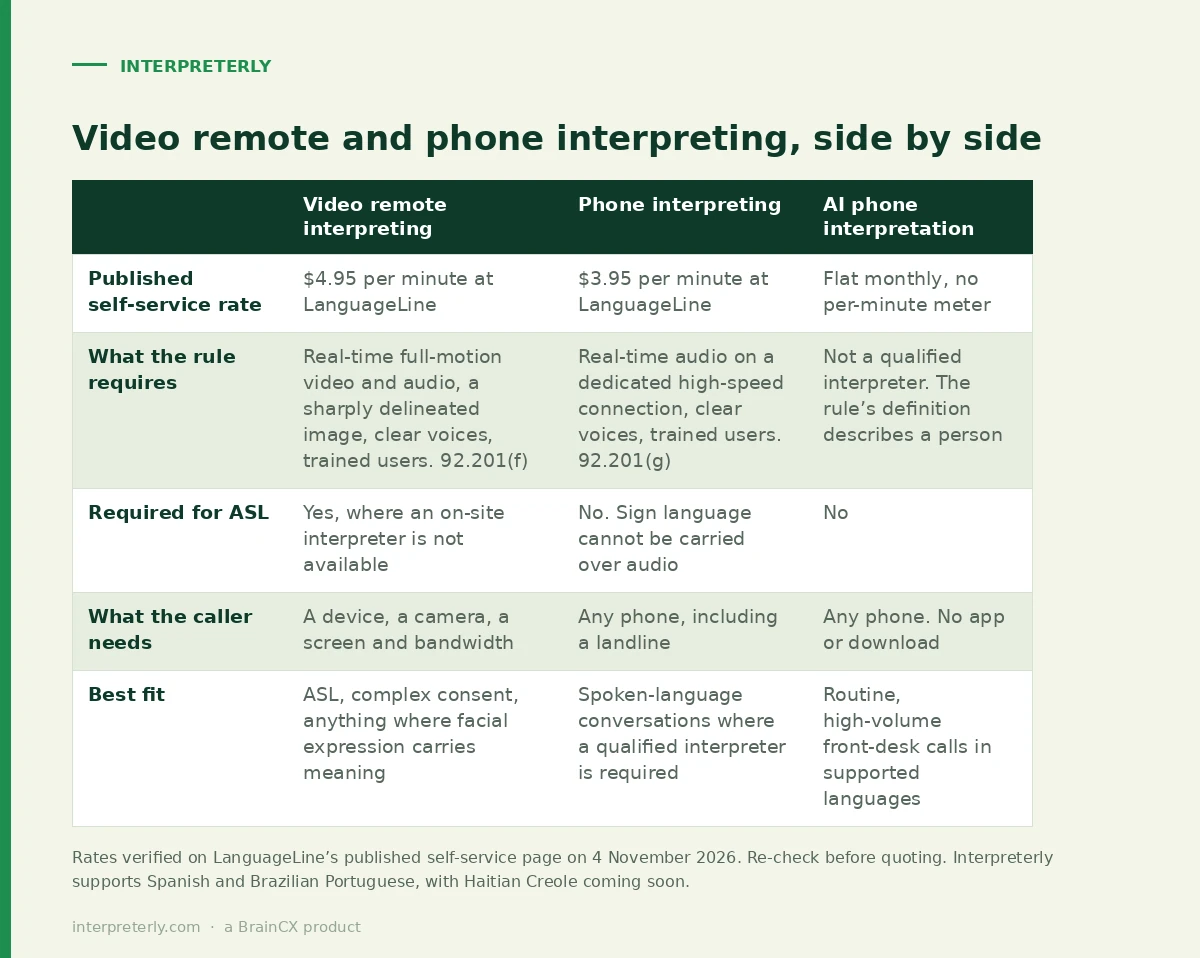
On its published self-service tier, LanguageLine lists $4.95 per minute for video and $3.95 per minute for audio, with no contracts, setup fees or monthly minimums on that tier. Those were the published figures on 4 November 2026, and rates move, so check the live page before you budget against them.
That dollar difference sounds small until you apply it to volume. A practice running 200 interpreted minutes a day pays roughly $200 a day more for video than for audio. Over a month that is the cost of a part-time hire, for a modality most of those calls never needed.
Contracted rates differ from self-service rates, and most contracts add things the headline figure does not mention: a per-call minimum, billable connect time, rounding to the next full minute, after-hours and less common language differentials. On short calls those modifiers move the invoice more than the rate does. The full arithmetic is in our interpretation cost calculator.
The rule treats video and audio differently
This is the part almost no vendor comparison mentions, and it is the part a compliance officer will ask about.
Section 1557 sets separate quality standards for each modality. Under 45 CFR 92.201(f), a covered entity using video remote interpreting must provide real-time full-motion video and audio over a dedicated high-speed, wide-bandwidth connection, a sharply delineated image large enough to display the interpreter’s face, clear and audible transmission of voices, and adequate training for the people using it. The video has to be free of lags, choppiness, blur and graininess.
Under 92.201(g) the audio equivalent is narrower: real-time audio on a dedicated high-speed connection, high quality and free of lags or irregular pauses, clear transmission of voices, and trained users.
Two practical consequences follow. Video is a higher bar to clear, so a VRI deployment that runs over a congested clinic wifi network may not meet the standard the rule describes. And training is a named requirement in both, not an optional extra, which is why services nobody at the front desk knows how to start fail on their own terms.
Where video is the right answer, and not negotiable
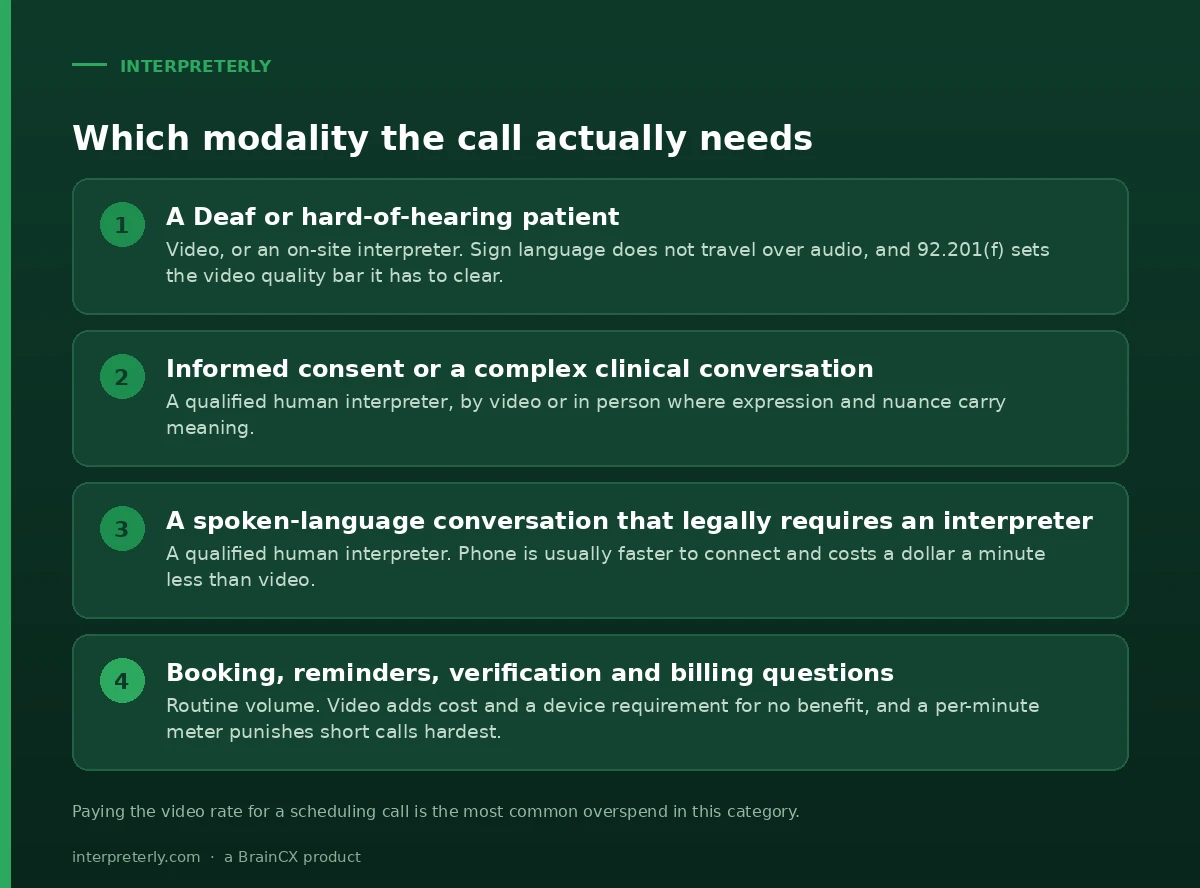
For a Deaf or hard-of-hearing patient who uses sign language, video or an on-site interpreter is the answer. Sign language cannot be carried over audio, and no phone-based service of any kind substitutes for it. If ASL is part of your patient population, VRI is not an optional line in your budget.
Video also earns its cost wherever facial expression, gesture or a visible object carries meaning: complex consent discussions, conversations where a clinician needs to read a patient’s reaction, demonstrations of how to use a device or administer a medication.
Where phone wins outright
For spoken-language conversations, phone connects faster, costs less and asks nothing of the caller.
That last point is the one buyers underrate. Video requires the patient to have a device with a working camera, a screen large enough to be useful, and enough bandwidth to hold a call. A meaningful share of any limited English proficiency patient population does not have all three, and some are calling from a landline. A modality that excludes part of the population it exists to serve is not meaningful access.
And for the routine volume that makes up most of a front desk’s day, booking, reminders, verification, directions and billing questions, video adds a device requirement and a dollar a minute for no benefit at all.
What the contract adds that the rate does not show
A published self-service rate is the cleanest number in this market. A negotiated contract is where the real cost hides, and the same modifiers apply to video and audio.
The per-call minimum. A minimum number of billable minutes on every connected call. On a front desk where calls run ninety seconds, the minimum is not a detail, it is the price.
Connect time. Ask precisely when the meter starts. If it starts when you dial rather than when the interpreter speaks, your hold time is on the invoice, and on video the connection sequence is longer than on audio.
Rounding. Per second, to the next six seconds, or to the next full minute. On short calls, rounding moves the total more than the headline rate does.
Differentials. Evening, weekend and less common language rates are usually quoted separately. Video differentials tend to be larger in absolute terms because the base rate is higher.
Five questions to put to any vendor in writing before signing: is there a per-call minimum and what is it, when does the meter start, how are partial minutes rounded, what are the after-hours and language differentials, and what is the all-in cost per call on our actual volume last month. The last one is the only number that compares cleanly across providers.
Where an AI phone interpreter fits, and where it does not
Being plain about this, because the category invites overclaiming. An AI service is not a qualified interpreter. The definition in the rule describes a person who has demonstrated proficiency, interprets accurately and impartially, and follows interpreter ethics. Where the law calls for a qualified interpreter, use one.
Traditional interpreter companies add a third person to the phone call. AI companies replace the employee entirely. We do neither. The employee stays on the call and we carry the language, in Spanish and Brazilian Portuguese today, with Haitian Creole coming soon.
What changes is the cost shape on routine volume. Flat monthly pricing removes the meter and the minimum, which is where a per-minute contract does the most damage on a front desk making short calls. The honest version of the trade-off is in AI interpreter vs human interpreter, and if you are comparing providers on price, an option without the per-minute meter sets out the head-to-head.
The failure mode nobody budgets for
Video deployments rarely fail on price. They fail on use.
The cart gets parked in a corner because the wifi in that wing is unreliable. The tablet is locked in an office and the person with the key is at lunch. Nobody on the evening shift was trained, so the evening shift uses a family member instead. The camera points at the ceiling.
Every one of those is a training and deployment problem rather than a technology problem, and 92.201(f) names training as a requirement precisely because the rule anticipates it. When you price video, price the training and the device logistics alongside the per-minute rate, and then ask how many of your interpreted calls actually need the camera at all.
Audio has a much shorter failure list, which is a real part of why routine volume gravitates to the phone regardless of what the policy says.
How to decide, in one afternoon
Split last month’s interpreted calls into three buckets. ASL and anything where expression carries meaning goes to video. Spoken-language conversations that legally require a qualified interpreter go to phone with a human interpreter. Everything else, the routine operational volume, is where you compare a per-minute meter against a flat cost.
Then price each bucket separately. The mistake that produces the wrong answer is pricing all three together and buying one modality for all of it. More questions buyers ask are answered in our FAQ, and phone interpretation for medical practices covers the clinic setup in more detail.
Frequently asked questions
How much does video remote interpreting cost?
LanguageLine publishes $4.95 per minute for video and $3.95 per minute for audio on its self-service tier, with no contracts or monthly minimums on that tier. Contracted rates vary and often add per-call minimums, connect time and after-hours differentials, so compare all-in cost per call rather than headline rates.
Is video remote interpreting better than phone interpreting?
It depends on the call. Video is necessary for sign language and valuable where facial expression carries meaning. For spoken-language conversations, phone connects faster, costs less per minute and works for callers without a camera, a screen or bandwidth.
What does Section 1557 require for video remote interpreting?
Under 45 CFR 92.201(f), video remote interpreting must provide real-time full-motion video and audio on a dedicated high-speed, wide-bandwidth connection, a sharply delineated image large enough to show the interpreter’s face, clear audible voices, and adequate training for users, free of lags, choppiness and blur.
Can video remote interpreting be used for ASL?
Yes, and for a Deaf or hard-of-hearing patient it is the appropriate modality where an on-site interpreter is not available. Sign language cannot be carried over an audio-only connection.
Do we need both video and phone interpreting?
Most healthcare organisations do. Video for sign language and visually dependent conversations, phone with a qualified human interpreter for spoken-language conversations that require one, and a lower-cost route for routine operational calls. Price each bucket separately.