Fifteen languages. That is the number most people get wrong, and it is the number that decides whether your notice of availability meets the rule or not.
It is not the fifteen most common languages in the United States, and it is not the fifteen you happen to see at your front desk. It is the fifteen languages most commonly spoken by individuals with limited English proficiency in the state or states where you operate, and for a multi-state organisation that is more than one list.
What the notice of availability is
Under 45 CFR 92.11, a covered entity must provide a notice telling people that language assistance services and auxiliary aids and services are available, and that they are provided free of charge where required for compliance with Section 1557.
It is a separate document from the notice of nondiscrimination at 45 CFR 92.10. The two are commonly confused and often combined on one sheet, which is permitted, but they are distinct requirements with distinct content.
The notice of availability has one job: to tell someone who cannot read your English signage that help with language exists and costs them nothing. A notice that only an English reader can find has failed at its own purpose.
The language requirement, precisely
The rule requires the notice in English and in at least the fifteen languages most commonly spoken by individuals with limited English proficiency in the relevant state or states.
Three consequences follow, and all three catch organisations out.
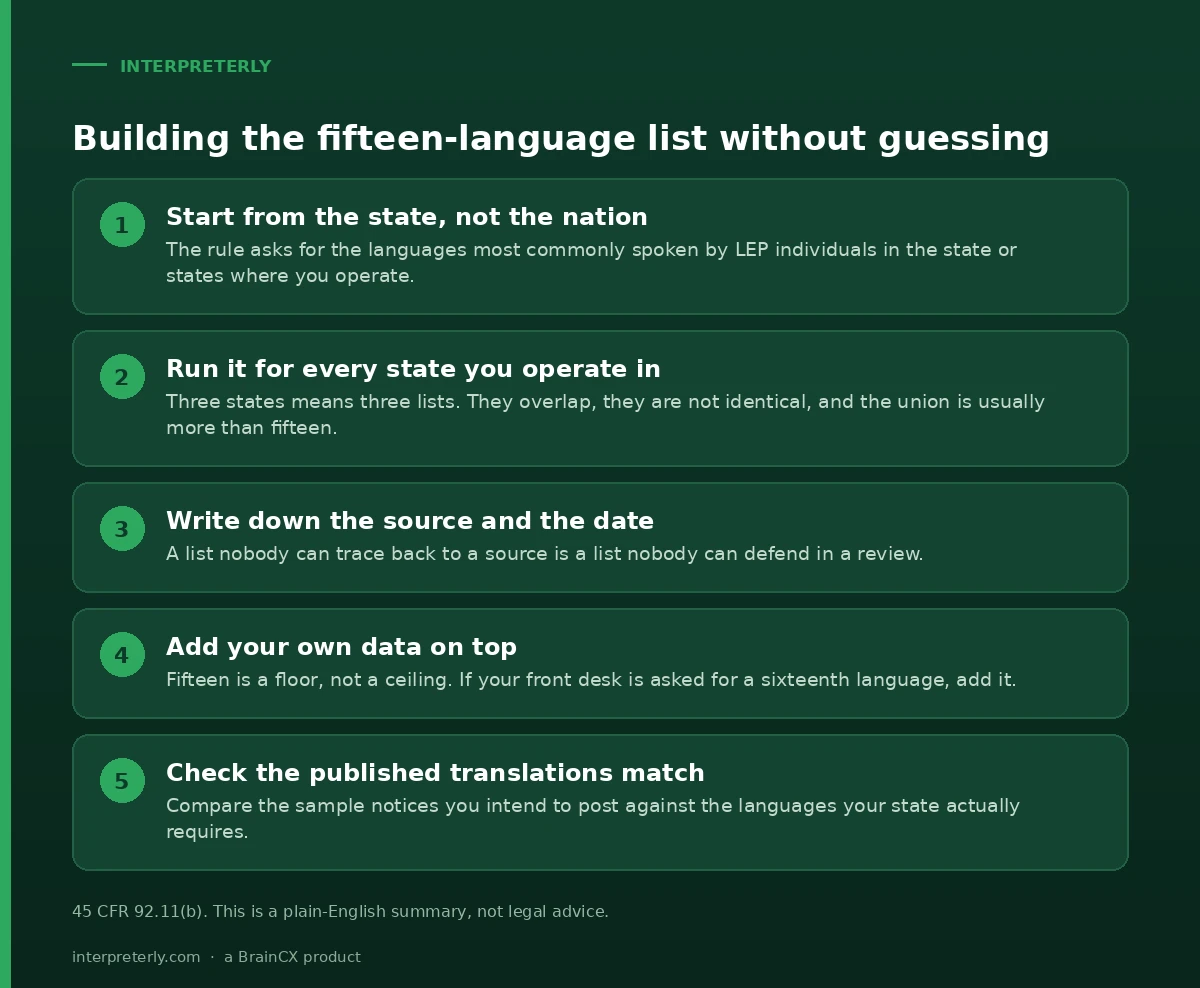
It is state-based, not national. The fifteenth most common LEP language in Texas is not the fifteenth in Minnesota. If you build the list from a national ranking you will miss languages that matter in your actual service area.
Multi-state means multiple lists. An organisation operating in three states needs the languages for all three. The sets overlap but they are not identical, and the union is usually more than fifteen.
It is a floor, not a ceiling. The rule says at least fifteen. Nothing stops you adding the sixteenth if your own data says you need it, and your own data is the better guide to what your front desk will actually be asked for.
Where it has to appear
This is the part that turns a policy decision into a facilities task.
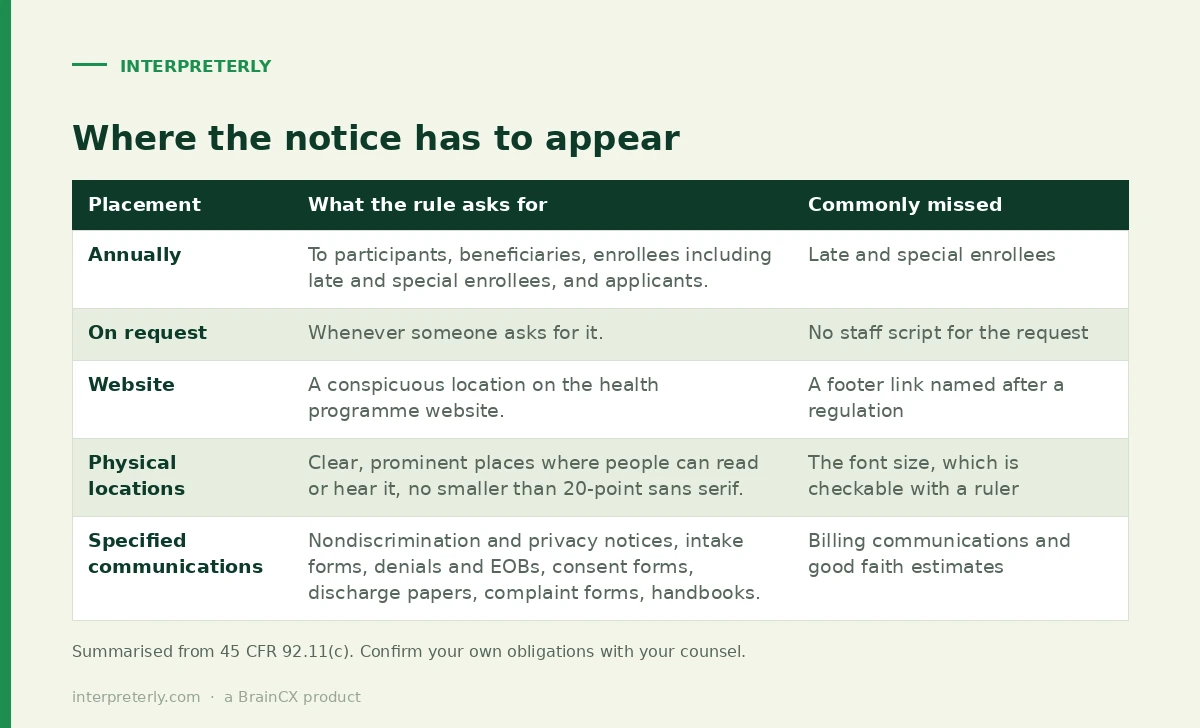
Annually, to participants, beneficiaries, enrollees including late and special enrollees, and applicants.
On request.
On your website, in a conspicuous location on your health programme’s site. Conspicuous is doing work in that sentence. A link in the footer labelled with a regulation number is not the same as a visible, findable notice.
In physical locations, in clear and prominent places where people seeking service can read or hear it, in no smaller than 20-point sans serif font. That is a specific typographic instruction and it is checkable with a ruler, which is exactly why reviewers check it.
Inside specified communications. This is the longest and most-missed part. The notice has to be included in the nondiscrimination notice, privacy practices notices, application and intake forms, denial and termination notices including explanations of benefits and appeal or grievance rights notices, communications requiring a response about rights or benefits, public health emergency communications, procedure consent forms, medical power of attorney and living will forms, discharge papers, cost and billing communications including good faith estimates, complaint forms, and patient or member handbooks.
Read that list against your own document set and you will find gaps. Billing communications and good faith estimates are the two most commonly missed, because they are usually produced by a different team from the one that owns compliance notices.
The deemed-compliance route
The rule offers an alternative for an individual, at 45 CFR 92.11(d), and it is worth knowing because it is less work for organisations that already capture language preference properly.
You are deemed compliant with respect to an individual if you either offer them an annual opportunity to opt out of receiving the notice in their primary language, under conditions including that no benefit is conditioned on opting out, that non-response is not treated as an opt-out, and that opt-outs are documented each year. Or you document the individual’s primary language and auxiliary aid needs and then provide materials in that language and format, or provide the notice in that language and format within the listed communications.
The second route rewards organisations with a clean preferred-language field. The first rewards organisations with disciplined annual records. Neither rewards the common middle state, which is a language field that is half empty.
HHS publishes translated versions
You do not have to commission fifteen translations from scratch. HHS has published sample translated notices of availability of language assistance services and auxiliary aids in a range of languages through its Office for Civil Rights, alongside the 2024 final rule at 89 FR 37522 that created the requirement.
Two cautions about using them. Check the current list against the languages your state requires rather than assuming the published set matches. And have someone confirm that the version you post is the current one, because posting a superseded sample is an avoidable finding.
Why the notice matters operationally, not just legally
A notice is a sign. Signs do not interpret calls.
The reason to get it right is narrower and more useful than compliance theatre. The notice is the one piece of your language access programme that a patient encounters before they need help. It is what tells someone it is acceptable to ask. Front desks that post it properly report more people asking for language support, which looks like a cost increase and is actually demand that was previously being absorbed as abandoned calls and missed appointments.
That is the number worth watching when you fix your notices. Not the cost of interpretation, but whether the no-show rate and the call-back rate move.
Where the phone call comes in
The notice promises help. The phone line has to deliver it, and that is a different problem from printing a sign.
Traditional interpreter companies add a third person to the phone call. AI companies replace the employee entirely. We do neither. The employee stays on the call and we carry the language.
Interpreterly is a language assistance tool, not a certified interpreter service, and it does not replace a qualified human interpreter where one is required. For the routine operational volume behind a front desk, the practical question is whether the person who picks up can finish the call. The procedure side of this belongs in your written plan, and the broader framework is on our compliance overview. The mechanics of serving the call itself are in how the interpreter joins an existing call, and for community health centres specifically, language access for FQHCs goes into the notice requirement at that funding level.
This is a plain-English summary of a regulation and not legal advice. Which notices your organisation must post, and in which languages, depends on where you operate. Confirm your position with your own counsel.
A short audit you can run this week
Walk your own lobby. Is the notice visible from where people queue, and is the type at least 20-point sans serif? Measure it.
Search your own website the way a patient would, not through the admin menu. If you cannot find it in two clicks from the homepage, neither can they.
List your fifteen languages and show your working. Write down the source and the date. A list nobody can trace back to a source is a list nobody can defend.
Pull one of each document type on the 92.11 list and check the notice is in it. Start with a billing statement and a good faith estimate.
Check the preferred-language field fill rate in your practice management system. That one number tells you whether the deemed-compliance route is open to you.
Frequently asked questions
What is a notice of availability under Section 1557?
A notice required by 45 CFR 92.11 stating that language assistance services and auxiliary aids and services are available free of charge where needed for compliance with Section 1557. It is separate from the notice of nondiscrimination at 45 CFR 92.10.
How many languages does the notice of availability need?
English plus at least the fifteen languages most commonly spoken by individuals with limited English proficiency in the state or states where the entity operates. Multi-state organisations need the list for each state.
What font size does the notice have to be?
In physical locations the rule requires clear and prominent placement in no smaller than 20-point sans serif font, where people seeking service can read or hear it.
Does the notice have to go on billing statements?
Cost and billing related communications, including good faith estimates, are on the list of communications in which the notice must be included. This is one of the most commonly missed items because billing documents are usually owned by a different team.
Can we combine the notice of availability with the nondiscrimination notice?
The notice of availability must be included with the nondiscrimination notice when that notice is provided. They remain separate requirements with separate content, so combining the delivery does not merge the obligations.
Where can we get translated versions of the notice?
HHS publishes sample translated notices of availability of language assistance services and auxiliary aids through the Office for Civil Rights. Check the current published set against the languages required for your state before you post them.
Regulatory text was checked against the published Code of Federal Regulations on the date of writing. This article is not legal advice. Confirm your specific obligations with your own counsel.