Take one tablet twice daily. Do not take with alcohol. Finish the course even if you feel better.
Three sentences, and a patient who cannot read them is a patient taking the medicine wrong. The pharmacy counter is one of the last points in the healthcare system where a misunderstanding converts directly into a clinical harm, and it is the point with the least language infrastructure. A pharmacy interpreter is rarely part of the workflow, even where the law expects one.
New York is the state that actually wrote it down
Most states have nothing specific. New York does, and it is the clearest model in the country of what a pharmacy language obligation looks like in practice.
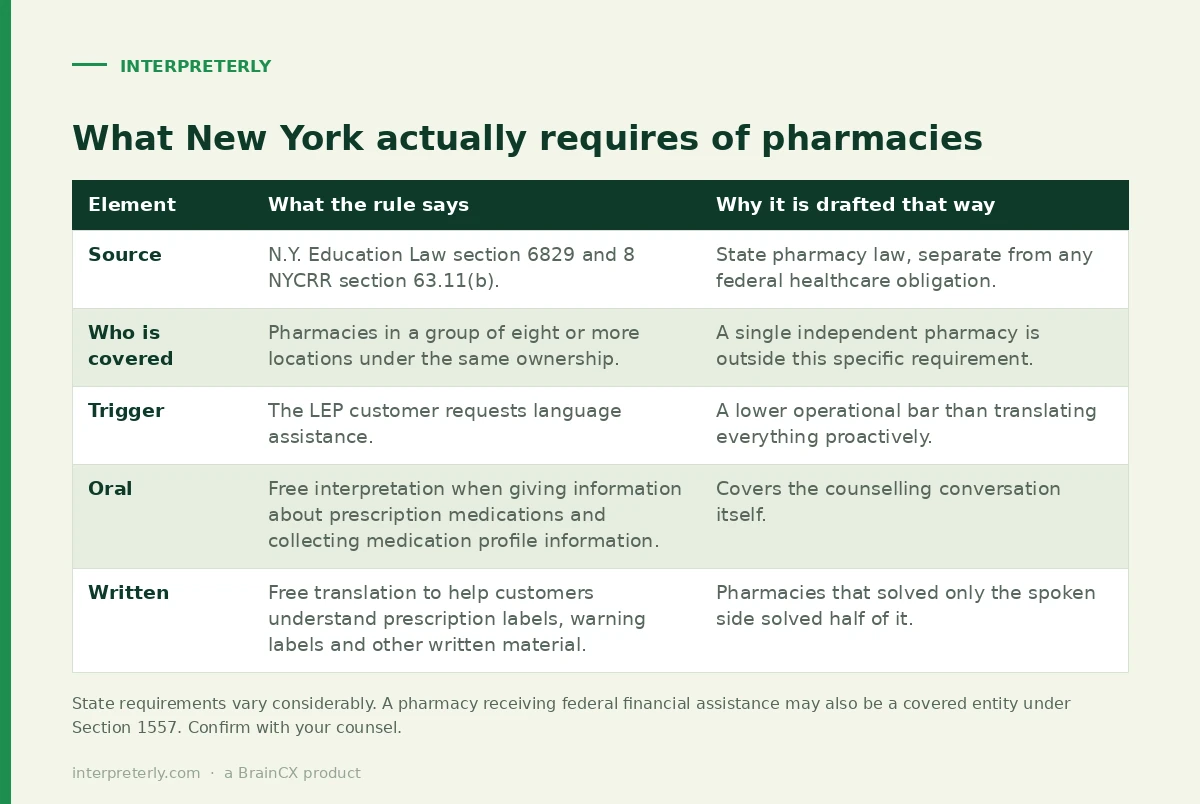
Under New York Education Law § 6829 and the regulation at 8 NYCRR § 63.11(b), pharmacies in a group of eight or more locations under the same ownership must provide free interpretation and translation services to limited English proficient customers who request language assistance. The obligation covers providing information about prescription medications and collecting the information needed for a patient’s medication profile, and it extends to helping customers understand prescription labels, warning labels and other written material. The New York Attorney General’s office sets this out in its language access guidance.
Three features of that drafting are worth noticing, because they are what make it workable.
It is triggered by a request. The patient asks, and the pharmacy provides. That is a lower operational bar than proactive translation of everything.
It covers oral and written. Interpretation for the conversation, translation for the label. Pharmacies that solved only one of those solved half the problem.
It is scoped by chain size. Eight or more locations under one owner. An independent single-site pharmacy is outside that specific requirement, which does not mean it is outside every other obligation.
The federal layer sits underneath
Separately from state pharmacy law, a pharmacy that receives federal financial assistance may be a covered entity under Section 1557 of the Affordable Care Act, which carries its own language assistance obligations at 45 CFR Part 92, including the qualified interpreter standard and the notice of availability requirement.
Whether a particular pharmacy is covered turns on facts about its funding and its corporate structure, and it is genuinely contested at the margins. This is exactly the question to put to counsel rather than to a vendor, and we are not going to tell you the answer for your business.
What is safe to say is the shape: a chain pharmacy in New York may be carrying a state pharmacy requirement and a federal healthcare requirement at once, and they are not identical.
What makes a pharmacy interpreter call different
Four things, and they are why generic healthcare language advice fits badly here.
The vocabulary is unforgiving. Milligrams, millilitres, twice daily versus every twelve hours, with food versus on an empty stomach. These are not synonyms and a loose interpretation changes the dose.
Numbers carry the whole meaning. A prescription conversation is mostly quantities, frequencies and dates. Get a number wrong and the sentence is still fluent and still wrong, which is the most dangerous kind of error because nothing sounds off.
The conversation is short and the queue is real. Counselling happens at a counter with people waiting. Anything that adds three minutes gets skipped under pressure, which is how language support that exists on paper stops happening in practice.
Much of it is on the phone. Refill requests, prior authorisation chasing, “is my prescription ready”, transfers between pharmacies, and the call to the prescriber’s office. Phone volume is the majority of a pharmacy’s language contact and it gets the least attention.
The five pharmacy conversations that need to work
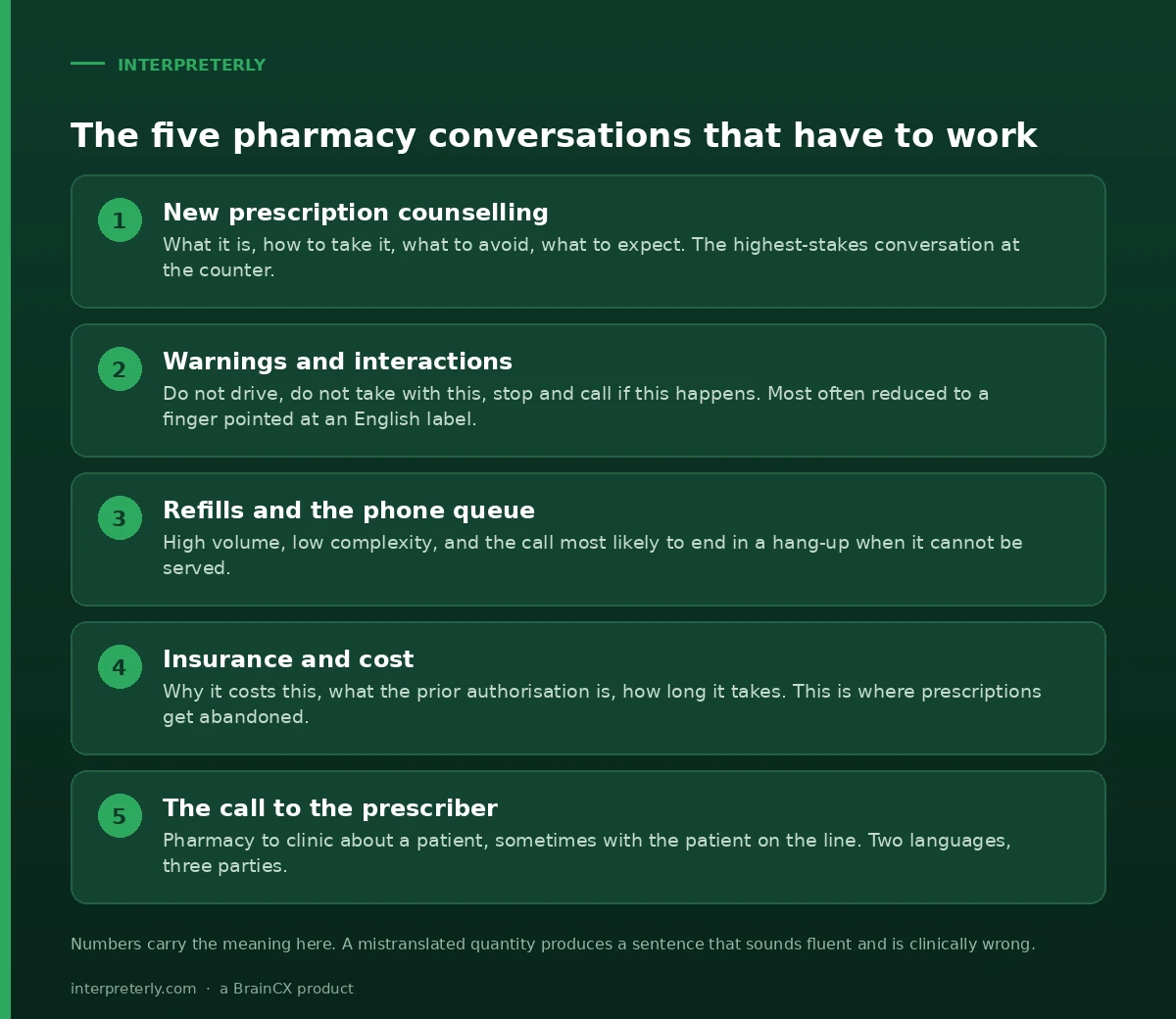
New prescription counselling. What it is, how to take it, what to avoid, what to expect. The highest-stakes conversation at the counter.
The warning and interaction conversation. Do not drive, do not take with this other medicine, stop and call if this happens. These warnings are the ones most often reduced to a pointed finger at an English label.
Refills and the phone queue. High volume, low complexity, and the conversation most likely to end in a hang-up when it cannot be served.
Insurance and cost. Why it costs this much, what the prior authorisation is, how long it will take. The conversation that produces abandoned prescriptions, which is a clinical outcome dressed as a billing one.
The call to the prescriber. Pharmacy to clinic, about a patient, sometimes with the patient on the line. A three-party call where the language gap can sit on either end.
Abandoned prescriptions are the number to watch
A prescription that is filled and never collected is a visible, countable event in every pharmacy system.
Very few pharmacies split that figure by patient language preference. Where it can be split, it is usually the most persuasive internal number available, because an abandoned prescription is both a clinical failure and a direct financial loss on stock already dispensed.
Run it for last quarter. If your system cannot split it, that absence is the first finding, and fixing the preferred-language field is a cheaper project than anything else on this page.
What to put in place
Make the offer visible at the counter. Not in a policy binder. A sign at the point of counselling, in the languages your customers actually speak, saying interpretation is free. Patients do not ask for what they do not know exists.
Read back every number. Dose, frequency, quantity, duration. Say it, then have the patient say it back. This single habit catches more errors than any technology.
Fix the phone line, not just the counter. Most language contact is on the phone and most pharmacy language policy describes the counter.
Record the language the counselling happened in. In the patient record. It makes the next interaction better and it is the only way to produce the abandoned-prescription split above.
Know where your written translation comes from. Label translation is a different problem from spoken interpretation, usually solved in the pharmacy system rather than on a call, and the two need separate answers.
This is a plain-English summary and not legal advice. Pharmacy language obligations vary significantly by state and by the pharmacy’s funding and structure. Confirm your own position with your counsel.
Where a phone-based pharmacy interpreter fits
Traditional interpreter companies add a third person to the phone call. AI companies replace the employee entirely. We do neither. The employee stays on the call and we carry the language.
For a pharmacy that distinction matters at the counter. The pharmacist is the one who has to judge whether the patient understood, and that judgement is harder through a relay. Keeping the pharmacist in the conversation keeps the clinical responsibility where it belongs.
Interpreterly is a language assistance tool, not a certified interpreter service, and it does not replace a qualified human interpreter where one is required. It also does not translate printed labels, which is a pharmacy system function. What it covers is the spoken volume: refill calls, readiness checks, cost questions, the call to the prescriber’s office. It carries Spanish, Brazilian Portuguese, Russian, Filipino/Tagalog, German, Hindi and Urdu on calls today.
If you want the setup, see a Spanish medical interpreter on an existing line and how the interpreter joins the call. The regulatory overview is on our compliance overview, and if you are costing this against a per-minute contract, the per-minute arithmetic on short calls is the relevant piece, because pharmacy calls are short and per-call minimums punish short calls hardest.
Frequently asked questions
Are pharmacies required to provide interpreters?
It depends on the state and on the pharmacy. In New York, Education Law § 6829 and 8 NYCRR § 63.11(b) require pharmacies in groups of eight or more locations under common ownership to provide free interpretation and translation to limited English proficient customers who request it. Separately, a pharmacy receiving federal financial assistance may be a covered entity under Section 1557. Confirm your position with counsel.
Do pharmacies have to translate prescription labels?
New York’s requirement extends to helping customers understand prescription labels, warning labels and other written material. Other states differ considerably. Label translation is usually handled in the pharmacy management system rather than by an interpreter.
Which pharmacy conversation carries the most risk?
New prescription counselling, because dose, frequency and warnings all have to survive translation exactly. Numbers are the specific danger, since a mistranslated quantity produces a sentence that sounds perfectly fluent and is clinically wrong.
Can a bilingual pharmacy technician interpret for a patient?
Where the qualified bilingual staff standard applies, the employee must be designated to provide language assistance as part of their role and have demonstrated proficiency including specialised vocabulary. Medication vocabulary is specialised, and conversational fluency alone does not meet the standard.
How do we measure whether language is costing us?
Split last quarter’s abandoned prescriptions by the patient’s preferred language. It is a countable event already in your system, it carries direct stock cost, and it is the clearest internal evidence most pharmacies can produce.
State law citations were checked against published sources on the date of writing and vary by state. This article is not legal advice. Confirm your specific obligations with your own counsel.