Every front desk in a Portuguese-speaking community has the same story. The Spanish line works. Someone calls speaking Portuguese, a staff member who speaks Spanish tries to help, and both people leave the call believing something slightly different happened.
A Brazilian Portuguese medical interpreter is rarely in the plan until something goes wrong. Portuguese is the second language most US healthcare organisations discover they have and the last one they staff for. It is also the one where the near-miss is most dangerous, because the two languages are close enough that the conversation feels like it worked.
Serve the second language without a second hire
Brazilian Portuguese on the same line as Spanish, across every site, with no app and no new hardware for the person calling in. Flat monthly pricing and no per-minute meter.
Start your free trialSpanish is not close enough
Spanish and Portuguese share a great deal, which is exactly the problem. A Spanish speaker and a Portuguese speaker can have a conversation. They cannot reliably have a clinical or financial one.
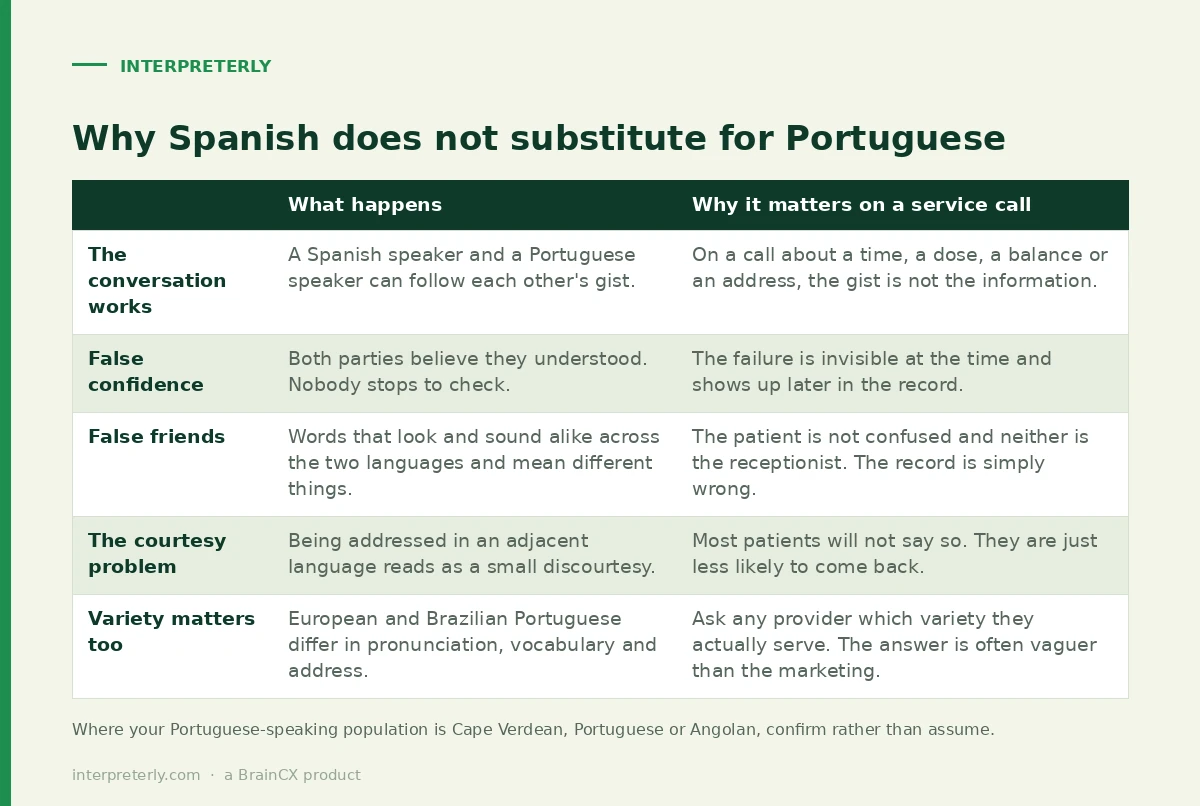
The failure mode is not incomprehension, it is false confidence. Both parties follow the gist, both believe they have understood, and nobody stops to check. On a call about a time, a dose, a balance or an address, the gist is not the information.
There is a specific trap in the false friends, words that look and sound alike across the two languages and mean different things. Staff who rely on Spanish to serve Portuguese speakers hit these without knowing they have. The patient is not confused, and neither is the receptionist. The record is simply wrong.
A second point that surprises people: a Portuguese speaker being addressed in Spanish often understands it as a small discourtesy, in the way an Austrian patient might if you addressed them in a language that was merely adjacent. Most will not say so. They will just be less likely to come back.
A Brazilian Portuguese medical interpreter is the right specification
European and Brazilian Portuguese differ in pronunciation, in vocabulary and in forms of address, and the differences are large enough to be noticeable on a service call.
For most US organisations the relevant population is Brazilian, and a service tuned to Brazilian Portuguese is the right specification. It is worth asking any provider which variety they actually serve, because the answer is frequently vaguer than the marketing.
Where your Portuguese-speaking population is Cape Verdean, Portuguese or Angolan, the picture is different again and worth confirming rather than assuming.
Where the Portuguese-speaking population sits
Portuguese speakers in the United States are heavily concentrated rather than evenly spread, which is why national averages are useless for this decision.
Massachusetts and Rhode Island carry long-established Portuguese-speaking and Brazilian communities. Southeastern Massachusetts in particular has towns where Portuguese is a routine language of service. Florida has a large and growing Brazilian population, concentrated in the south of the state. Parts of Connecticut, New Jersey, New York and California carry meaningful numbers.
The practical consequence is that for an organisation in those areas, Portuguese is not an exotic request to be handled by exception. It is a second service language, and the difference between those two framings is the difference between a plan and an improvisation.
Check your own numbers rather than any of this. Pull last quarter’s calls by language, and if the field is empty, ask your front desk staff, who will know.
Why one bilingual hire does not solve it
A practice with a Portuguese-speaking receptionist has a person, not a plan. The arithmetic is the same as for any single-language hire and it is unforgiving.
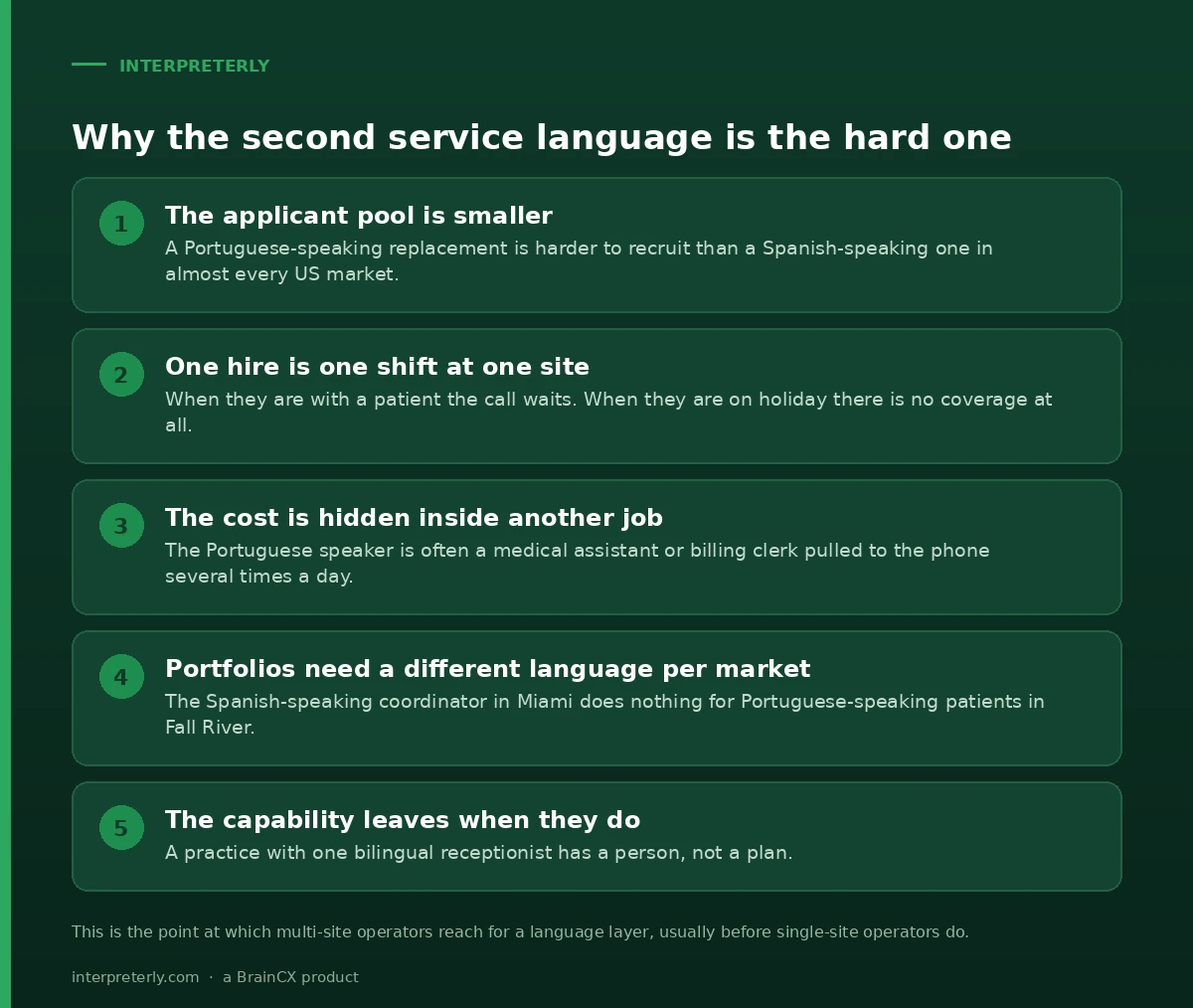
One person covers one shift at one location. When they are with a patient, the call waits. When they are on holiday, there is no coverage. When they leave, the capability leaves with them, and a Portuguese-speaking replacement is harder to recruit than a Spanish-speaking one in almost every US market.
There is also a quieter version of the problem. In many organisations the Portuguese-speaking staff member is not in a front-desk role at all. They are a medical assistant, a technician or a billing clerk who gets pulled to the phone several times a day. That cost never appears anywhere, because the time comes out of their actual job.
We set out the full version of this arithmetic in hiring a bilingual receptionist versus buying language support, and the qualified-staff standard question in why a bilingual receptionist is not automatically a qualified interpreter.
The portfolio problem
A single site usually has one dominant second language. A group across several markets has a different one at each location, and that is where staffing stops scaling entirely.
The Spanish-speaking coordinator at your Miami site does nothing for the Portuguese-speaking patients at your Fall River site. Hiring one bilingual person per language per location per shift is not a plan anyone has ever successfully executed.
This is the point at which multi-site operators tend to reach for a language layer on the existing phone lines, usually before single-site operators do, because the arithmetic becomes obvious a lot faster.
What to put in place
Record the language properly, and distinguish Portuguese from Spanish. A surprising number of systems have a single Hispanic or Latino category that conflates them. It cannot support a language decision.
Serve the caller on the first call. No transfer, no call-back. A call-back is where second-language callers disappear, and they disappear more completely than Spanish-speaking callers because they have fewer alternatives who will serve them.
Read back names, dates and numbers. Brazilian naming conventions frequently include multiple surnames, which means names get truncated or transposed in US systems and the record stops matching. Spell it back.
Send written follow-up in the language of the conversation. A confirmation nobody can read does not confirm anything.
Stop using Spanish as the fallback. Write it into the procedure. If Portuguese is not available, say so and arrange it, rather than approximating.
What it costs to find out you were wrong
The argument for staffing a second language is usually made on goodwill, which is why it usually loses. The argument that works is made on the three numbers your organisation already tracks.
No-shows by booking language. If an appointment was booked in a language the confirmation and reminder did not go out in, the reminder did not do its job. This is frequently a settings change rather than a staffing question, and it moves the number on its own.
Call abandonment by time of day. If your Portuguese-speaking staff member works mornings, look at the afternoon abandonment rate. The shape of that curve is the coverage gap, drawn for you.
New patient conversion. Enquiry to booked appointment. A caller who could not be served does not leave a message, they call somewhere else, and nothing in a standard report records why.
None of these requires a new system. All three require the language field to be populated, which brings the problem back to the same place every language access project starts: you cannot manage what you have never counted.
Where a language layer fits
Traditional interpreter companies add a third person to the phone call. AI companies replace the employee entirely. We do neither. The employee stays on the call and we carry the language.
For a second service language that model has a specific advantage. You do not have to decide in advance which site needs Portuguese cover on which shift, because the capability sits on the line rather than in a chair.
Interpreterly is a language assistance tool, not a certified interpreter service, and it does not replace a qualified human interpreter where one is required. It carries Brazilian Portuguese alongside Spanish, Russian, Filipino/Tagalog, German, Hindi and Urdu on calls today. The clinical setup is on Brazilian Portuguese for medical calls, the general page is Portuguese phone interpretation, the full set is on our languages page, and the mechanics are in how the interpreter joins an existing call.
Clinical consent conversations belong with a qualified interpreter. Booking, verification, reminders, balances and directions are the routine volume this is built for. Confirm your own obligations with your counsel; this is an operational guide, not legal advice.
Frequently asked questions
Can Spanish-speaking staff help Portuguese-speaking patients?
They can hold a conversation. They cannot reliably convey a dose, a time, a balance or an address, and the specific danger is that both parties believe the exchange worked. False friends between the two languages produce records that are wrong without sounding wrong.
Is Brazilian Portuguese different from European Portuguese?
Yes, in pronunciation, vocabulary and forms of address, and noticeably so on a service call. For most US healthcare organisations the relevant population is Brazilian, so ask any provider which variety they actually serve.
Where in the United States is Portuguese most spoken?
It is concentrated rather than evenly spread. Massachusetts and Rhode Island carry long-established Portuguese-speaking and Brazilian communities, south Florida has a large Brazilian population, and there are meaningful numbers in Connecticut, New Jersey, New York and California. Check your own call data before planning.
Why is the second service language harder to staff than the first?
The applicant pool is smaller, the replacement time is longer, and the person who speaks it is often not in a front-desk role, so the coverage cost is hidden inside another job. One hire also covers only one shift at one site.
How should we record Portuguese in our patient system?
As its own language value, distinct from Spanish. Systems that collapse both into a single ethnicity category cannot support a language staffing decision or tell you what your actual demand is.
This article is an operational guide for organisations serving Portuguese-speaking patients and is not legal advice. Confirm your specific obligations with your own counsel.