The first notice of loss is the shortest call in the claims lifecycle and the one that shapes everything after it. Date, time, location, what happened, who was involved, whether anyone was hurt, where the vehicle or property is now.
Every one of those is a fact the entire file will be built on. Get them imprecise on the first call and you are correcting them for six weeks, with the policyholder increasingly convinced you are not listening.
Now take that call from someone whose English runs out somewhere around the word “intersection.” That is the moment a Spanish interpreter for insurance claims earns its place, or fails to.
Why FNOL is the worst possible call to get wrong
Three reasons, and they compound.
The caller is not at their best. They have just had an accident, a fire, a break-in or a flood. People under stress fall back on their first language, including people who normally operate comfortably in English. A policyholder who handled their renewal in English may not be able to handle this call in English, and that is not a contradiction.
The details are evidentiary. Not impressions, facts. Where the other vehicle came from, which direction, whether the light was green, who else was present. These are the details a liability decision rests on, and they are the hardest things to convey through a strained exchange.
It sets the tone for the claim. Claims satisfaction is decided early. A policyholder who felt unheard at FNOL will read every subsequent delay as indifference, and the complaint, when it comes, will usually start with that first call.
The workaround and what it costs
Most carriers and agencies handle this one of three ways, and all three have a specific failure mode.
Route to the bilingual adjuster. The right answer when they are available. The problem is that FNOL does not queue politely. Losses cluster: a storm, a freeze, a hailstorm across one metro area. The Spanish queue spikes exactly when the bilingual team is already saturated, and the policyholder waits.
Use the family member who called in. Fast, free, and the reason files get reopened. The relative is often a witness, sometimes an involved party, and occasionally has a financial interest in the outcome. They are also not accountable for accuracy. When the account changes later, you have no record of who said what.
Call back later. The policyholder has already told the story once. Asking them to wait and tell it again, when they are standing on a roadside, is where the relationship breaks.
The five claims conversations that need language
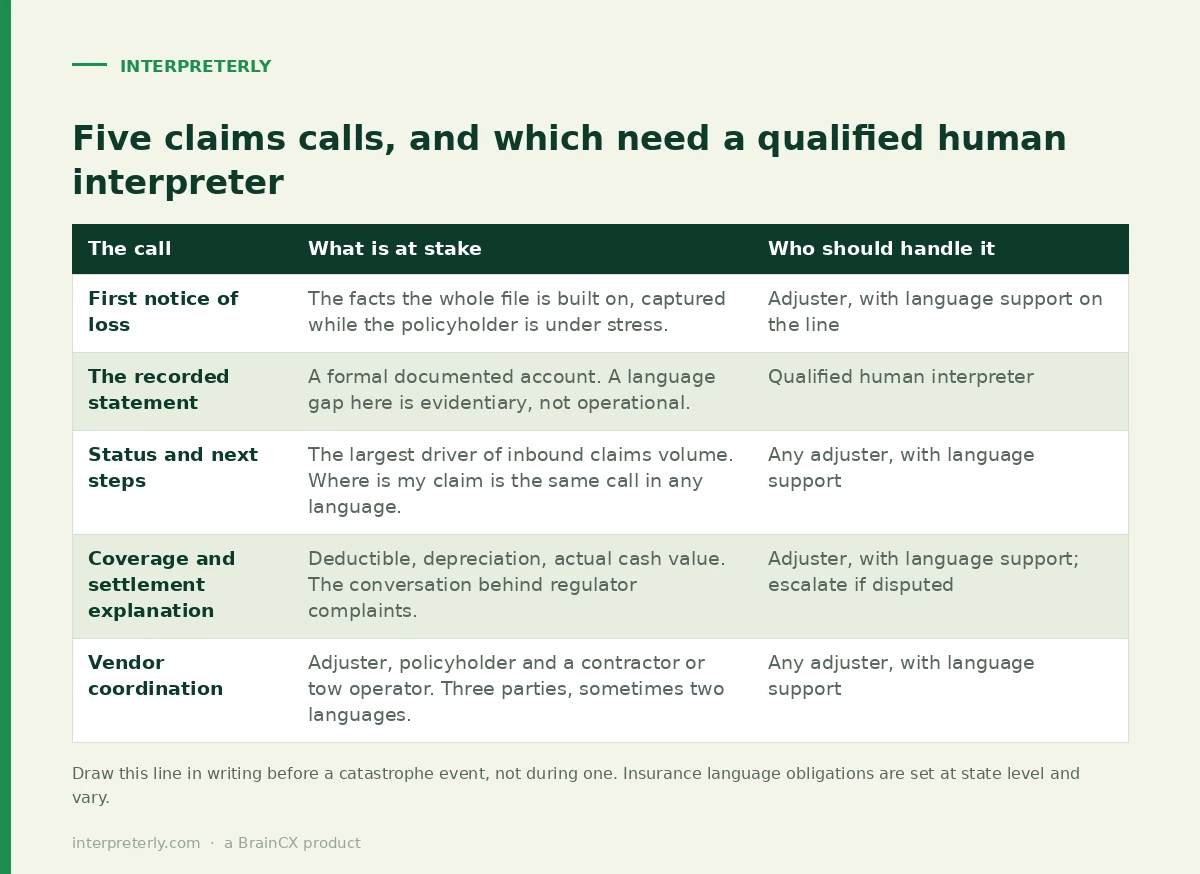
FNOL. Covered above. The highest-value two minutes in the file.
The recorded statement. A formal, documented account. If a language barrier affects accuracy here, the consequences are not operational, they are evidentiary. This is the conversation where a qualified human interpreter belongs, and your policy should say so.
Status and next steps. High volume, low complexity, and the single largest driver of inbound claims calls. “Where is my claim” asked in Spanish is the same call as in English and should not need a specialist.
Coverage and the settlement explanation. Deductible, depreciation, actual cash value versus replacement cost, why the figure is what it is. The conversation that produces complaints to the regulator when it is not understood.
The vendor coordination call. Adjuster, policyholder and a contractor, tow operator or restoration crew. Often three parties and sometimes two languages.
What to capture, and how to capture it right
Four habits that materially change file quality on a language call.
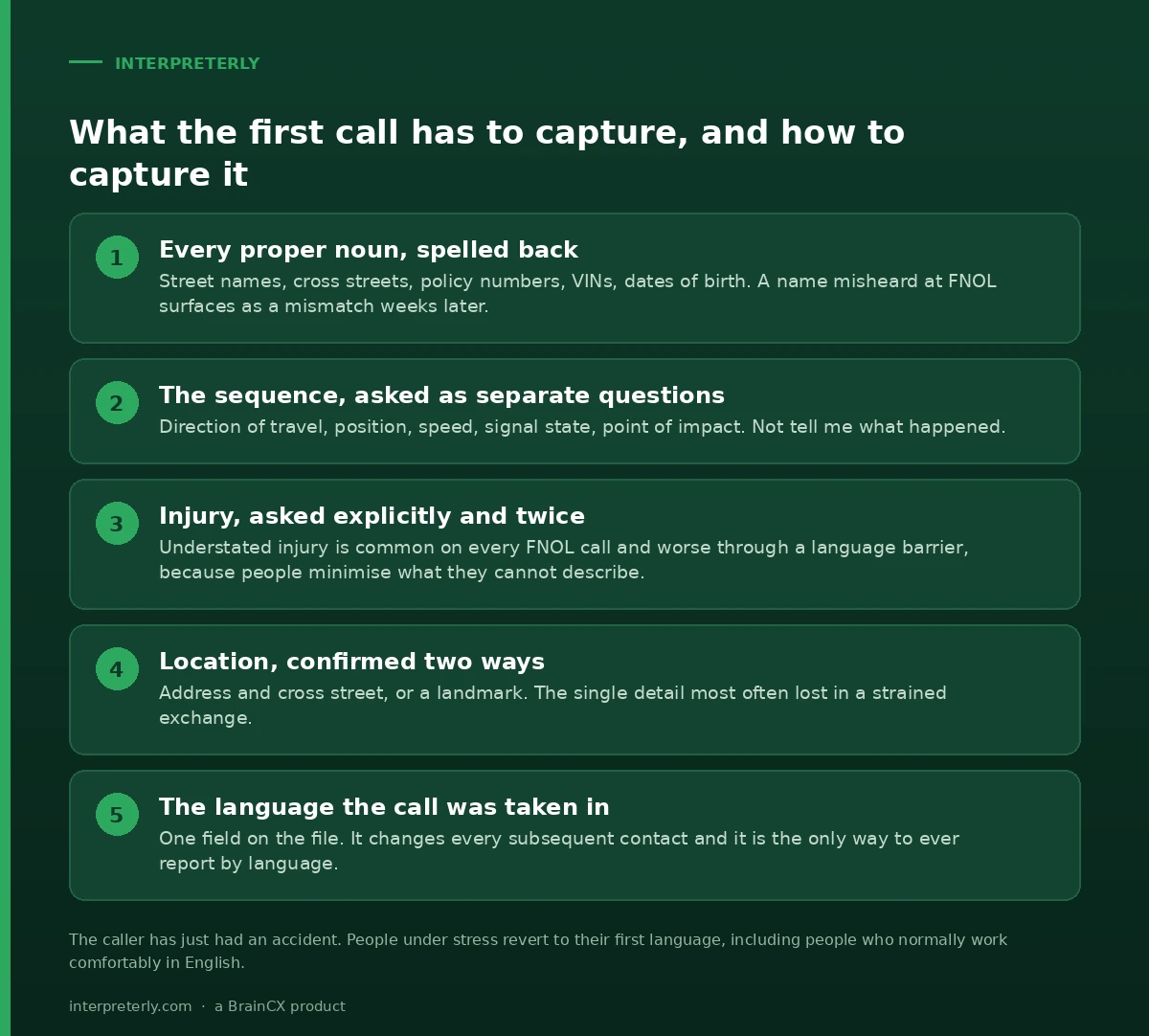
Read back every proper noun and every number. Street names, cross streets, policy numbers, VINs, dates of birth, claim numbers. Spell them. A name misheard at FNOL propagates through the entire file and surfaces as a mismatch weeks later.
Ask the sequence questions separately. Not “tell me what happened,” which produces a narrative that is hard to interpret accurately under stress. Direction of travel, position, speed, signal state, point of impact, each as its own short question.
Ask about injury explicitly and more than once. Understated injury is common across all FNOL calls and worse through a language barrier, where people minimise what they cannot describe precisely.
Record the language the call was taken in. On the file. It is one field, it changes how every subsequent contact is handled, and it is the only way to ever look at cycle time or satisfaction by language.
The measurement nobody runs
Three numbers, split by the language the claim was reported in.
Cycle time from FNOL to first payment. If Spanish-reported claims take materially longer, the cause is usually rework on details captured imprecisely at intake.
Reopen rate. Files reopened because the facts changed are often files where the facts were never captured cleanly.
Complaint rate. Including regulator complaints. Many of these begin with a sentence about not being understood.
Most carriers cannot produce any of the three by language, because the language field is not populated. That is the first project, and it costs nothing.
The regulatory picture, briefly and honestly
Insurance is regulated at state level and language requirements vary widely. Some states impose specific obligations on policy documents or on communications in particular lines; others do not. Unfair claims settlement practices acts in most states require, in general terms, prompt and reasonable communication with claimants, and an insurer should consider what that means when the claimant does not speak English.
We are not going to tell you what your state requires, because it is not one answer and getting it wrong in either direction is costly. Your compliance team and your counsel are the right route, and the relevant question for them is narrower than it looks: what does our unfair claims practices obligation require when the claimant’s primary language is not English?
Where a deal or a document is involved rather than a claim, the analysis changes again. Our piece on what happens when a deal is negotiated in Spanish and signed in English covers that pattern in financial services, and California Civil Code 1632 is the clearest state example of a translated-document rule.
This is a plain-English summary and not legal advice. Confirm your obligations with your own counsel.
Capacity is the other half of the problem
Language in claims is not only a quality question, it is a capacity question, and catastrophe events make that obvious.
A hailstorm across a metro area with a large Spanish-speaking population does not generate proportionally more Spanish calls, it generates them in the same hour. A bilingual claims team sized for ordinary volume cannot absorb that, and unlike English capacity it cannot be flexed by moving staff across from another queue, because the constraint is the language rather than the seat. We go through that asymmetry in why you cannot hire your way out of a Spanish call spike.
The useful planning question is not how many bilingual adjusters you need. It is which claims conversations genuinely require one, and which are status, scheduling and coordination calls that any adjuster could take with a language layer on the line.
Where a Spanish interpreter for insurance claims fits
Traditional interpreter companies add a third person to the phone call. AI companies replace the employee entirely. We do neither. The employee stays on the call and we carry the language.
For claims that is the whole point. The adjuster is the one building the file, judging the account and deciding what to ask next. Keeping them in the conversation, rather than relaying through a third party, is what keeps the file theirs.
Interpreterly is a language assistance tool, not a certified interpreter service, and it does not replace a qualified human interpreter where one is required, which includes recorded statements and anything evidentiary. It carries Spanish, Brazilian Portuguese, Russian, Filipino/Tagalog, German, Hindi and Urdu on calls today. The carrier setup is on our page for insurance calls, the language page is Spanish interpretation for insurance lines, and if peak windows are your concern, what AEP does to a Spanish queue covers the seasonal version. To talk through your own mix, book a 15-minute call.
Frequently asked questions
Why does language matter most at first notice of loss?
Because FNOL captures the facts the entire file is built on, the caller is usually under stress and reverting to their first language, and errors introduced at intake propagate through liability, cycle time and settlement.
Can a family member interpret on a claims call?
It is common and it is risky. The relative may be a witness or an involved party, may have an interest in the outcome, is not accountable for accuracy, and leaves you with no record of who said what if the account later changes.
Which claims calls need a qualified human interpreter?
Recorded statements and anything evidentiary. Status updates, scheduling, document requests and vendor coordination are routine operational volume of a different kind. Draw that line in writing before a catastrophe event, not during one.
How do we tell whether language is slowing our claims down?
Split cycle time from FNOL to first payment, reopen rate and complaint rate by the language the claim was reported in. Most carriers cannot, because the language field is empty, which is itself the first finding.
What happens to the Spanish queue during a catastrophe?
It spikes at the same moment as everything else, but bilingual capacity cannot be flexed by moving staff from another queue, because the constraint is the language skill rather than the seat. That makes it a continuity question as much as a staffing one.
This article is a plain-English operational summary and is not legal advice. Insurance language obligations are set at state level and vary. Confirm your specific obligations with your own counsel.